This article contains affiliate links: if you buy through them we may earn a commission, at no extra cost to you. Read our affiliate disclosure.
The only way to know whether your tap water has lead is to test it, because lead has no taste, color or smell. Start by calling your water utility, which may test for free, or use a state-certified laboratory; home kits are a quick screen, not a lab result.
In short: lead usually gets into tap water from the plumbing between the water main and your faucet, not from the treatment plant. A first-draw sample, taken after water has sat in the pipes for at least six hours, shows the worst case. EPA’s goal for lead in drinking water is zero. The legal action level for water systems is 15 parts per billion (ppb) today and drops to 10 ppb when the Lead and Copper Rule Improvements take effect on November 1, 2027. Neither number is a safe level for your household.
- 0 ppb EPA health goal
- 5 ppb FDA bottled water limit
- 10 ppb Action level from Nov 2027
- 15 ppb Action level today
Action levels trigger utility action; they are not safe levels. EPA's health goal is zero. Source: EPA, FDA (eCFR)
How lead gets into tap water
EPA explains that lead enters drinking water when plumbing materials that contain lead corrode, especially where the water is acidic or low in minerals. The main sources are:
- Lead service lines. The pipe that connects a home to the water main. Where one exists, it is typically the largest source of lead in the water. See lead pipes for how to check yours.
- Lead solder on copper pipes in older homes.
- Brass or chrome-plated brass faucets and fittings. In homes without a lead service line, EPA says these and lead solder are the most common sources.
How much lead reaches your glass depends on the water’s chemistry and temperature, the wear on the pipes, and how long the water has been sitting. Under the Safe Drinking Water Act, plumbing sold today as “lead-free” may still contain a small amount: a weighted average of no more than 0.25% lead in pipes, fittings and fixtures, and 0.2% in solder and flux.
Three ways to test water for lead
| Option | How it works | Good for | Limits |
|---|---|---|---|
| Your water utility | Many public water systems test on request, sometimes free | Homes on city water; also learning whether you have a lead service line | Programs vary by utility |
| Certified laboratory | You collect samples in the lab’s bottles and ship or drop them off | A measured result in ppb or µg/L; private wells | EPA says tests typically cost $20 to $100 |
| Home test kit or strips | A reagent or strip changes color within minutes | A quick screen while you arrange a lab test | Ranges, not a precise number; not a certified result |
Your state or local drinking water authority lists certified labs, and your local health department may be able to help. Some products combine both: a quick home test plus a bottle to mail to a lab. For a side-by-side look, read home lead test vs lab testing and our best lead water test kits guide.
How to take a first-draw sample
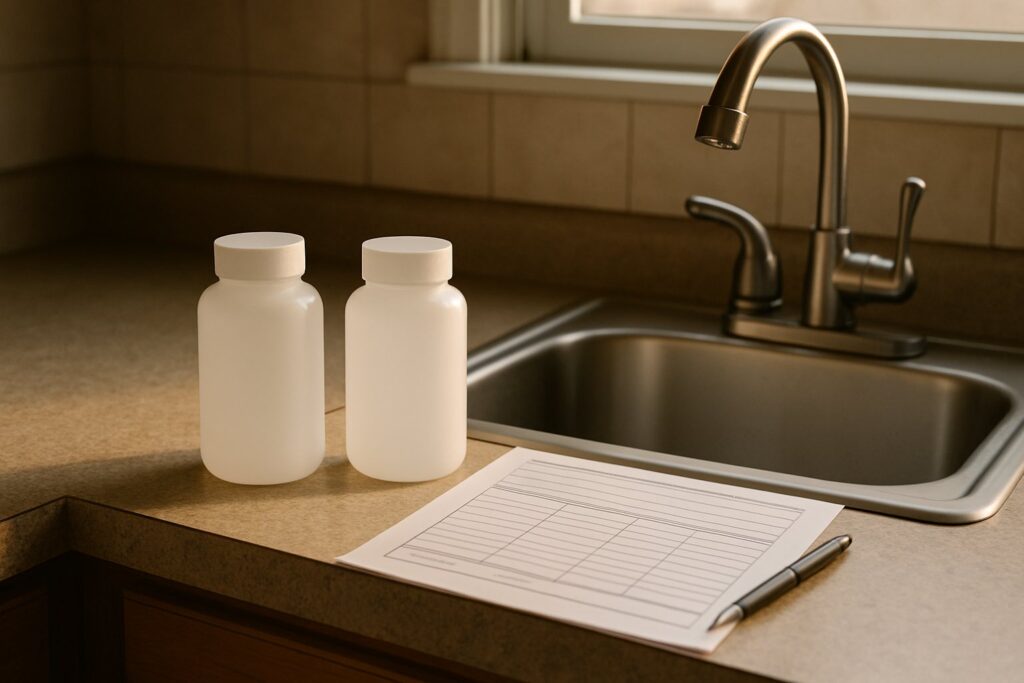
Always follow the instructions from your lab or utility, since their methods can differ. EPA’s homeowner instructions for regulatory sampling give the general idea:
- Let the water sit unused for at least 6 hours, with no water used from that tap or nearby taps. Early morning or after work is easiest.
- Use the cold tap you normally drink from, in the kitchen or bathroom. Skip taps with a filter or softener.
- Do not flush the tap first, and do not remove or clean the aerator just before sampling.
- Fill the bottle to the line (EPA’s form uses a 1-liter bottle) as if filling a glass, cap it and label it.
Under the new rules, water systems will collect both a first-liter and a fifth-liter sample at homes with lead service lines and use the higher of the two results. A single sample is a snapshot. CDC notes that results vary with the time of day, season, sampling method and water flow. Full steps are in how to test water for lead.
Private wells
EPA says private wells are not regulated by the federal government under the Safe Drinking Water Act, nor by most states, and that well owners are responsible for their own water. Lead from plumbing inside the home can affect well water the same way it affects city water. EPA advises using only labs certified for drinking water testing; your state certification office or local health department can point you to one, and some health departments offer free well testing.
Reading your results: what EPA’s numbers mean
Lab results are usually reported in parts per billion (ppb) or micrograms per liter (µg/L), which are the same thing for water. Three EPA numbers come up:
- Maximum contaminant level goal: zero. EPA set its health goal for lead at zero because there is no known safe level of exposure.
- Action level: 15 ppb today. If more than 10% of a water system’s tap samples are above it, the system must take more steps, such as improving corrosion control and educating the public.
- Action level: 10 ppb from November 1, 2027. The Lead and Copper Rule Improvements (LCRI), finalized in October 2024, lower the action level, end the separate trigger level, add first- and fifth-liter sampling, and require most water systems to replace lead service lines and galvanized lines that need replacing within 10 years, whatever their test results.
The action level is a trigger for the water system, not a safety line for your home. If your water shows any lead, it is worth acting. Ask your utility about your service line and replacement programs; see lead service line replacement.
What to do if your water has lead
- Use a certified filter. EPA and CDC advise a filter certified to reduce lead; look for NSF/ANSI 53 with a lead claim (or 58 for reverse osmosis). Replace cartridges on schedule and do not run hot water through them. See lead water filters and best water filters for lead.
- Use only cold water for drinking, cooking and baby formula. Boiling does not remove lead.
- Run the water before drinking when it has been sitting; your utility can tell you how long, which depends on whether you have a lead service line.
- Clean faucet aerators regularly, and be alert to nearby construction that may disturb lead lines.
If you are concerned about a child’s or your own exposure, talk to a doctor or your local health department about a blood lead test; CDC says a blood test is the best way to know whether a child has been exposed. Read more in lead and health. For a possible poisoning, call Poison Help at 1-800-222-1222.
Water test kits and filters you can buy
Both were in stock on Amazon when checked in October 2026. The Safe Home kit is a home screen with an optional mail-in lab test (fee extra). The PUR PLUS faucet system, model PFM400H, is listed by NSF as certified to NSF/ANSI 53 for lead reduction. Compare more in lead test kits.
Safe Home DIY Lead in Drinking Water Combo Test Kit
- Three result ranges: 0-4, 5-15, 15+ ppb (maker)
- Mail-in lab sample kit included, fee extra
- About $20, seen October 2026
PUR PLUS Horizontal Faucet Mount Filtration System
- Model PFM400H, NSF-listed for lead reduction
- Filter RF-9999 rated 100 gallons
- About $33, seen October 2026
Lead in water testing FAQ
How much does a lead water test cost?
EPA says certified lab tests typically cost $20 to $100. Many utilities test on request, sometimes for free, so call yours first.
Are lead water test strips accurate?
Strips and color kits give a range, not a measured number, and they are not a certified result. Use them as a first screen and confirm with a certified laboratory.
What is a safe level of lead in drinking water?
EPA’s health goal is zero. The 15 ppb action level (10 ppb from November 1, 2027) tells water systems when to act; it is not a safe threshold.
Does boiling water remove lead?
No. CDC and EPA say boiling does not reduce lead. Use cold water and a filter certified for lead reduction.
Should I test my well for lead?
Private wells are the owner’s responsibility, and no federal rule requires testing them. Use a lab certified for drinking water; your local health department can help.
Worried someone has been exposed to lead?
Testing your home finds the source; only a blood lead test shows whether a person has lead in their body. Here is how to get tested, and what the numbers mean.
How to test for lead poisoningBlood lead levels explainedLead screening for childrenTesting for adultsSymptoms