This article contains affiliate links: if you buy through them we may earn a commission, at no extra cost to you. Read our affiliate disclosure.
You can test for lead paint three ways: with a home swab kit, by sending a paint chip to a laboratory, or by hiring a certified inspector or risk assessor who uses a portable XRF analyzer and lab samples. Swabs are a quick screen, a lab result is more reliable, and only a certified professional can give you a formal inspection report for the whole home.
In short: if your home was built before 1978, EPA says it is more likely to have lead-based paint, and the older it is, the higher the odds. A home swab can tell you whether a surface reacts to lead. It cannot tell you how much lead is there, what is under the top layers, or whether the home has lead dust. For a home with young children, a planned renovation or a purchase, a certified inspection or risk assessment is the way to get a real answer.
Lead paint was banned for homes in 1978. Source: EPA
Which homes are at risk for lead paint
In 1978 the federal government banned the sale of lead-based paint for use in homes and childcare facilities. Paint applied before then may still be on walls, windows, doors and trim, often under newer coats. EPA estimates that about three-quarters of US homes built before 1978 still contain some lead-based paint, and the share rises with age:
| Year the home was built | Homes likely to have lead-based paint (EPA) |
|---|---|
| Before 1940 | 87% |
| 1940 to 1959 | 69% |
| 1960 to 1977 | 24% |
| 1978 and later | Lead-based paint was banned for homes; testing is rarely needed unless older materials were reused |
Intact paint is not the main worry. EPA names dust and chips from deteriorating lead-based paint as one of the most common sources of lead exposure in homes. Friction surfaces such as windows and doors, peeling exterior paint, and sanding or scraping during repairs are where trouble usually starts. Lead-contaminated soil can also be tracked indoors.
Under federal rules, paint counts as lead-based paint when it contains at least 1.0 milligram of lead per square centimeter, or 0.5% lead by weight. Some states and cities use stricter numbers, so check with your state lead program.
Three ways to test paint for lead
| Method | Who does it | What it tells you | Limits |
|---|---|---|---|
| Chemical swab kit | You, or a certified renovator | Whether a surface reacts to lead (color change) | A screen only; no amount; EPA recognizes only a few kits, for specific surfaces |
| Paint chip lab analysis | You or a professional collects; an accredited lab analyzes | How much lead is in that sample | Covers only the spots you sample; you must remove all layers down to the surface |
| XRF plus lab samples | EPA- or state-certified inspector or risk assessor | Whether lead-based paint is present, surface by surface, in a formal report | Costs more; you need to book a certified professional |
Home swab kits
Swab kits contain a reagent that changes color when it touches lead. They are cheap and fast, which makes them useful for a first look. But they vary a lot. EPA recognizes only three kits, and only for use by a certified renovator under its Renovation, Repair and Painting (RRP) rule:
- LeadCheck (now made by Luxfer Magtech): wood, ferrous metal (iron-containing alloys), and drywall and plaster.
- D-Lead (ESCA Tech): wood, ferrous metal, and drywall and plaster.
- The State of Massachusetts kit: drywall and plaster only, not wood or ferrous metal.
EPA recognized these kits because a negative result is reliable enough for a certified renovator to treat that paint as not lead-based. EPA also says no kit has yet met its second goal of keeping false positives low, so a positive swab can be wrong. Kits sold for “all surfaces,” ceramics or toys are not on EPA’s list. Our best lead paint test kits guide compares them, and how to test for lead paint walks through using one.
Paint chip samples sent to a lab
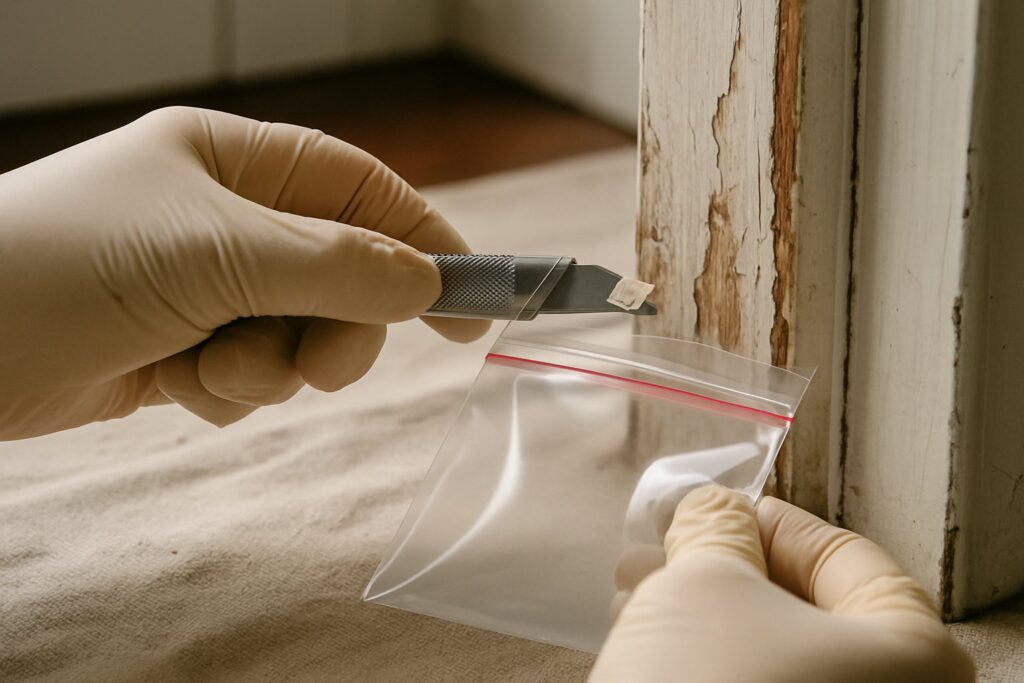
A laboratory can measure the lead in a paint chip and report it as a percentage by weight or as a concentration. That gives you a number you can compare with the federal definition. EPA keeps a list of labs recognized under its National Lead Laboratory Accreditation Program (NLLAP) for paint chips, dust and soil, and requires those labs for samples from risk assessments in the states where EPA runs the program, so it is a sensible list to choose from. Collecting a chip disturbs paint, so mist the area, wear disposable gloves, catch debris on plastic, and clean up with wet wipes. See home lead test vs lab testing for the trade-offs.
XRF testing by a certified inspector
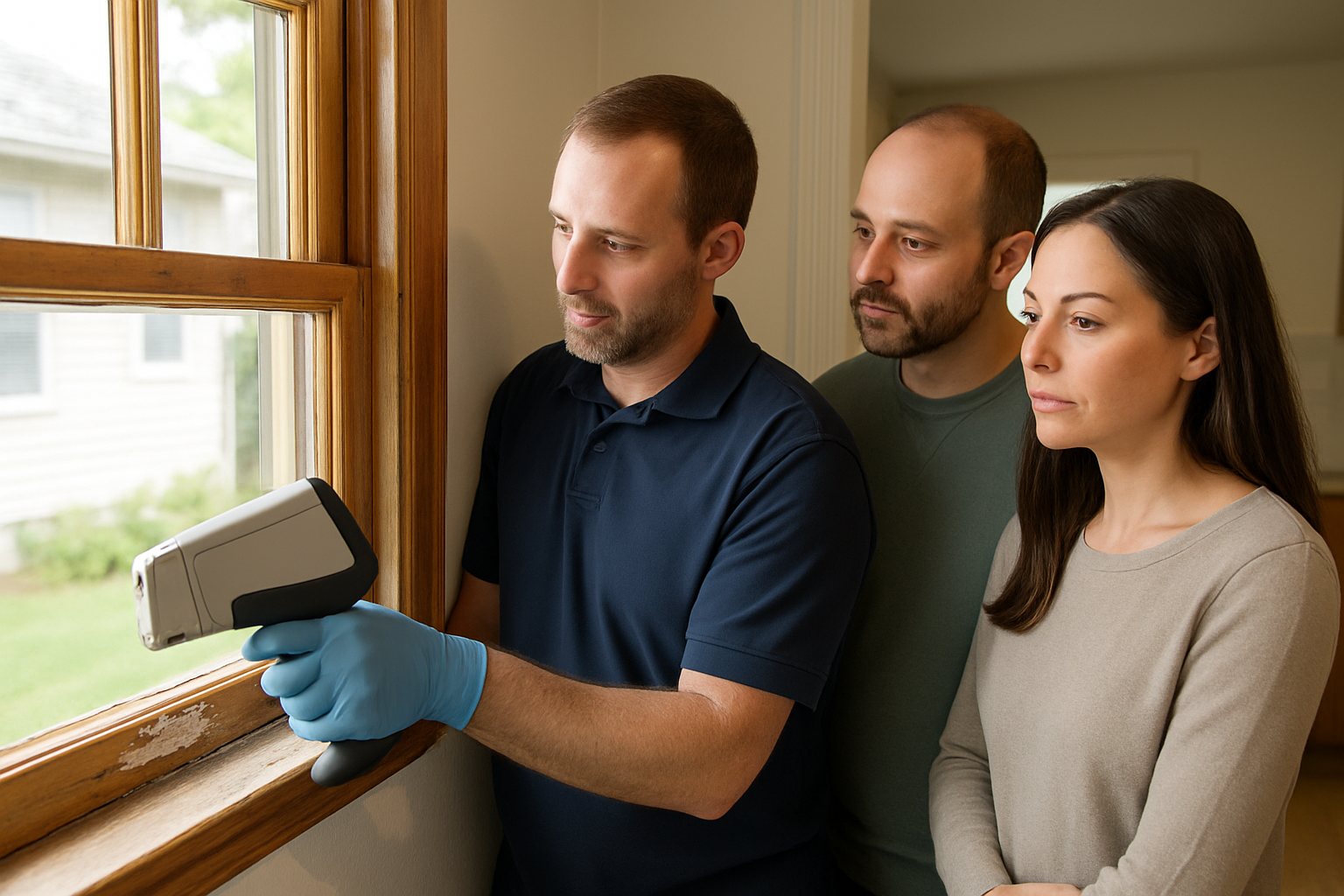
An XRF (X-ray fluorescence) analyzer is a portable instrument that reads lead through paint layers without removing them, so an inspector can check many surfaces in one visit. EPA training material notes that some spots, like corners and narrow edges, cannot be read by XRF, and inspectors may collect paint chips to confirm readings. XRF operators need radiation safety training, and inspections can legally be done only by inspectors or risk assessors certified by EPA or an EPA-authorized state, tribal or territorial program.
Screening vs inspection vs risk assessment
These words have specific meanings in EPA’s lead program, and the right one depends on your question:
- Inspection: a surface-by-surface investigation to find out whether there is lead-based paint in a home and where it is. It does not tell you whether that paint is a hazard right now. Useful before buying or renovating.
- Risk assessment: an on-site investigation of the presence, type, severity and location of lead hazards from paint, dust and soil, with suggested ways to control them. The risk assessor samples deteriorated paint, dust and bare soil and has them lab-tested. Useful when children live in the home.
- Combined inspection and risk assessment: both, in one written report.
- Lead hazard screen: a more limited check of deteriorated paint and dust that only a certified risk assessor may perform.
A home swab is none of these. It is a screen you do yourself, and it does not produce a record that replaces an inspection report. For more detail, read lead paint inspection vs risk assessment.
When to test for lead paint
- Before renovation, repair or painting in a pre-1978 home. Paid contractors working in pre-1978 housing and child-occupied facilities must follow EPA’s RRP rule. See lead-safe renovation and the RRP rule.
- Before buying a pre-1978 home. The federal disclosure rule gives buyers a 10-day period to arrange an inspection or risk assessment, unless both sides agree otherwise in writing. See lead paint disclosure.
- When paint is peeling, chipping or cracking, especially on windows, doors, porches and stairs.
- When a child or pregnant person lives in or often visits the home. CDC says no safe blood lead level in children has been identified.
What to do with your results
A positive swab means the surface reacted to lead. Treat the paint as lead-based until a lab or certified inspector says otherwise, avoid sanding or dry scraping, and keep children away from chips and dust. A negative swab on a surface the kit is not recognized for, or on paint with many layers, is not proof the paint is lead-free.
A lab or inspection report tells you where lead-based paint is. A risk assessment adds dust and soil results and a plan. In late 2024 EPA lowered its dust standards: any lead dust a recognized lab can report now counts as a dust-lead hazard in pre-1978 housing and child-occupied facilities, and the post-abatement action levels are 5 µg/ft² for floors, 40 for window sills and 100 for window troughs. Our lead dust and soil testing hub explains those tests.
Options to fix lead paint include encapsulation, enclosure and removal, and full lead abatement by certified professionals. Read is lead paint dangerous? for when intact paint is and is not a hazard.
If you are worried that someone has been exposed, talk to a doctor or your local health department. A blood lead test is the way to check exposure; see lead and health. For a possible poisoning, call Poison Help at 1-800-222-1222, or 911 in an emergency.
Lead paint test kits you can buy
Both were in stock on Amazon when checked in October 2026. LeadCheck is on EPA’s recognized list for the surfaces named above; the Safe Home swabs are not, but the kit includes a mail-in sample kit for the maker’s lab (lab fee extra). Check the expiration date on any swab kit you buy. More choices are in lead test kits.
LeadCheck Swabs, 2-Swab Blister Pack
- Recognized by EPA for wood, ferrous metal, drywall and plaster
- Red means lead; about 30 seconds
- About $15, seen October 2026
Safe Home Lead in Solids Combo Test Kit
- 10 DIY swabs (not EPA-recognized)
- Mail-in sample kit for the maker's lab, fee extra
- About $20, seen October 2026
Finding a certified lead inspector
EPA runs an online locator for certified inspection, risk assessment and abatement firms, and many states run their own certification programs. You can also call the National Lead Information Center at 1-800-424-LEAD (5323), Monday to Friday. Our find a lead professional page and how to choose a lead inspector guide cover what to ask before you book.
Lead paint testing FAQ
Are home lead paint test kits accurate?
They are a screen, not a measurement. EPA recognizes only LeadCheck and D-Lead for wood, ferrous metal, drywall and plaster, and the Massachusetts kit for drywall and plaster, and notes that no kit has met its goal for avoiding false positives.
Does a house built after 1978 need a lead paint test?
Usually not for paint, because lead-based paint was banned for homes in 1978. Older salvaged doors, windows or furniture brought into a newer home can still carry old paint.
What is the difference between a lead inspection and a risk assessment?
An inspection finds where lead-based paint is. A risk assessment finds whether paint, dust or soil are a hazard now and what to do about it. Both must be done by certified professionals.
Can I test for lead paint myself before renovating?
You can screen with a swab or send chips to a lab. If you hire a contractor for a pre-1978 home, the RRP rule applies, and certified renovators may use only EPA-recognized kits or paint chip sampling to decide that paint is not lead-based.
Worried someone has been exposed to lead?
Testing your home finds the source; only a blood lead test shows whether a person has lead in their body. Here is how to get tested, and what the numbers mean.
How to test for lead poisoningBlood lead levels explainedLead screening for childrenTesting for adultsSymptoms