This article contains affiliate links: if you buy through them we may earn a commission, at no extra cost to you. Read our affiliate disclosure.
If someone is paid to disturb paint in a home built before 1978, EPA’s Renovation, Repair and Painting (RRP) Rule says the firm must be lead-safe certified and the work must follow lead-safe practices. That covers remodelers, painters, window installers, plumbers, electricians, handymen and landlords’ maintenance staff, not just “lead” companies. This guide explains who needs EPA RRP certification, the exact size thresholds, the work practices and cleaning check the rule requires, the paperwork you should get, how to check a contractor, and what EPA advises if you do the work yourself.
In short: the RRP Rule (40 CFR part 745, subpart E) applies to paid renovation that disturbs painted surfaces in pre-1978 housing and in child-occupied facilities such as preschools. The firm needs EPA (or state) certification, and each job needs a certified renovator. Small jobs that disturb 6 square feet or less of paint per room inside, or 20 square feet or less outside, are exempt, but window replacement, demolition and prohibited practices are never exempt. The firm must hand out the Renovate Right pamphlet, contain the work area, clean up and verify the cleaning, and keep records for 3 years. Homeowners working on their own home are generally not covered, but EPA urges them to work lead-safe too.
Why the RRP Rule exists
Ordinary renovation is one of the quickest ways to turn old lead paint into lead dust. EPA estimates that about three-quarters of US homes built before 1978 still contain some lead-based paint, and CDC lists sanding, cutting and replacing windows among the common activities that create hazardous lead dust. The rule is designed to keep that dust inside the work area and out of the home afterward. For more on when lead paint becomes a hazard, see is lead paint dangerous?
What the RRP Rule covers
Under 40 CFR 745.82, the rule applies to all renovations performed for compensation in target housing and child-occupied facilities. “Renovation” means modifying any existing structure in a way that disturbs painted surfaces. EPA’s contractor page lists remodeling, repair and maintenance, electrical work, plumbing, painting preparation, carpentry and window replacement as examples.
- Target housing: housing built before 1978. Housing for the elderly or people with disabilities and zero-bedroom units (studios, dorms) are excluded unless a child under 6 lives or is expected to live there.
- Child-occupied facilities: pre-1978 buildings, or parts of them, visited regularly by the same child under 6 on at least two different days in a week, with each visit at least 3 hours, combined weekly visits at least 6 hours and combined annual visits at least 60 hours. Think day care centers and preschools.
- Who it applies to: anyone paid to do the work, including sole proprietors. EPA says it also applies to landlords, child care operators working in their homes and house flippers, and property management companies that do this work must be certified firms.
The 6 and 20 square foot thresholds
The rule exempts “minor repair and maintenance activities.” In the exact terms of 40 CFR 745.83, that means work that disturbs:
| Where | Exempt if it disturbs | Never exempt |
|---|---|---|
| Interior | 6 square feet or less of painted surface per room | Window replacement, demolition of painted surfaces, prohibited practices |
| Exterior | 20 square feet or less of painted surface | Window replacement, demolition of painted surfaces, prohibited practices |
Two catches. First, jobs in the same room within the same 30 days count as one job, so you can’t split a project into small pieces to stay under the line. Second, a single window replacement is covered no matter how little paint it disturbs.
When testing takes a job out of the rule
Testing is optional. Without documentation that the affected paint is not lead-based, the firm must follow the rule. The paint can be shown to be below the federal definition (1.0 mg/cm² or 0.5% by weight) in three ways: a written determination by a certified inspector or risk assessor; an EPA-recognized test kit used by a certified renovator; or paint chips collected by a certified renovator and analyzed by an EPA-recognized lab. EPA recognizes three kits: LeadCheck and D-Lead for wood, ferrous metal, drywall and plaster, and the Massachusetts kit for drywall and plaster only, all for negative results only. For your own testing options, see how to test for lead paint and lead paint testing.
EPA RRP certification: firms and renovators
There are two separate credentials, and a legal job needs both: a certified firm and a certified renovator assigned to the job. Other workers can be trained on the job by the certified renovator.
| Firm certification | Renovator certification | |
|---|---|---|
| How you get it | Apply online to EPA through its lead program site | Take an initial course from an EPA-accredited training provider |
| Training | None for the firm itself | 8-hour initial course, including 2 hours of hands-on learning |
| Fee (EPA) | $300 for certification or recertification ($20 for tribal firms) | Set by the training provider |
| How long it lasts | 5 years; apply to recertify at least 90 days before expiry | 5 years with a hands-on refresher, 3 years with an online refresher |
| Staying certified | Recertify before expiry | 4-hour refresher before expiry; hands-on every other time. If it lapses, retake the 8-hour course |
States with their own programs. EPA certification does not apply where a state or tribe runs its own authorized RRP program. When we checked, EPA listed Alabama, Delaware, Georgia, Iowa, Kansas, Massachusetts, Mississippi, North Carolina, Oklahoma, Oregon, Rhode Island, Utah, Vermont, Washington, Wisconsin and the Bois Forte Band of Chippewa. Firms working there apply to that program, and firms working in several states may need more than one certification.
Before the job: the Renovate Right pamphlet
No more than 60 days before work starts, the firm must give the owner EPA’s pamphlet Renovate Right: Important Lead Hazard Information for Families, Child Care Providers and Schools, and get a signed acknowledgment or a certificate of mailing sent at least 7 days before the work. If the owner doesn’t live there, an adult occupant gets a copy too. Common-area jobs in apartment buildings need written notice to each affected unit or posted signs, and child care facility jobs require notice to parents and guardians (40 CFR 745.84).
Lead-safe work practices required on the job
The work practice standards are in 40 CFR 745.85. In plain terms:
- Signs. Post warning signs around the work area, in the occupants’ primary language where practicable, until cleaning verification is done.
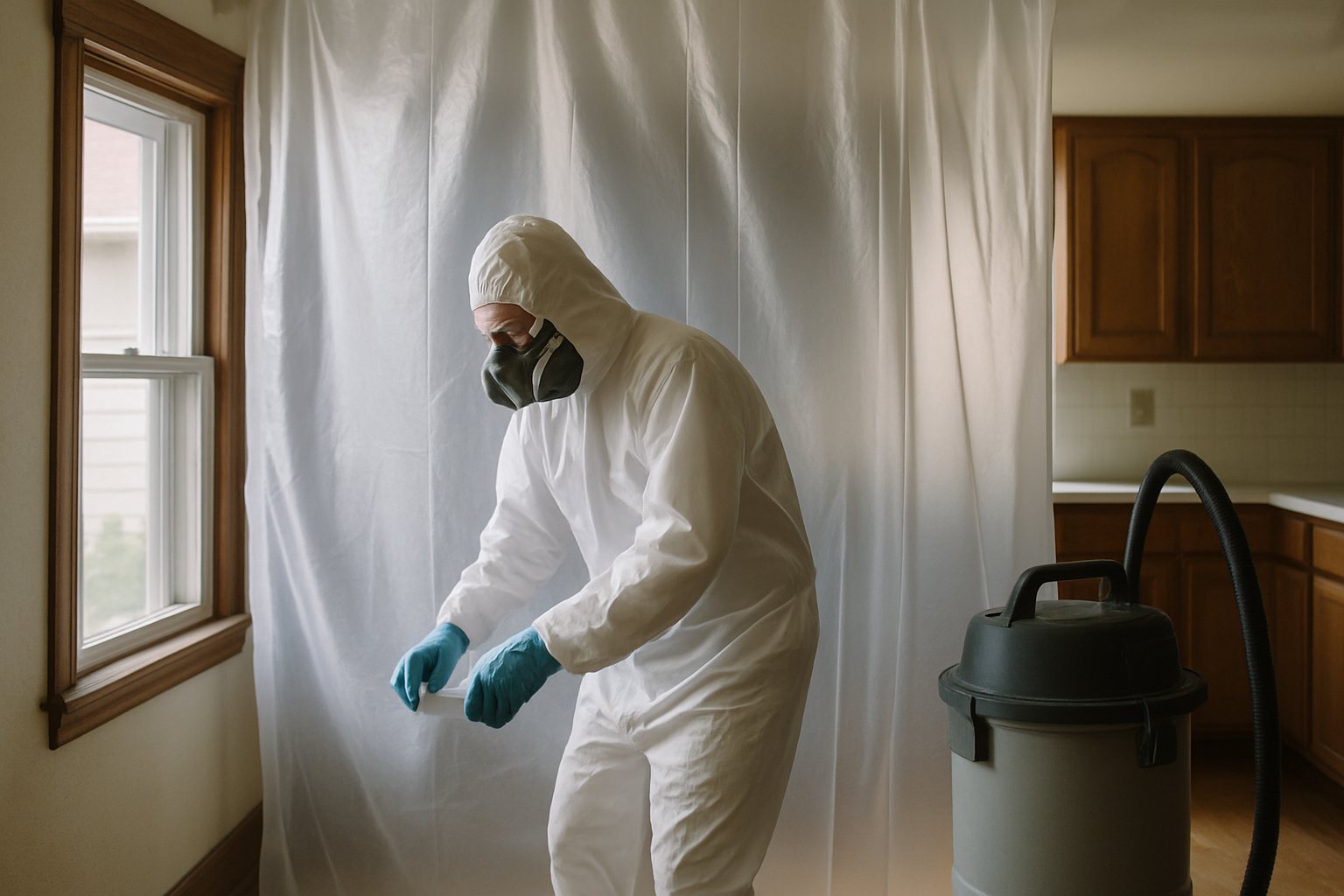
- Interior containment. Remove or cover objects, close and cover ducts and doors, and cover the floor with taped-down plastic at least 6 feet beyond the work surfaces (or farther if needed), so no dust or debris leaves the area.
- Exterior containment. Close doors and windows within 20 feet and cover the ground at least 10 feet beyond the work surfaces; use vertical containment when working within 10 feet of a property line.
- Prohibited and restricted practices. No open-flame burning or torching of painted surfaces. Sanders, grinders, abrasive blasters and other high-speed paint removal machines only with shrouds or containment and a HEPA vacuum attachment, with no visible dust escaping. Heat guns only below 1,100°F.
- Waste. Contain waste before it leaves the work area, store it securely at the end of each day, and keep it contained during transport.
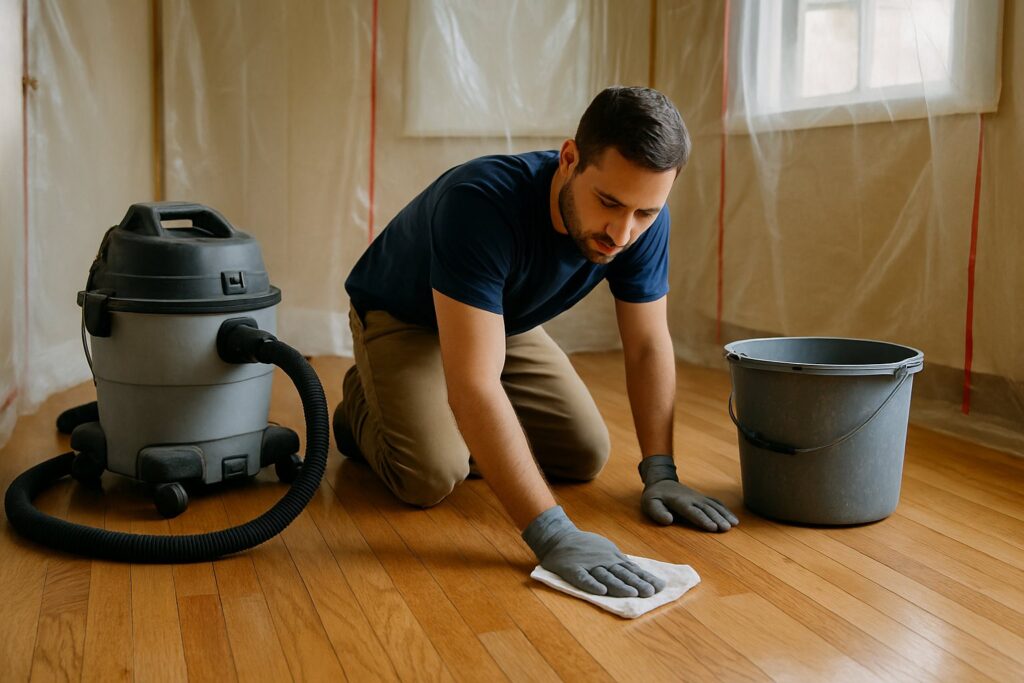
- Cleaning. Collect debris and seal it in heavy-duty bags, remove sheeting carefully, clean walls top to bottom with a HEPA vacuum or damp cloth, HEPA-vacuum all remaining surfaces, wipe them with damp cloths and mop floors with separate wash and rinse water.
Cleaning verification: how the job is checked
Interior jobs end with a check against EPA’s cleaning verification card. After a visual inspection, the certified renovator wipes each window sill with a damp disposable cleaning cloth and compares it with the card. A cloth that matches or is lighter than the card passes; a darker one means re-clean and wipe again. Uncarpeted floors and countertops are checked the same way, in sections of no more than 40 square feet each, using a long-handled applicator on floors. If a surface still fails after re-cleaning, the renovator waits at least 1 hour or until it is dry and wipes it with a dry disposable cloth. Exterior jobs need a visual inspection of the work area, sills and ground below. Only then can the warning signs come down.
A job can use dust clearance testing instead, when the contract or a law requires it: a certified inspector, risk assessor or dust sampling technician takes samples, and the firm re-cleans until results are below EPA’s dust-lead action levels. Cleaning verification is a work check, not a lab measurement. If you want numbers, ask for clearance testing or see lead dust testing.
Records you should get afterward
Firms must keep records showing compliance for 3 years after the renovation is completed (40 CFR 745.86). The owner (and an adult occupant, if different) must receive the compliance information with the final invoice or within 30 days of completion, whichever comes first. It typically includes who the certified renovator was, worker training, how the area was contained, how waste was handled, cleaning and cleaning verification results, and any test kit or paint chip results. EPA’s Sample Renovation Recordkeeping Checklist is one way firms provide it. Keep your copy with your home records; it can matter later, for example in a lead paint disclosure when you sell or rent.
How to check a contractor’s RRP certification
- Search EPA’s locator. EPA’s lead-safe certified firm search finds EPA- or state-certified renovation firms near you.
- Ask for both certificates. The firm’s certificate and the certified renovator’s course certificate, with expiry dates. In a state-run program, check with that state.
- Look for the logo. EPA tells homeowners to look for the Lead-Safe Certified Firm logo, but verify it in the locator.
- Ask how they will contain and clean. Expect plastic sheeting, HEPA vacuums, no open flame and cleaning verification.
- Expect the pamphlet before work and records after. If neither shows up, ask.
RRP renovation is not the same as lead abatement, which is a separately regulated activity aimed at ending lead hazards for good, done by certified abatement professionals. EPA explains the difference on its “Lead Abatement versus Lead RRP” page; our lead abatement, lead paint removal and lead paint encapsulation guides cover those options. To find inspectors, risk assessors and certified firms, use find a lead professional. You can report suspected violations through EPA’s lead complaints, tips and violations page.
Penalties under the RRP Rule
RRP violations are enforced under the Toxic Substances Control Act. EPA’s inflation-adjusted table in 40 CFR 19.4 lists a maximum civil penalty of $49,772 per violation under TSCA section 16 for penalties assessed on or after January 8, 2025. The figure can change with future adjustments.
Doing it yourself: EPA’s homeowner guidance
The RRP Rule generally doesn’t apply when homeowners work on their own home. It does apply if you rent out all or part of it, run a child care center there, or flip houses for profit. EPA’s first recommendation is to hire a lead-safe certified contractor. If you do it yourself, EPA’s do-it-yourself guidance says:
- Find out first. If the home is pre-1978, assume lead paint unless a certified inspector or risk assessor says otherwise.
- Set up. Move belongings out, cover floors and vents with plastic, seal doors and windows and turn off forced-air heating and cooling. Keep family members, especially children, out of the work area.
- Protect yourself. EPA lists an N-100 respirator, disposable coveralls, a painter’s hat, shoe covers, eye protection and gloves. Wash hands and face whenever you stop, and wash work clothes separately. Don’t eat, drink or smoke in the work area.
- Keep dust down. Mist surfaces before sanding, scraping or cutting, use a HEPA vacuum attachment with power tools, and avoid dry sanding and high-heat tools; a heat gun below 1,100°F or a chemical stripper used per its instructions are EPA’s suggested alternatives.
- Clean daily and at the end. Bag waste as you go, HEPA-vacuum often, and before anyone comes back mop floors, clean walls, HEPA-vacuum everything and wipe surfaces with wet disposable cloths until they come up clean. Dust-lead testing by a certified professional afterward is an option.
- Dispose properly. Seal debris in heavy plastic bags and check your state and local disposal rules.
EPA’s booklet Steps to LEAD Safe Renovation, Repair and Painting (2026 edition, PDF) walks through each step in detail. If anyone in the home is pregnant or a young child lives there, CDC advises keeping them away during renovation; see lead and health and lead and children.
Tools for a lead-safe project
A swab kit helps you decide whether to treat a surface as lead paint; a HEPA vacuum is the one tool EPA mentions again and again. The swab’s EPA recognition covers certified renovators testing wood, ferrous metal, drywall and plaster, for negative results only. The vacuum below is sold as a certified HEPA unit; we have not confirmed that any particular model meets the RRP Rule’s HEPA vacuum definition, so ask the maker if you need that for compliance. Both were in stock on Amazon when checked in October 2026:
LeadCheck Swabs, Instant Lead Test, 8 Swab Pack
- Seller states detects lead down to 600 ppm
- Color change on the swab tip
- About $39, seen October 2026
Dustless Technologies HEPA Wet+Dry Pro Vacuum, 8 Gallon (D1618)
- Maker: certified HEPA system
- Wet and dry pickup, 138 CFM
- About $313, seen October 2026
RRP rule questions
Does the RRP Rule apply to homeowners?
Generally not when you work on the home you own and live in. It does apply to landlords, house flippers and child care operators working in their homes, and to anyone you pay to do the work.
How do I get EPA RRP certification?
Individuals take an 8-hour initial renovator course from an EPA-accredited training provider. Firms apply to EPA online and pay $300. In states with their own programs, apply to the state instead.
How long does RRP certification last?
Firm certification lasts 5 years. Renovator certification lasts 5 years with a hands-on refresher or 3 years with an online refresher; refreshers are 4 hours and must be taken before the current certificate expires.
Is replacing one window covered by the RRP Rule?
Yes. Window replacement is excluded from the minor repair exemption, so it is covered in pre-1978 homes regardless of how much paint it disturbs.
What is the difference between RRP and lead abatement?
RRP covers ordinary renovation and repair done in a lead-safe way. Abatement is a separately regulated activity aimed at ending lead-based paint hazards for good, done by certified abatement professionals. See lead abatement.
Worried someone has been exposed to lead?
Testing your home finds the source; only a blood lead test shows whether a person has lead in their body. Here is how to get tested, and what the numbers mean.
How to test for lead poisoningBlood lead levels explainedLead screening for childrenTesting for adultsSymptoms
Leave a Reply