This article contains affiliate links: if you buy through them we may earn a commission, at no extra cost to you. Read our affiliate disclosure.
A “lead detector” can mean five very different things: a handheld XRF analyzer that certified inspectors point at painted walls, a chemical swab that turns color on lead, an electronic pen sold as a water “lead tester”, a water test strip or kit, or a sample you mail to a laboratory. Only some of them actually measure lead, and only a few produce a result that counts for legal or health decisions.
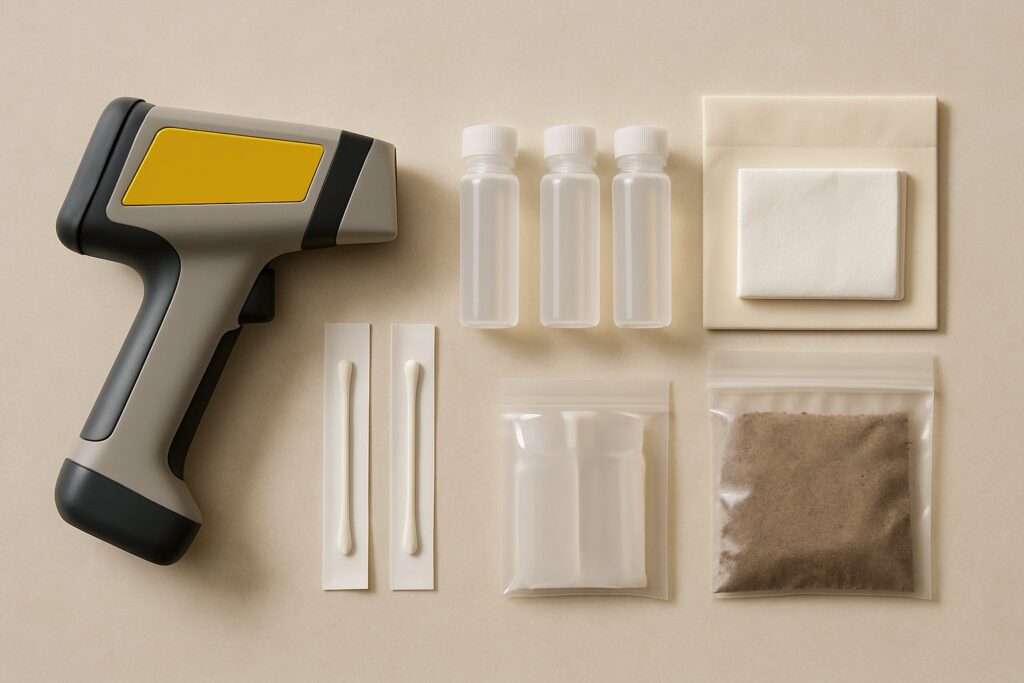
In short: for paint, the professional lead detector is an XRF analyzer used by a certified inspector or risk assessor under HUD’s testing guidelines; for a home check, EPA recognizes three swab kits, each only on certain surfaces. For water, a lab test is the reliable answer, and a cheap digital “TDS” pen does not detect lead at all. Dust and soil go to a lab. When a result has to stand up (a home sale disclosure, an abatement clearance, or a child with an elevated blood lead level), it comes from a certified professional and an accredited lab, not from a home kit.
Lead detectors compared
| Type | What it tests | Who uses it | Strengths | Limits | Typical cost (if published) |
|---|---|---|---|---|---|
| Handheld XRF analyzer | Lead in paint layers, in mg/cm², without removing paint; some models also soil | Certified lead inspectors and risk assessors, housing agencies | Reads through layers in seconds; results backed by a HUD/EPA Performance Characteristic Sheet | Professional instrument; radiation rules apply; corners and narrow edges hard to read | Makers we checked publish no prices |
| Chemical swab (rhodizonate or sulfide) | Whether a painted surface reacts to lead | Homeowners, certified renovators | Fast and cheap; EPA-recognized kits give a dependable negative on listed surfaces | No amount; false positives; only some kits and surfaces are EPA-recognized | 2-swab pack $15 on Amazon (Oct 2026) |
| Digital TDS “lead tester” pen | Total dissolved solids (all minerals and salts) in water | Water filter users | Shows if filtered water changed overall | Does not identify lead; reads in parts per million, lead matters in parts per billion | Not tracked |
| Water test strip or color kit | A rough range of lead in a water sample | Homeowners, renters | Minutes, at home | A range, not a certified number | $19.99 for one combo kit on Amazon (Oct 2026) |
| Mail-in water lab test | Measured lead in ppb from a certified lab | Homeowners, well owners, utilities | A real number you can act on | Takes days; sampling must follow instructions | About $20 to $100 (EPA) |
| Dust-wipe and soil lab tests | Lead on floors and sills (µg/ft²) or in soil (ppm) | Risk assessors, sampling technicians, gardeners | The way dust and soil hazards are judged | Must use a recognized lab and the right method | Varies by lab |
XRF lead paint analyzers: the professional lead detector
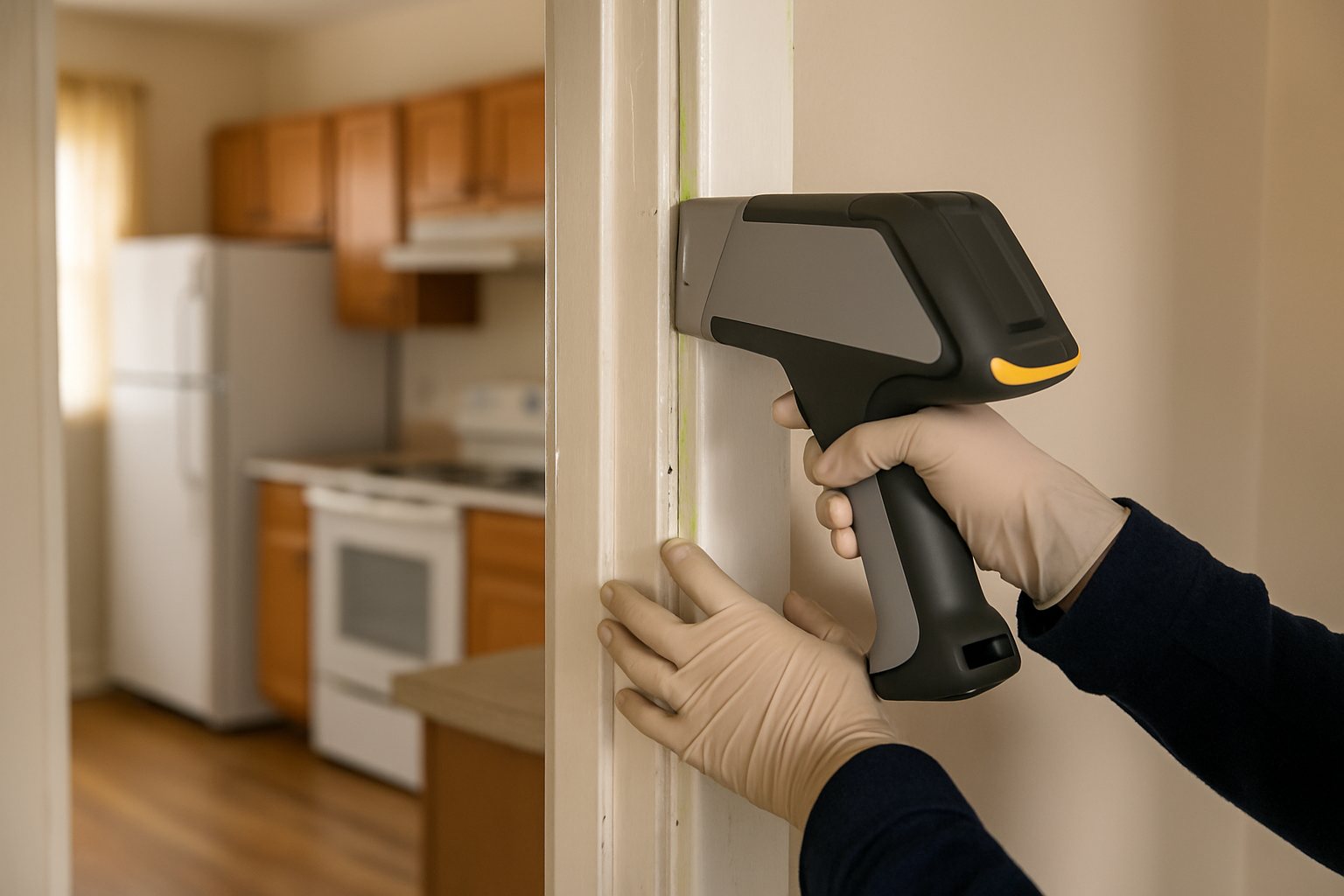
XRF stands for X-ray fluorescence. The analyzer sends X-rays or gamma rays into the painted surface; lead atoms answer with their own X-rays at energies that belong only to lead, and the instrument counts them. The result is lead per area of paint, in milligrams per square centimeter. Federally, lead-based paint means 1.0 mg/cm² or more (or 0.5% by weight in a lab test), so an XRF reading can be compared directly with that line. Viken Detection explains that higher-energy “K-shell” lead X-rays pass through paint layers that contain zinc or titanium, which is how an analyzer can find lead buried under newer coats.
EPA’s training material notes the limits: some spots, like corners and narrow edges, cannot be measured, and paint chips sent to a lab are used to confirm doubtful results. Under EPA’s rules, a lead-based paint inspection is a surface-by-surface investigation, and only a certified inspector or risk assessor can perform one and write the report.
Performance Characteristic Sheets
An XRF is only used for HUD-guideline inspections when its model has a Performance Characteristic Sheet (PCS), a joint EPA/HUD document that goes with Chapter 7 of HUD’s Guidelines for the Evaluation and Control of Lead-Based Paint Hazards in Housing. Each sheet sets the instrument’s calibration-check limits, whether readings need correcting for the material underneath (wood, plaster, metal, brick), and any “inconclusive range” in which the result cannot be called either way. Thermo Fisher’s published PCS for the Niton XLp 300, for example, sets a calibration check of 0.8 to 1.2 mg/cm², needs no substrate correction on brick, concrete, drywall, metal, plaster or wood, and classifies readings at or above 1.0 mg/cm² as positive. It is fair to ask an inspector which analyzer they use.
Radiation licensing and registration
XRF analyzers use either a small radioactive source or an X-ray tube, and both fall under radiation rules set by the Nuclear Regulatory Commission and state radiation programs. What applies depends on the instrument and the state, so inspectors check with their state radiation control program. Here is what each maker says:
- Viken Detection Pb200e (the Pb200i was renamed when it received its exemption). Uses a cobalt-57 source and K-shell XRF. Viken says the NRC exempted it from licensing, so no radiation license or registration is needed in any state, and that its PCS has no inconclusive range and needs no substrate correction. Viken also offers an optional soil calibration and a separate Pb200w for checking water service line pipes.
- SciAps X-550 Pb. Uses a 5 W X-ray tube, so there is no radioactive isotope to replace or track. SciAps says tests take 2 to 6 seconds, with no substrate corrections or inconclusive ranges, based on PCS testing at action levels of 0.5, 0.7 and 1.0 mg/cm², and lists a weight of 2.98 lb with battery. Viken notes that tube-based analyzers typically require state registration.
- Thermo Scientific Niton XLp 300 series. Its PCS (edition 1, effective September 24, 2004) covers the cadmium-109 source version in its Lead-in-Paint K+L mode. We could not confirm Thermo’s current lead paint lineup because its website was down when we checked.
None of these makers published a price on the pages we checked in October 2026; all three sell through sales contacts. Find one through our guide to choosing a lead inspector and read what an inspection or risk assessment includes.
Chemical swab lead detectors
Swab kits are the lead detector most people can buy. There are two chemistries. Rhodizonate kits turn pink or red when lead is present; sulfide kits turn gray or black. A NIST laboratory study of eight kits (four of each type), published in 2000, found that kits gave positive results below 1 mg/cm², so a positive cannot prove that paint is lead-based paint by the federal definition. It also found the type of lead pigment affected how well kits worked.
EPA recognizes only three kits for use by certified renovators, and each only on certain surfaces:
- LeadCheck (now made by Luxfer Magtech, after 3M sold the formula in 2024): wood, ferrous metal, drywall and plaster.
- D-Lead (ESCA Tech): wood, ferrous metal, drywall and plaster.
- The Massachusetts kit: drywall and plaster only, not wood or ferrous metal.
These kits met EPA’s negative-response criterion, meaning a negative on a listed surface is dependable. EPA says no kit has met both of its performance criteria, so a positive may be a false positive. Swabs are made for paint; they are not a water test, and they say nothing about how much lead is present. Our lead paint test kit comparison and lead paint testing guide go further.
Digital “lead testers” for water: what they really measure
Search for “lead tester” online and you will see pocket pens with a digital screen, sold as water quality testers. Most are TDS meters. TDS means total dissolved solids: everything dissolved in the water, mostly harmless minerals such as calcium and magnesium. EPA treats TDS as a secondary, aesthetic standard (500 mg/L) linked to taste, scaling and staining, not to health.
A TDS meter cannot tell lead apart from anything else, and the scales are far apart. The meter reads parts per million; lead in drinking water is measured in parts per billion. EPA’s current action level for water systems is 15 ppb, which is 0.015 mg/L, and under the Lead and Copper Rule Improvements it drops to 10 ppb from November 1, 2027. A glass with a high TDS reading can be free of lead, and a glass with a low reading can still contain lead. A TDS pen can show that a reverse osmosis unit has stopped working; it is not a lead detector.
Water test strips and mail-in lab kits
Home strips and color kits react with lead in a water sample and show a range; one widely sold kit reports three bands, 0 to 4, 5 to 15 and 15+ ppb. We could not find published, independently verified detection limits for most strip brands, so treat any strip as a first look. Mail-in lab kits have you collect water in a bottle and ship it to a laboratory, which reports a number in ppb.
EPA says testing is the only way to know whether there is lead in your water and recommends a lab certified for drinking water, found through your state or local drinking water authority; EPA puts the typical cost at about $20 to $100. Call your water utility first, since many test for free on request. How you sample matters: EPA’s homeowner instructions call for water that has sat unused for at least six hours, from the cold tap you drink from, without removing the aerator. Step-by-step help is in our lead water testing guide, and kits are compared in best lead water test kits.
Dust-wipe and soil tests
Lead dust is the main way young children are exposed, according to EPA’s 2024 dust rule, and there is no instant dust detector for homes. Dust is collected on special wipes from floors and window sills and analyzed by a lab recognized under EPA’s National Lead Laboratory Accreditation Program (NLLAP). EPA’s dust-lead action levels for post-abatement clearance are 5 µg/ft² for floors, 40 for window sills and 100 for window troughs.
For soil, EPA says the best way to know is to send samples to a qualified lab, such as an NLLAP lab, a state university extension lab or, in some areas, the health department. Extension labs recommend a full lab test for decisions like a home sale or a community garden.
Accuracy, detection limits and false negatives
Four terms help you read any lead detector’s claims:
- Detection limit: the smallest amount the method can reliably see. Below it, the test says “not detected,” which does not mean zero.
- False negative: the test says no lead when lead is there. This is the dangerous error. Causes include lead buried under fresh paint, a swab on a surface it was not validated for, an expired kit, or water sampled after the tap was run.
- False positive: the test reacts when paint is below the legal line. EPA says no swab kit has met its false-positive criterion, which is why a positive swab leads to a professional test rather than straight to removal.
- Inconclusive range: for some XRF models, a band of readings that cannot be called; the inspector then confirms with a lab paint-chip sample.
The honest rule: a home kit can tell you to look closer; it should not be the reason you stop looking. Our home test vs lab testing guide shows where each fits.
When only a certified professional or accredited lab counts
- Selling or renting pre-1978 housing. Sellers and landlords must disclose known lead-based paint and hazards and hand over available reports. Buyers get a 10-day opportunity for an inspection or risk assessment. A swab result is not an inspection report; EPA says only a certified inspector or risk assessor performs a lead-based paint inspection. See lead paint inspection.
- Abatement clearance. Federal rules (40 CFR 745.227) say post-abatement clearance, the visual check and dust sampling, is performed only by a certified inspector or risk assessor, with dust analyzed by an NLLAP-recognized lab.
- A child with an elevated blood lead level. CDC’s clinical guidance has the healthcare provider report the result to the health department and arrange an environmental investigation as required. That investigation is done by licensed or certified professionals, not with home kits. Health questions belong with your doctor or local health department; see lead and health.
- Drinking water decisions. Use a lab certified for drinking water, through your utility or state.
You can find certified firms through EPA’s lead firm locator or our find a lead professional page, and EPA’s National Lead Information Center answers questions at 1-800-424-LEAD (5323).
Home lead detectors worth having
These consumer kits were in stock on Amazon when we checked in October 2026. Each one tests one thing; match it to your question. More choices are in our lead test kits hub.
Lead Check Swabs, Instant Lead Test, 2-Swab Pack
- LeadCheck: one of the three EPA-recognized kits
- Wood, ferrous metal, drywall, plaster
- Pink or red means lead; check the expiration date
Safe Home DIY Lead in Drinking Water Combo Test Kit
- Home test reports 0-4, 5-15 or 15+ ppb
- Second kit for optional lab test (lab fee extra)
- Tap or well water
Tap Score Lead and Copper in Water Test Kit
- Lab report on lead and copper
- Prepaid return shipping
- City or well water
How to pick the right lead detector
- Name what you are testing. Paint, water, dust, soil or an object; each needs its own method.
- Decide what the result is for. Curiosity or a quick check before a small repair: an EPA-recognized swab or a home water kit. A sale, a lease, a renovation plan, a child’s health: a certified professional and an accredited lab.
- Confirm anything that worries you. A positive swab, a water result near 15 ppb, or peeling paint in a pre-1978 home with young children all deserve a professional test.
Worried someone has been exposed to lead?
Testing your home finds the source; only a blood lead test shows whether a person has lead in their body. Here is how to get tested, and what the numbers mean.
How to test for lead poisoningBlood lead levels explainedLead screening for childrenTesting for adultsSymptoms
Frequently asked questions
Can I buy an XRF lead detector for my home?
They are sold to professionals through the makers’ sales teams, with no published prices on the pages we checked. Even with an analyzer, an inspection that counts for disclosure or clearance must be done by a certified inspector or risk assessor, so hiring one is the practical route.
Does a TDS meter detect lead in water?
No. It measures all dissolved solids together in parts per million and cannot single out lead, which matters in parts per billion. Use a lab test or a lead-specific kit.
Are lead swab tests accurate?
On the surfaces EPA lists, a negative from LeadCheck, D-Lead or the Massachusetts kit is dependable. Positives can be false positives, and swabs never tell you how much lead is there.
I think my child was exposed. Which detector should I use?
Start with your child’s doctor; a blood lead test is the best way to know about exposure. For urgent concerns, call Poison Control at 1-800-222-1222. Testing the home comes next, through your health department or a certified risk assessor.