Tag: Blood Lead Test

  • Lead Poisoning in Pregnancy: Risks, Sources and Breastfeeding

    Lead Poisoning in Pregnancy: Risks, Sources and Breastfeeding

    Lead poisoning in pregnancy matters because lead in the mother’s blood reaches the baby: the CDC says lead readily crosses the placenta, and lead stored in the mother’s bones can be released into the blood during pregnancy. Most people with lead exposure feel nothing, so the way to find it is a blood lead test, ordered by your health care provider when your history shows a risk.

    Mother holding her swaddled newborn by a sunny window

    In short: the CDC says lead in the blood during pregnancy can increase the risk for miscarriage, cause the baby to be born too early or too small, hurt the baby’s brain, kidneys and nervous system, and cause the child to have learning or behavior problems. Common sources include eating clay or soil (pica), imported remedies, cosmetics and spices, lead-glazed pottery, renovation of pre-1978 homes, and lead dust brought home from a household member’s job. The CDC recommends a risk check at the first prenatal visit and a blood test if any risk is found, and it says mothers below 40 µg/dL should breastfeed.

    This guide explains what the CDC, the World Health Organization (WHO) and the FDA say. It is not medical advice. Your prenatal care provider decides whether you need a test and what a result means. For urgent questions about a possible poisoning, call Poison Control at 1-800-222-1222.

    How lead reaches the baby

    The WHO explains that lead is stored in the teeth and bones, where it builds up over time. That stored lead is why pregnancy is a special case.

    • Through the placenta. The CDC’s 2010 Guidelines for the Identification and Management of Lead Exposure in Pregnant and Lactating Women say lead crosses the placenta by passive diffusion and has been measured in the fetal brain as early as the end of the first trimester. That is why the guidelines call preventing exposure “particularly important.”
    • From the mother’s own bones. The CDC pregnancy page says lead stored in adults’ bones can be released into the blood during pregnancy, so blood lead levels can rise. The WHO says the same: bone lead released during pregnancy “becomes a source of exposure to the developing fetus.” Past exposure, even years before, can matter.
    • After birth, through breast milk. The CDC says mothers can also expose infants to lead through breast milk (see breastfeeding below).

    What lead exposure during pregnancy can do

    The CDC’s “Risk Factors and Pregnancy” page lists four effects of lead in the blood during pregnancy. In its words, lead can:

    • Increase risk for miscarriage
    • Cause the baby to be born too early or too small
    • Hurt the baby’s brain, kidneys, and nervous system
    • Cause the child to have learning or behavior problems

    The WHO fact sheet on lead says lead exposure during pregnancy “can cause reduced fetal growth and preterm birth,” and that there is no level of exposure to lead known to be without harmful effects.

    The 2010 CDC guidelines add detail: studies link prenatal exposure, even with maternal levels below 10 µg/dL, to lower fetal growth and neurodevelopment; lead has been associated with high blood pressure in pregnancy; and the evidence on miscarriage and preterm delivery is more limited and mixed. The CDC has not named any blood lead level as safe for mother or baby. For the long-term picture, see effects of lead poisoning.

    Common sources of lead for pregnant people

    The 2010 guidelines name the groups most likely to be exposed: workers in certain jobs, recent immigrants, and people with habits such as pica or renovating older homes.

    Pica: eating clay, soil and other non-food items

    Some pregnant people feel an urge to eat clay, soil, plaster or paint chips. The CDC guidelines advise never eating or mouthing non-food items because they may contain lead, and note that pica is common in many parts of Africa, Asia and Central America. Tell your provider: it is a recognized risk factor, not a judgment.

    Imported remedies, cosmetics, spices and candies

    The guidelines advise avoiding imported cosmetics, food additives and medicines that may contain lead, such as azarcon, kohl, kajal and surma, and using caution with candies, spices and foods brought from abroad. The FDA warns that kohl can cause lead poisoning and advises asking a provider to test pregnant or nursing women who used it; it has also cautioned about some Ayurvedic products and issued alerts on ground cinnamon. Our guide to lead in cinnamon and spices lists the FDA alerts.

    Pottery, crystal and metal cookware

    The CDC guidelines advise against using imported lead-glazed pottery, pewter or brass for food, leaded crystal for drinks, and chipped or cracked dishes. The FDA says some traditional pottery labeled “lead free” still released lead, and in December 2024 it warned that certain imported aluminum, brass and Hindalium cookware can leach lead. See lead in pottery and dishes.

    Renovation and old paint

    The guidelines say to stay away from repair, repainting, renovation and remodeling work in homes built before 1978 and to avoid deteriorated lead paint. Work should be done by others using lead-safe renovation (RRP) practices while you are out of the home.

    Jobs and hobbies, yours or a household member’s

    The guidelines advise avoiding jobs or hobbies involving lead and guarding against take-home lead dust if a household member works with lead, such as in pre-1978 renovation or lead battery making or recycling. Dust carried home on clothes, shoes or skin settles in the car and home. Pregnant women at 10 µg/dL or higher should be removed from work exposure to lead. Our guide to lead testing for adults covers the jobs on the CDC list and the NIOSH advice for workers.

    Concerns at a glance

    ConcernWhat CDC / WHO sayWhat you can do
    Lead reaching the babyLead crosses the placenta; bone lead can be released into the blood during pregnancy (CDC, WHO)Tell your provider about any past or present exposure, even years ago
    Pregnancy outcomesCan increase risk for miscarriage and cause the baby to be born too early or too small (CDC); reduced fetal growth and preterm birth (WHO)Ask about a lead risk assessment at your first prenatal visit
    PicaNever eat or mouth clay, soil, pottery or paint chips (CDC 2010)Mention any cravings for non-food items to your provider
    Imported remedies, cosmetics, spicesAvoid imported products that may contain lead, such as azarcon, kohl, kajal, surma (CDC 2010); kohl can cause lead poisoning (FDA)Stop using the product and bring it to your appointment
    RenovationStay away from renovation in homes built before 1978 (CDC 2010)Let others do the work lead-safely while you are away
    Take-home dustTake precautions if a household member works with lead (CDC 2010)Work clothes and shoes stay at work or are washed separately
    NutritionEat a balanced diet with adequate iron and calcium (CDC 2010); “a diet high in iron and calcium” (CDC)Ask your provider before taking any supplement

    How to lower lead exposure during pregnancy

    The CDC puts it simply: the best way to prevent lead in the blood is to prevent lead exposure. Based on the CDC guidelines and pregnancy page:

    • Keep lead dust out. Stay away from renovation in pre-1978 homes. Work clothes and shoes of household members who work with lead stay out of the living space. The CDC advises wet-mopping floors and other flat surfaces.
    • Skip imported remedies, cosmetics, unlabeled foods and lead-glazed pottery, and check FDA alerts for spices you already have.
    • Eat well. The guidelines say to eat a balanced diet with adequate intakes of iron and calcium and to avoid cigarettes and alcohol. The CDC pregnancy page says doctors may suggest “eating a diet high in iron and calcium.” Do not start supplements on your own, and never use products sold to “remove lead.”
    • Check your home. Our free home lead risk checker walks you through the usual sources room by room.

    Testing during pregnancy

    The CDC does not recommend testing all pregnant women in the US. Instead, providers are asked to look for risk factors as part of your work, home and lifestyle history, at the earliest prenatal contact, and to order a venous blood lead test if even one risk factor is found. Clinics that serve communities with known risks may test everyone. The CDC pregnancy page adds that if you think you may have been exposed, you should talk to your provider about a blood lead test.

    A sample questionnaire reprinted in the guidelines (Minnesota Department of Health) asks about lead jobs or hobbies at home, eating clay, soil, plaster or paint chips, dusty renovation in a pre-1978 home, high lead in your water, folk remedies or cosmetics not sold in regular stores, and homemade pottery or leaded crystal.

    At 5 µg/dL or higher, the guidelines recommend follow-up testing, a search for the source and testing of the newborn. Our guide to blood lead levels has the CDC schedule and explains the units, and lead testing for adults covers who should ask. Home kits do not test people; they check paint, dust, soil or water (see lead poisoning test).

    Lead and breastfeeding

    Lead can pass into breast milk, but the CDC still calls breast milk the most complete and ideal food for infants in their first year. Its guidance, from the 2010 guidelines and the current CDC breastfeeding page:

    • Below 40 µg/dL: mothers should breastfeed. The CDC page says women with levels of 5 µg/dL up to below 40 can breastfeed, while their providers watch the baby’s levels.
    • 40 µg/dL or higher (confirmed): pump and discard breast milk until the mother’s level drops below 40, then begin breastfeeding.
    • Testing breast milk for lead is not recommended. The blood test is what guides decisions.
    • If the baby’s level rises or does not come down, providers look for other sources first. Only if none is found, and the mother’s level is above 20 µg/dL with the baby at 5 µg/dL or higher, may a temporary pause be considered.

    For formula that needs mixing, the guidelines say to use water only from the cold tap, flushed for at least 3 minutes, or bottled or filtered water known to be free of lead. More on water at lead in water testing.

    What to ask your provider

    • Based on my job, home, hobbies and the products I use, do I have a risk factor for lead? Should I have a blood lead test?
    • I had lead exposure in the past (or I grew up or lived abroad). Could stored lead matter in this pregnancy?
    • If my level is 5 µg/dL or higher, when will you retest, and will the baby be tested at birth?
    • Is there anything about my diet I should change? Should I take any supplement, or avoid one?
    • What does my level mean for breastfeeding?

    Bring any imported remedy, cosmetic or spice you use to the appointment. For more on lead and health, start at our lead poisoning hub.

    Frequently asked questions

    Can lead pass from mother to baby during pregnancy?

    Yes. The CDC’s 2010 guidelines say lead readily crosses the placenta, and both the CDC and the WHO say lead stored in the mother’s bones can be released into the blood during pregnancy and reach the baby.

    Should every pregnant woman get a lead test?

    The CDC does not recommend testing everyone. It recommends a risk assessment at the first prenatal contact and a blood lead test if any single risk factor is found. If you think you were exposed, ask your provider.

    Is there lead in breast milk?

    It can, but the CDC says mothers below 40 µg/dL should breastfeed; at 40 or higher, pump and discard until the level drops below 40. Testing breast milk is not recommended.

    Why does my provider ask if I eat clay or dirt?

    Eating non-food items such as clay, soil, plaster or paint chips (pica) is a known source of lead in pregnancy, and it is on the CDC’s list of risk factors. A “yes” usually means a blood lead test, which helps protect you and the baby.


  • Which Doctor Treats Lead Poisoning? Who to See and How to Find Them

    Which Doctor Treats Lead Poisoning? Who to See and How to Find Them

    For most people, the doctor who treats lead poisoning is the one they already have: a child’s pediatrician or an adult’s family doctor, working together with the local health department. When blood lead levels are high, the CDC tells that doctor to bring in specialists, such as a Pediatric Environmental Health Specialty Unit (PEHSU), Poison Control or a medical toxicologist.

    Doctor on a phone consultation at a desk in a clinic office

    In short: start with your own doctor or your child’s pediatrician and ask for a blood lead test. Your local health department can often test too, and it follows up on high results. Workers exposed on the job can also see an occupational medicine clinic. At higher levels, the CDC’s guidance has the doctor consult a PEHSU or Poison Control, and at the highest levels a medical toxicologist or a pediatrician experienced in lead poisoning, sometimes with a hospital stay. For urgent questions call Poison Control at 1-800-222-1222; for a seizure, collapse or trouble breathing, call 911.

    This page sums up what the CDC, ATSDR, NIOSH, OSHA and the specialist networks publish. It is not medical advice; only a provider who knows the patient can decide on care.

    Who to see first: your own doctor

    The CDC’s advice to parents is simple: if you believe your child has been exposed to lead, talk to your child’s health care provider, who may order a blood lead test. Most children with lead in their blood have no obvious symptoms (see lead poisoning symptoms). Our blood lead test guide explains the finger-prick and blood-draw versions and what a result means.

    The CDC’s clinical guidance is written for these providers: it tells them what to do at each blood lead level, from education and repeat tests to reporting, home investigations and specialist referrals. Your regular doctor is not just a gatekeeper; for most people with lead exposure, that doctor manages the follow-up. Our guide to lead screening for children covers when children are usually tested.

    For adults, NIOSH, the CDC’s worker-safety institute, says that if you or someone in your household works with lead, tell your doctor, and ask about a blood lead test if your employer does not offer routine testing. See lead testing for adults for who should ask.

    Your local health department’s lead program

    The CDC says health care providers and most local health departments can test for lead in the blood. The CDC also funds childhood lead poisoning prevention programs run by state and local health departments. When a child’s result is at or above the CDC’s blood lead reference value of 3.5 µg/dL, the CDC tells the doctor to report it to the state or local health department, which may then follow the child, help the family find the source and arrange a home investigation where local rules require one.

    What each program offers is set by the state or city, so call your county or city health department and ask for its lead program. Our lead poisoning test page lists other places to get tested.

    Lead poisoning specialists

    Three kinds of specialists come up in official guidance, working alongside your own doctor.

    Pediatric Environmental Health Specialty Units (PEHSU)

    The PEHSU network was created in 1998 by ATSDR, the CDC’s agency for toxic substances, with support from the EPA. It has ten regional units based at academic health institutions, each covering a group of states, with experts in pediatrics, environmental medicine and clinical toxicology. According to pehsu.net, pediatric and obstetric providers, public health departments and other health professionals can contact their regional unit for a consultation on children’s or pregnancy-related environmental exposures, lead included. ATSDR says the units also work with parents, schools and community groups.

    Note for families: the national PEHSU site says the units do not provide clinical services. Your doctor can consult the regional unit. Find yours on the PEHSU regions page, which lists the states each region covers with phone and email contacts. We could not find a published statement on whether consultations cost anything, so ask your regional unit.

    Medical toxicologists

    Medical toxicologists are physicians who specialize in poisoning. The CDC’s guidance names them for the highest blood lead levels, where the provider consults “a medical toxicologist or pediatrician with experience in treating lead poisoning” about treatment. The American College of Medical Toxicology (ACMT) runs a public Find a Toxicologist directory that can be filtered by state and by inpatient or outpatient services. Some poison centers are listed in the directory too.

    Occupational medicine doctors, for workers

    Most adults with high blood lead are exposed at work, according to NIEHS. OSHA’s lead standards require employers to provide medical surveillance, including blood lead tests, without cost to employees who are or may be exposed at or above the action level for more than 30 days a year. The Association of Occupational and Environmental Clinics (AOEC) keeps a clinic directory of member clinics that see workers with job-related illness and people exposed to environmental hazards.

    Who to see, when, and how to find them

    WhoWhen to see themHow to find one
    Pediatrician or family doctorFirst stop for any lead worry, a blood lead test and all follow-upYour own provider, or ask your health department where to go
    Local health departmentTesting, follow-up of high results, home investigations where requiredYour county or city health department’s lead program
    Poison ControlSomeone swallowed something that may contain lead, or you have urgent questions1-800-222-1222, free and confidential, 24/7
    PEHSUYour doctor wants expert advice on a child’s or pregnancy exposure (CDC: at 20 µg/dL and above)pehsu.net, by region; no clinical care
    Medical toxicologistVery high levels (CDC: 45 µg/dL and above), usually through your doctor or a hospitalACMT Find a Toxicologist; ask your doctor or Poison Control
    Occupational medicine clinicLead exposure at workYour employer’s medical program; AOEC clinic directory
    Emergency room / 911Seizure, collapse, trouble breathing or other severe symptomsCall 911

    What the CDC tells doctors to do at each level

    Which specialist joins in depends on the blood lead level. In the CDC’s guidance for children’s providers (dated August 21, 2025), each step includes the ones before it:

    • Below 3.5 µg/dL: the regular doctor teaches families about lead sources, checks development and diet, and retests based on age and risk.
    • 3.5 to 19 µg/dL: the doctor reports to the health department, takes an exposure history, arranges a home investigation as required locally and schedules follow-up tests.
    • 20 to 44 µg/dL: a full history and exam, and the doctor contacts a PEHSU or Poison Control for guidance.
    • 45 µg/dL and above: the doctor consults a medical toxicologist or a pediatrician experienced in lead poisoning about treatment, and admits the child to a hospital as soon as possible if there are signs or symptoms. The CDC also tells doctors to consider admission when the home is not lead-safe and no lead-free housing is available.

    Our blood lead levels page puts these numbers in context, and lead poisoning treatment explains what the CDC and ATSDR say about care, including why there is no home treatment.

    When to call Poison Control or 911

    Poison Control, at 1-800-222-1222, connects you to your local poison center, where trained nurses, pharmacists or doctors answer; HRSA says the call is free, confidential and open 24 hours a day. Call if a child swallowed a paint chip, a fishing weight or anything else that might contain lead, or if you have urgent questions. For a seizure, collapse or trouble breathing, call 911. MedlinePlus (National Library of Medicine) also lists vomiting or seizures as reasons to call 911.

    What to bring to the appointment

    • Test results: every blood lead result you have, with dates, and whether each was a finger-prick or a blood draw from a vein.
    • Home information: the year your home was built (paint before 1978 may contain lead), any recent renovation, peeling paint, known lead pipes, and any home or water test results. See lead paint testing and lead in water testing.
    • Products: names or photos of imported spices, foods, candies, remedies, cosmetics, pottery or toys you use, or the items themselves if the doctor asks. See lead in household items.
    • Work and hobbies: jobs and hobbies of everyone in the home, since NIOSH notes lead dust can come home on work clothes and shoes.

    Questions to ask the doctor

    • Was this a finger-prick or a venous test, and does it need to be confirmed?
    • When should the next blood lead test be?
    • Will you report this to the health department, and will someone check our home?
    • Should other people in the household be tested?
    • Do you plan to consult a PEHSU, Poison Control or a medical toxicologist?

    For what usually happens over the following months, see lead poisoning recovery.

    Insurance and Medicaid

    The CDC says many private insurance policies cover the cost of blood lead testing, and for children enrolled in Medicaid the cost is covered by the Centers for Medicare and Medicaid Services. A 2016 CMS bulletin states that all children enrolled in Medicaid are required to receive blood lead screening tests at 12 and 24 months, and any child aged 24 to 72 months with no record of a previous test must receive one. The same bulletin says Medicaid can reimburse lead investigations in the home of a child with elevated blood lead. Workers covered by OSHA’s lead standards get medical surveillance from their employer at no cost. Ask your insurer about specialist visits.

    For the bigger picture on lead and health, start at our lead poisoning hub.

    Frequently asked questions

    What kind of doctor treats lead poisoning?

    Usually a pediatrician or family doctor, with the local health department. At higher levels the CDC tells that doctor to consult a PEHSU or Poison Control, and at the highest levels a medical toxicologist or a pediatrician experienced in lead poisoning.

    Is there a lead poisoning specialist near me?

    Check ACMT’s Find a Toxicologist directory, your regional PEHSU on pehsu.net, and the AOEC clinic directory if the exposure is from work. Your doctor or health department can also refer you.

    Can I call a PEHSU myself?

    PEHSUs mainly advise health professionals, but ATSDR says they also work with parents, and each region lists a phone and email. They do not provide clinical care.

    Should I go to the emergency room for lead exposure?

    Call 911 for severe symptoms such as a seizure, collapse or trouble breathing. Otherwise, call Poison Control at 1-800-222-1222 or your doctor; they will tell you whether you need to be seen right away.

    Does insurance pay for a blood lead test?

    The CDC says many private plans cover it, and Medicaid covers it for enrolled children. OSHA requires employers to provide it free to covered workers.

  • Lead Testing for Adults: Who Should Get a Blood Lead Test

    Lead Testing for Adults: Who Should Get a Blood Lead Test

    The lead poisoning test for adults is the same as for children: a blood lead test, ordered by a health care provider or done through your employer’s medical program. The CDC says it is the only way to tell whether you have been exposed, and most exposed adults have no symptoms. What matters is whether your work, hobby or home puts you near lead.

    Pregnant woman talking with her doctor in a calm clinic room

    In short: adults who work with lead (construction and renovation, battery making and recycling, smelting, firing ranges, welding and cutting, demolition), adults with lead hobbies (shooting, casting bullets or fishing weights, stained glass, lead glazes), and adults who use certain imported remedies, cosmetics or spices should talk to a doctor about a blood lead test. At work, OSHA requires employers to offer free blood lead testing to workers exposed at or above an airborne action level of 30 µg/m³. The CDC does not recommend testing every pregnant woman, but it does recommend a risk assessment at the first prenatal visit and a blood test if even one risk factor is found.

    This guide explains what the CDC, NIOSH and OSHA say. It is not medical advice: only a health care provider can decide whether you need a test and what your result means. For urgent questions about a possible poisoning, call Poison Control at 1-800-222-1222.

    Which adults should ask about a blood lead test

    Most adult lead exposure comes from work. The CDC’s list of jobs that may involve lead includes:

    • Repair, renovation, remodeling and painting of homes and commercial buildings, plus abatement and demolition
    • Painting or sanding steel structures such as bridges and water towers
    • Making products that contain lead, such as batteries, bullets and circuits, and recycling materials such as electronics (NIOSH also names lead-acid battery recycling)
    • Melting lead: secondary smelting, foundries and casting, incinerators; and mining or smelting ore
    • Using firearms or working at a firing range (law enforcement, military, instructors)
    • Welding and cutting, and art work with leaded ceramic glaze, glasswork or stained glass

    NIOSH studies have also found lead exposure above OSHA’s limit in radiator repair shops.

    Hobbies count too. The CDC names casting or soldering (bullets, fishing weights, stained glass), target shooting, mixing or applying lead glazes and pigments, home renovation in a building from before 1978, and drinking home-distilled liquor such as moonshine. People with bullet fragments retained from a gunshot wound are also on the CDC’s list.

    Finally, some products carry lead into the body directly. The CDC lists complementary, alternative or traditional medicines, cosmetics and ceremonial powders that may contain lead; the FDA has warned about kohl (also sold as kajal, surma and other names) and about certain Ayurvedic products; and recalls have involved ground spices, including cinnamon. Our guide to lead in cinnamon and spices covers the food side, and lead poisoning causes and prevention covers the rest.

    Who is recommended a test: a quick table

    Your situationWhat’s recommendedSource
    Worker exposed to airborne lead at or above 30 µg/m³ (the action level)The employer must offer blood lead testing (and zinc protoporphyrin) at no cost; periodic testing followsOSHA 29 CFR 1910.1025 and 1926.62
    Construction worker exposed at or above the action level on any dayInitial blood sampling offered by the employerOSHA 29 CFR 1926.62(j)(1)(i)
    Worker whose employer does not testAsk your employer about routine testing; if there is none, talk with your health care providerCDC/NIOSH Information for Workers
    Lead hobby (shooting, casting, stained glass, glazes) or pre-1978 home renovationContact a health care provider, who decides whether you need a testCDC Jobs, Hobbies or Other Activities
    Use of imported remedies, kohl or similar cosmeticsStop using the product; ask a provider about testing, especially for children and pregnant or nursing womenFDA (kohl); CDC
    Pregnant, with one or more risk factorsBlood lead test; risk assessment at the earliest prenatal contactCDC 2010 pregnancy guidelines
    Breastfeeding parent who works with leadAlso ask the baby’s pediatrician whether you should have a blood lead testCDC/NIOSH Information for Workers

    Lead exposure at work: what the OSHA lead standards require

    Occupational lead exposure in the US is covered by two OSHA standards: 29 CFR 1910.1025 for general industry and 29 CFR 1926.62 for construction. Both set a permissible exposure limit (PEL) of 50 µg/m³ of air and an action level of 30 µg/m³, each averaged over an 8-hour day. The action level is what switches on the blood testing rules. Blood levels below are in µg/dL, as on a lab report.

    Blood testing schedule

    • General industry: workers exposed at or above the action level for more than 30 days a year get blood lead testing at least every 6 months; every 2 months if the last result was 40 µg/dL or higher (until two results in a row are below 40); and at least monthly while removed from lead work.
    • Construction: initial blood sampling for anyone exposed at or above the action level on any day. Workers exposed at that level for more than 30 days in any 12 months are tested at least every 2 months for the first 6 months, then every 6 months; every 2 months while at 40 µg/dL or higher; monthly during removal.
    • In construction, tasks such as manual scraping or sanding of lead paint and heat-gun use count as high exposure until measured, with blood monitoring as part of interim protection.

    Both standards say the medical surveillance must be provided without cost to employees. In construction, the employer must tell each worker their blood lead result in writing within five working days. In both, workers at 40 µg/dL or higher must be told in writing within five working days, along with the medical removal rules.

    Medical removal

    General industry (1910.1025)Construction (1926.62)
    Removed from lead exposure at60 µg/dL or higher, or an average of the last three tests at 50 µg/dL or higher (not required if the last test was below 40)50 µg/dL or higher
    Return to former jobTwo tests in a row below 40 µg/dLTwo tests in a row below 40 µg/dL
    Medical removal protectionUp to 18 months of benefits (pay, seniority and rights kept)Up to 18 months of benefits

    Workers also have a right to a second medical opinion, and under the general industry standard a worker can ask for pregnancy testing or a male fertility evaluation as part of the medical exam.

    Keep in mind that these numbers date from the 1970s and 1990s. OSHA itself said in 2022, when it opened a rulemaking on the blood lead triggers, that harm in adults can occur below the current removal and return-to-work levels. As of October 2026 OSHA’s page still shows only that 2022 advance notice, with no proposed rule. NIOSH notes that a few state agencies, such as Michigan’s MIOSHA and the California Department of Public Health, have their own blood lead guidance for workers, so check your state. For what health research says about lower levels, see effects of lead poisoning and blood lead levels.

    Take-home lead: protecting your family

    NIOSH warns that people who work near lead can bring lead dust home on their clothes, shoes and hair, and that children and pregnant women are especially at risk. NIOSH’s advice to workers:

    • Change into work clothes and shoes that stay at work, and never leave without cleaning up, even for a quick trip.
    • Wash with soap designed to remove lead before eating, drinking or smoking; NIOSH says ordinary soap and water are not enough.
    • Shower and wash your hair before leaving if showers are provided; if not, wash as much skin as you can and change clothes and shoes before going home.
    • Do not take tools, scrap or packaging home. If work clothes must go home, keep them in a closed plastic bag and wash and dry them alone.

    For workers above the PEL, OSHA’s construction standard also requires clean change areas and showers where feasible. If someone in your home works with lead, ask your children’s doctor about testing them; our blood lead test guide explains how it works for children. Home renovators should follow lead-safe renovation (RRP) practices.

    Lead test in pregnancy and while breastfeeding

    Lead stored in bone can be released during pregnancy and pass to the baby, the CDC says. Its Guidelines for the Identification and Management of Lead Exposure in Pregnant and Lactating Women (November 2010, still linked from CDC’s pregnancy page) say:

    • The CDC does not recommend testing all pregnant women. Routine testing is recommended in clinics that serve populations with specific risk factors.
    • Elsewhere, providers should assess risk as part of the occupational, environmental and lifestyle history, at the earliest prenatal contact, and test if even one risk factor is found.
    • Risk factors named include recent immigration, pica (eating non-food items), work with lead, nutritional status, traditional remedies or imported cosmetics, and lead-glazed pottery used for cooking or storing food. Old paint matters mainly during renovation of older homes.
    • Follow-up testing and a search for the source start at 5 µg/dL. The guidelines say pregnant women at 10 µg/dL or higher should be removed from work exposure to lead.
    • Breastfeeding: the CDC encourages mothers below 40 µg/dL to breastfeed, and encourages mothers at 40 µg/dL or higher to pump and discard milk until their level drops below 40. CDC’s breastfeeding page says testing breast milk for lead is not recommended.

    The American College of Obstetricians and Gynecologists (ACOG) Committee Opinion No. 533 on lead screening in pregnancy also favors a risk assessment over routine testing for everyone. If any of these risk factors apply, tell your provider. Treatment decisions belong to your doctor; do not try supplements or products sold to “remove lead.”

    Adult lead surveillance: NIOSH ABLES and your state

    NIOSH runs the Adult Blood Lead Epidemiology and Surveillance program (ABLES), which it describes as a state-based surveillance program of laboratory-reported adult blood lead levels. Labs report adult results to participating states, which follow up on high results and track where exposure comes from. Since 2015, NIOSH has used 5 µg/dL as the reference level that marks an elevated adult blood lead level for surveillance. The Council of State and Territorial Epidemiologists (CSTE) uses a reference value of 3.5 µg/dL for adults and children.

    How to ask your doctor or employer

    • Your employer: NIOSH suggests asking whether they do routine blood lead testing and following their lead control plan. If you are exposed at or above the action level, OSHA requires the employer to offer testing at no cost.
    • Your doctor: say plainly what you do: “I scrape paint in old houses,” “I cast my own bullets,” “I use an imported remedy.” NIOSH says lead symptoms look like other illnesses, so your exposure history is what prompts the test.
    • Concerns about your workplace: NIOSH offers a free Health Hazard Evaluation on request, and you can contact your nearest OSHA office about unsafe conditions.

    Cost and coverage

    For workers covered by OSHA’s lead standards, required blood testing is free to the employee. Outside work, the CDC says health care providers and most local health departments can test for lead, and many private insurance plans cover the test. We do not list prices because no official source publishes one; ask your provider, insurer or health department before the test.

    Home test kits do not test people. They check paint, dust, soil or water, which helps find a source but cannot replace a blood test. See our lead poisoning test page and the lead poisoning hub.

    Frequently asked questions

    Is there a lead poisoning test for adults?

    Yes. It is a blood lead test, usually a blood draw from a vein, ordered by a health care provider or done through an employer’s medical surveillance program. The CDC says it is the only way to confirm exposure.

    Does my employer have to pay for a blood lead test?

    If you are exposed at or above OSHA’s action level of 30 µg/m³, the lead standards require the employer to provide medical surveillance, including blood lead tests, without cost to you.

    Should every pregnant woman get a lead test?

    The CDC does not recommend testing all pregnant women. It recommends a risk assessment at the first prenatal contact and a blood lead test if any risk factor is found, and routine testing where the patient population has known risk factors.

  • Lead Screening for Children: When and How Kids Are Tested

    Lead Screening for Children: When and How Kids Are Tested

    Lead screening for children happens at regular checkups: the doctor asks a few questions about lead risks, and many children also get a small blood test at 1 and 2 years old. Children on Medicaid must have that blood test at 12 and 24 months, and a growing number of states now require it for every child.

    Parent filling in a clipboard form in a clinic waiting room with a toddler beside them

    In short: the American Academy of Pediatrics (AAP) schedule calls for a lead risk assessment at the 6, 9, 12, 18 and 24 month visits and every year from age 3 to 6. Federal Medicaid rules require blood lead tests at 12 and 24 months, plus a test between 24 and 72 months for any child never tested, and a questionnaire alone does not count. States such as Illinois, Michigan, New York and Massachusetts require blood tests for all young children. The test is usually a finger or heel stick. Ask your pediatrician, your local health department or your WIC office which tests your child is due for.

    This guide summarizes official guidance and is not medical advice. If you think your child swallowed something with lead in it, call Poison Control at 1-800-222-1222, and call 911 for severe symptoms.

    Why children are screened even when they seem healthy

    Most children with lead in their blood have no obvious symptoms, and the CDC says all children at risk for lead exposure should be tested. The CDC says children younger than 6 are more likely to be exposed because of their hand-to-mouth behavior. Our lead and children guide explains why young children are most at risk, and lead poisoning symptoms covers the signs that can appear.

    “Screening” covers two different things:

    • Risk assessment: a short set of questions the doctor or nurse asks you about your home, family and habits. No needle involved.
    • Blood lead test: a small blood sample that measures lead in micrograms per deciliter (µg/dL). This is the only way to know your child’s actual level. See blood lead test for how results are read.

    The lead screening schedule at a glance

    Federal Medicaid rules, the AAP schedule and CDC guidance; states can add tests.

    AgeWhat’s recommendedSource
    6 monthsLead risk assessment (questions) at the well-child visitAAP Bright Futures
    9 monthsRisk assessment; in Massachusetts, a blood test once between 9 and 12 monthsAAP; Massachusetts DPH
    12 months (1 year)Risk assessment; blood lead test required for children on Medicaid or CHIP-funded Medicaid; blood test for all children in states with universal testingAAP; CMS (EPSDT); state health departments
    18 monthsRisk assessmentAAP Bright Futures
    24 months (2 years)Risk assessment; second blood lead test required for Medicaid; blood test in universal-testing statesAAP; CMS (EPSDT); state health departments
    2 to 6 years (24 to 72 months)Risk assessment every year at 3, 4, 5 and 6; blood test for any Medicaid child with no record of a previous test; extra tests in some states (for example ages 3 and 4 in Massachusetts)AAP; CMS; state health departments
    Newly arrived refugee children (up to 16)Blood test at the domestic medical exam; children 6 and under get a repeat test 3 to 6 months laterCDC refugee health guidance

    Medicaid and CHIP: tests at 12 and 24 months

    Medicaid’s EPSDT (Early and Periodic Screening, Diagnostic and Treatment) benefit sets the clearest rule. The Centers for Medicare & Medicaid Services (CMS) says all children enrolled in Medicaid, whether coverage is funded through title XIX (Medicaid) or title XXI (CHIP), are required to receive blood lead screening tests at 12 months and 24 months. Any child between 24 and 72 months with no record of a previous blood lead test must also receive one.

    Two details from CMS guidance:

    • Filling out a risk questionnaire does not meet the Medicaid requirement. The blood test itself has to be done.
    • Medicaid pays for point-of-care blood lead tests done in the doctor’s office, so many families get the result during the same visit.

    The AAP Bright Futures schedule for every child

    For children not on Medicaid, pediatricians usually follow the AAP’s Bright Futures periodicity schedule. The AAP says it recommends a lead risk assessment at the 6, 9, 12, 18 and 24 month well-child visits and at 3, 4, 5 and 6 years. A blood lead test follows when the risk assessment is positive or when parents are concerned. The AAP also notes that Medicaid programs in many states require a universal blood test at the 12 and 24 month visits.

    The CDC names higher-risk groups, including children who live in or spend time in buildings built before 1978, children in low-income households, and immigrant, refugee and recently adopted children. You can always ask for a test.

    States that test every child

    Many states go further. Examples from state health departments:

    • Illinois: universal testing took effect July 1, 2026. The Illinois Department of Public Health says all Illinois children are to be tested automatically at 12 and 24 months, and all children 6 and younger are to be assessed for lead exposure with a questionnaire from their health care provider. Before that date, the automatic tests applied only in high-risk ZIP codes.
    • Michigan: under a 2023 law and rules made final in 2025, physicians are to test, or order a test for, all children at 12 and 24 months, with a test between 24 and 72 months if there is no record of earlier tests. Families may opt out of universal testing.
    • New York: the state health department says to get children blood lead tested at age 1 and again at age 2, and that providers should assess children from 6 months to 6 years for lead risk at every well-child visit.
    • Massachusetts: the state requires a blood lead test at least once between 9 and 12 months, again at age 2 and age 3, and at age 4 in communities the state designates as high risk. Children need proof of a lead test to enter child care, preschool or kindergarten.

    Rules change, and other states have their own schedules. Your pediatrician or your state or local health department can tell you what applies to your child.

    The lead screening questionnaire

    The risk assessment is a handful of yes-or-no questions. There is no single national form; states and clinics use their own versions built on CDC guidance. As one example, the South Dakota Department of Health asks:

    1. “Does the child live in or regularly spend time in a home built before 1978?” (It notes this is especially important with chipping or peeling paint or a renovation in the past year.)
    2. “Does the child live with a parent or caregiver who works in an occupation with frequent lead exposure?”
    3. “Does the child have a sibling or playmate with a blood lead level of 3.5 µg/dL or higher?” Or has a parent or caregiver asked for a lead test out of concern?
    4. “Has the child recently arrived in the U.S. as an immigrant, refugee, or foreign adoptee?”

    If the answer to any question is “yes” or “I don’t know,” South Dakota advises talking with your child’s health care provider about a blood lead test.

    Before the visit, find out when your home and child care setting were built, and think about recent paint work, jobs and hobbies, and imported spices, remedies, dishes, toys or jewelry (see lead in toys and jewelry).

    What happens at the test

    The CDC describes two ways to take the sample:

    • Capillary test (finger-prick or heel-prick): usually the first step. A few drops of blood are collected, and results can come quickly, sometimes during the visit. Lead on the skin can get into the sample and make the result read higher than it really is.
    • Venous test (blood draw from a vein): results take a few days from a lab. It is used to confirm a capillary result at or above the CDC’s blood lead reference value of 3.5 µg/dL.

    A high finger-stick number is not a diagnosis on its own. The doctor will usually order a venous test to confirm it, and the timing of that test depends on how high the first result was. What the numbers mean and the CDC’s follow-up steps are explained in blood lead levels and lead poisoning test.

    Refugee, immigrant and internationally adopted children

    Children from other countries may have been exposed before arriving. For refugees, CDC guidance for the domestic medical exam (done within 90 days of arrival) says:

    • All refugee infants and children up to 16 years old should get a blood lead test.
    • Children 6 and younger should get a repeat test whatever the first result was; if it was below 3.5 µg/dL, within 3 to 6 months after the first screening.
    • Older children with an elevated first result, or with risk factors such as a sibling with an elevated level, may need follow-up testing too.
    • Newly arrived pregnant or breastfeeding women and girls should also be screened.

    Where to get your child tested, and what it costs

    • Your child’s doctor or clinic. The usual place, often at the 1 and 2 year checkups.
    • Your local health department. The CDC says health care providers and most local health departments can test for lead in blood.
    • WIC. If your family uses WIC, ask your WIC office whether it offers lead testing or can refer you to a place that does.

    Cost: the CDC says Medicaid covers testing for enrolled children and many private insurance plans cover it. Without coverage, prices are not standardized, so we don’t list them; ask your local health department about options.

    What you can do while you wait

    You can start looking for lead around your child now. These steps from the CDC and EPA don’t replace testing:

    • If your home was built before 1978, look for peeling or chipping paint, especially on windows, doors and porches, and keep children away from it. Our lead paint testing guide explains your options.
    • Wet-mop floors and wipe windowsills, wash hands and toys often, and take shoes off at the door.
    • Use cold tap water for drinking, cooking and baby formula.
    • Check toys, jewelry, spices and dishes against FDA and CPSC recalls.

    More in lead poisoning causes and prevention and the lead poisoning hub.

    Frequently asked questions

    At what age should my child have a lead test?

    Blood tests are due at 12 and 24 months for children on Medicaid and in universal-testing states, with a catch-up test by age 6 if missed. The AAP adds risk questions at every well-child visit from 6 months to 6 years.

    Does my 1 year old need a lead test?

    On Medicaid or in a universal-testing state, yes: the first blood test is due at 12 months. Otherwise the doctor asks risk questions and recommends a test if there is risk or if you ask.

    My child was tested at 1. Do they need another test at 2?

    Under Medicaid rules and in states such as Illinois, Michigan and New York, yes. A result below the reference value at 12 months does not rule out exposure later.

    Is the lead screening questionnaire enough?

    Not for children on Medicaid: CMS says a risk questionnaire does not meet the requirement, and the blood test must be done. For other children, the questionnaire helps the doctor decide whether a blood test is needed. Only a blood test shows your child’s actual level.

    Can I test my child for lead at home?

    No. Only a blood test through a doctor, health department or lab measures lead in a child. Home kits test surfaces or water, which can help find a source.

  • Heavy Metal Test: Blood, Urine and Hair Tests Explained

    Heavy Metal Test: Blood, Urine and Hair Tests Explained

    A heavy metal test measures possibly harmful metals such as lead, mercury, arsenic and cadmium in a sample of blood or urine, and less often hair or nails. Which sample is right depends on the metal: for lead, the CDC and ATSDR point to a venous blood test, while urine is the usual sample for arsenic and for some forms of mercury.

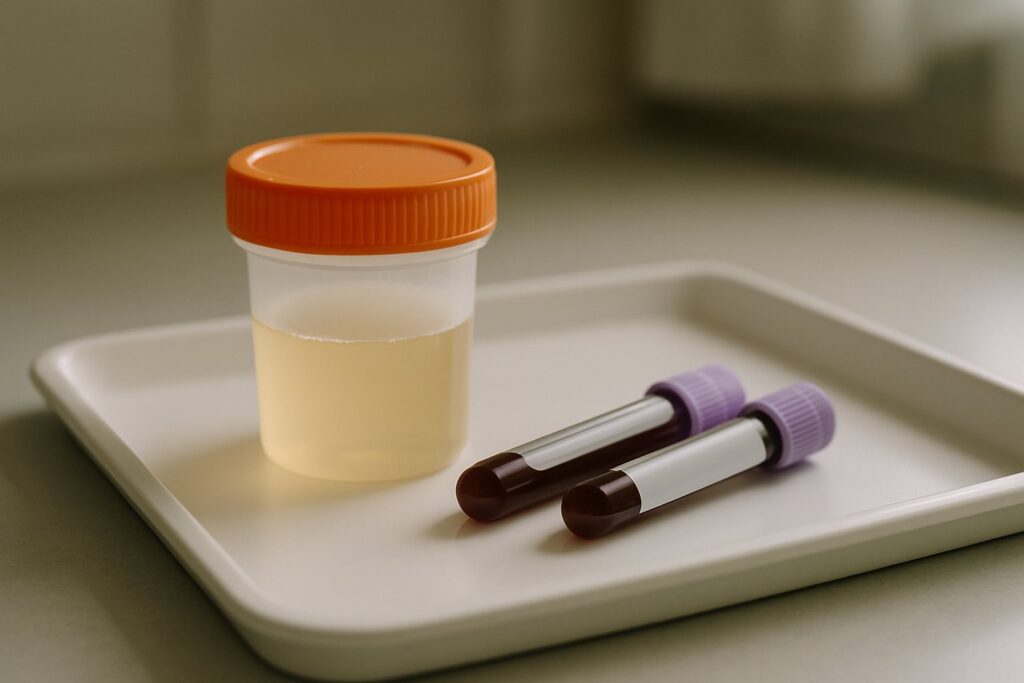
    Urine sample cup and blood tubes side by side on a lab tray

    In short: a “heavy metal panel” usually checks lead, mercury, arsenic and cadmium together. For lead, a blood test is the standard; a lead in urine test is mainly a specialist tool. Arsenic and inorganic mercury are better measured in urine. Hair testing for lead is not recommended by ATSDR, because hair picks up lead from the outside. “Provoked” urine tests taken after a chelating drug are not scientifically validated, according to the American College of Medical Toxicology. The safest route is to ask your doctor to order the test from an accredited lab.

    This guide summarizes official and clinical sources. It is not medical advice: only a health care provider can decide which test you need and what a result means. For urgent questions about a possible poisoning, call Poison Control at 1-800-222-1222.

    What a heavy metal panel usually measures

    MedlinePlus, the National Library of Medicine’s health site, describes heavy metal testing as a group of tests that measure possibly harmful metals in the body. The metals most often tested are lead, mercury, arsenic and cadmium, with chromium sometimes added. A doctor can order a single metal or a group of them, called a heavy metal panel. Blood and urine are the samples used most often.

    Large reference laboratories list what their panels include, and the core four are the same:

    • Blood panel: Mayo Clinic Laboratories’ Heavy Metals Screen, Blood (test ID HMDB) measures arsenic, cadmium, lead and mercury in whole blood.
    • Urine panel: ARUP Laboratories’ Heavy Metals Panel 4, Urine measures arsenic, cadmium, mercury and lead in a 24-hour or random urine sample. Other ARUP panels drop cadmium or add copper and zinc.

    Which sample fits which metal

    Each metal behaves differently, so labs and ATSDR (the federal Agency for Toxic Substances and Disease Registry) use different samples for different metals.

    TestSampleGood forLimits
    Blood lead testVenous blood (blood draw from a vein); finger-stick for screeningRecent or ongoing lead exposure; the standard lead test per CDC and ATSDRShows mainly recent exposure, not where the lead came from; a high finger-stick result needs a venous confirmation
    Heavy metal blood panelWhole bloodLead, mercury, cadmium and arsenic in one drawBlood arsenic shows only very recent exposure; labs prefer urine for arsenic
    Heavy metal urine panel24-hour or random urineArsenic, inorganic and metallic mercury, cadmiumSeafood can raise arsenic; contamination can give false highs; contrast dye in the last 72 hours makes the sample unusable
    Lead in urine test24-hour or random urineSpecialist uses, such as chronic exposure or monitoring treatmentARUP says venous blood lead is the preferred routine test
    Hair or nail testHair cut near the scalp, nail clippingsMethylmercury (hair), past high arsenic exposureATSDR says hair lead is not recommended; outside contamination, no agreed reference ranges
    “Provoked” or “challenge” urine testUrine collected after a chelating drugNothing validatedACMT recommends against it; no reference values, and chelators raise metals in anyone’s urine

    Lead: blood first

    The CDC calls a blood lead test the best way to find out whether a child has lead poisoning. ATSDR’s clinical guidance for doctors says venous blood lead testing is the most useful screening and diagnostic test for recent or ongoing lead exposure. The CDC’s blood lead reference value for children is 3.5 µg/dL. Our blood lead test guide explains finger-stick versus venous samples, and blood lead levels covers what the numbers mean.

    Arsenic: urine

    ATSDR says the urine test is the most reliable test for arsenic exposure within the last few days. ARUP Laboratories lists blood arsenic only for recent (under 24 hours) or large-dose exposure, and calls its urine arsenic test the preferred test for both acute and chronic exposure. Seafood can raise urine arsenic, so ARUP asks patients to avoid shellfish and seafood for 48 to 72 hours before collection. If total arsenic is high, the lab can split the result into its forms, separating the toxic inorganic kinds from harmless organic ones.

    Mercury: depends on the form

    ATSDR explains that urine mercury is used for exposure to metallic mercury vapor and inorganic mercury, while whole blood or scalp hair is used to monitor methylmercury, the form found in fish. Urine is not useful for methylmercury.

    Cadmium: blood or urine

    ARUP’s directory lists urine cadmium for chronic exposure and body burden, and blood cadmium for acute (recent) exposure.

    The lead in urine test: when it is used

    A lead in urine test is not the main lead test. ARUP Laboratories says a urine lead test may be useful for assessing chronic lead exposure or for monitoring chelation therapy, and that for routine testing of lead exposure a venous blood lead test is preferred. ATSDR’s toxicological profile for lead also describes blood as the common measure of absorbed lead.

    ARUP also warns that high urine results may come from skin or collection contamination and should be confirmed with a second specimen. A lead in urine result is for a doctor to read alongside a blood test, not a stand-alone answer.

    Why “provoked” urine tests are not recommended

    Some practitioners offer a “provoked,” “challenge” or “post-chelator” urine test: the patient takes a chelating drug such as DMSA or DMPS, which binds metals, and then collects urine. The results often look alarming. The American College of Medical Toxicology (ACMT), the specialty society for doctors who treat poisonings, has recommended against this test since 2010 and repeated the position in 2017.

    In its 2017 statement in the Journal of Medical Toxicology, ACMT says post-chelator testing has not been scientifically validated, has no demonstrated benefit and may be harmful. There are no accepted normal reference values for urine collected after a chelator, and chelators raise urine metals in healthy people as well as poisoned ones, so a “high” result does not show poisoning. ACMT warns the test can lead to unnecessary, costly and sometimes harmful treatment, and cites deaths after improper use of chelating agents.

    Chelation itself is a medical treatment, not a test and not a detox. The FDA says every FDA-approved chelation product requires a prescription, and that it has never approved any chelation product for over-the-counter use. Whether anyone needs chelation is decided only by a doctor. Our lead poisoning treatment page explains what official guidance describes.

    Hair test for lead: what CDC and ATSDR say

    Hair analysis is painless and widely sold online, but federal health agencies do not support it for lead:

    • ATSDR’s lead course for clinicians (on the CDC site) says that because hair and fingernails are exposed to outside contamination, testing their lead content gives an uncertain estimate of body burden and is not recommended. It cites the CDC and the American Academy of Pediatrics.
    • An ATSDR expert panel on hair analysis (2001) found that metals on hair are hard to separate into what came from inside the body and what landed on it from dust, air or hair products. It also noted a lack of agreed reference ranges, and found an established link between hair levels and health outcomes only for methylmercury.
    • ATSDR’s arsenic fact sheet says hair and nail tests can show high arsenic exposure over the past 6 to 12 months, but cannot predict whether the levels will affect your health.

    At-home heavy metal test kits

    Heavy metal kits sold online usually ask you to mail hair, urine or a few drops of finger-prick blood to a lab. We do not name or recommend any of them, for two reasons, besides the hair problem above:

    • The FDA has warned about some. In its questions and answers on unapproved chelation products, the FDA says companies selling over-the-counter chelation products have also marketed heavy metal urine tests, that these kits are not cleared by the FDA and that they may give false or misleading results.
    • Collection matters. Labs use trace-element-free containers, and the CDC warns that lead on the skin can get into a finger-prick sample and read falsely high.

    Under federal CLIA rules (run by CMS), any lab testing human samples to assess health must hold a CLIA certificate, so if you consider a kit, ask whether the lab is CLIA-certified and which sample it uses for each metal. Even then, a doctor will want a confirmed blood test before acting on a lead result. Home swab and water kits, by contrast, test surfaces and water, not people; see our lead poisoning test guide.

    How to get a heavy metal test through your doctor

    1. Tell your doctor why you are worried. Name the possible source (renovation of an old house, a job with lead, imported spices or remedies, fish, well water) so the right metal and sample are chosen.
    2. Let the doctor choose the test. For lead, that is usually a venous blood lead test. For arsenic or inorganic mercury, often urine. A panel may be ordered when the source is unclear.
    3. Follow the collection instructions. Labs may ask you to skip seafood for 48 to 72 hours before a urine test and to wait at least 72 hours after a scan with contrast dye (Mayo asks 96 hours for its blood panel).
    4. Go over the results together. Reference ranges differ by lab and sample, and a high result is usually confirmed first.

    The CDC says most local health departments can also test children for lead. We do not list prices because they vary by lab, insurer and state.

    If lead is found: look for the source

    A blood test shows that lead got in, not where it came from. After a high result, the CDC says a doctor may recommend finding and removing lead from the home. Common places to look:

    A certified risk assessor can check a home for lead hazards; see find a lead professional. For health questions, start with our lead poisoning hub and lead poisoning symptoms.

    Frequently asked questions

    What does a heavy metal blood test check for?

    Usually lead, mercury, arsenic and cadmium, as in Mayo Clinic Laboratories’ blood screen. A doctor can also order one metal alone.

    Is a blood or urine test better for heavy metals?

    It depends on the metal. Blood is the standard for lead and is used for methylmercury; urine is preferred for arsenic and metallic or inorganic mercury; cadmium can be measured in either.

    Can a lead in urine test replace a blood lead test?

    No. ARUP Laboratories says venous blood lead is preferred for routine testing; urine lead is for specific situations such as monitoring treatment.

    Is a hair test for lead accurate?

    No. ATSDR says hair lead is an uncertain estimate of body burden and is not recommended, because hair picks up lead from outside. Ask for a blood test.

    My provoked urine test came back high. Do I have heavy metal poisoning?

    Not on its own. ACMT says these tests have no valid reference values and that chelators raise urine metals in healthy people too. Ask your doctor about a standard blood or urine test, or a medical toxicologist.

    Should I do a heavy metal detox?

    No product sold over the counter is approved by the FDA for chelation or detox. Chelation is a prescription treatment that only a doctor decides on.

  • Lead Poisoning Treatment: How Doctors Manage High Blood Lead

    Lead Poisoning Treatment: How Doctors Manage High Blood Lead

    Lead poisoning treatment starts with finding the lead and getting the person away from it. For most children and adults with lead in their blood, the CDC’s guidance for health care providers centers on removing the source, repeat blood tests, a healthy diet and close follow-up, with medicine to pull lead from the body (chelation) kept for very high levels and given only by medical professionals.

    A health department nurse visiting a family at home

    In short: there is no home treatment for lead poisoning. If a blood test shows lead, a doctor and often the local health department will look for where it came from, schedule follow-up tests, check diet and development, and in some cases send an inspector to the home. At very high levels, the CDC tells providers to consider hospital care and to consult a medical toxicologist about treatments such as chelation. If you are worried about lead exposure, call your doctor, your local health department or Poison Control at 1-800-222-1222. Call 911 for severe symptoms such as a seizure.

    This page explains what the CDC and its toxic-substances agency ATSDR publish for health care providers. It is not medical advice, and it is not a plan you can follow at home. Only a health care provider who knows the patient can decide on care.

    Step one: find the lead and remove it

    Lead does not leave the body while new lead keeps coming in. That is why every level of the CDC’s recommended actions includes looking for the source. The CDC tells parents that when a child’s blood lead level is above its reference value, follow-up services can include finding and removing lead from the child’s environment, a diet high in iron and calcium, early educational services and follow-up blood testing. The CDC also describes primary prevention, removing lead hazards from the environment before a child is exposed, as the most effective way to protect children. Our lead poisoning hub sums up what the CDC, NIEHS and WHO say about why.

    ATSDR, the CDC’s sister agency for toxic substances, says medical and environmental steps should happen at the same time to best protect a child, and that providers should start a prompt investigation for the source of exposure. In practice, the source is often in the home: deteriorating paint and the dust it makes, water from lead pipes, bare soil, a parent’s work clothes, or an imported spice, remedy or cosmetic. Our guides to lead paint testing, lead in water testing, dust and soil testing and lead in household items explain how each one is checked.

    Do not try to strip or sand old paint yourself to “get rid of” the lead. The EPA warns that renovation can create large amounts of lead dust, and that lead abatement should be done by certified professionals. Find one through our lead professional directory.

    What the CDC recommends at each blood lead level

    The CDC publishes a table of recommended actions for children’s blood lead levels, measured in micrograms per deciliter (µg/dL). Its blood lead reference value is 3.5 µg/dL, the level that marks the top 2.5% of US children aged 1 to 5. The reference value is a screening tool, not a safe line: the CDC says no safe blood lead level in children has been identified. Each row below includes all the actions in the rows above it. We summarize the CDC’s provider guidance as published on its “Recommended Actions Based on Blood Lead Level” page (dated August 21, 2025).

    Blood lead level (µg/dL)What the CDC tells providers to do
    Below 3.5Teach families about lead sources and prevention; check development, diet and nutrition at well-child visits; repeat testing at intervals based on age and risk.
    3.5 to 19All of the above, plus: report to the state or local health department; take an environmental exposure history; arrange an environmental investigation as required where you live; test for and treat iron deficiency; review diet with a focus on calcium and iron; check development and refer for services as needed; schedule follow-up blood tests.
    20 to 44All of the above, plus: a full history and physical exam looking for signs of lead exposure; arrange or refer for an environmental investigation and lead hazard reduction; consider an abdominal X-ray to look for swallowed lead chips or objects; consult a Pediatric Environmental Health Specialty Unit (PEHSU) or Poison Control.
    45 or higherAll of the above, plus: a detailed neurological exam; abdominal X-ray and, if needed, bowel decontamination; hospital admission if the child has symptoms, or if the home is not lead-safe or the source is unknown; consultation with a medical toxicologist or a pediatrician experienced in lead poisoning about decontamination or chelation.

    A finger-prick (capillary) result at or above the reference value is confirmed with a blood draw from a vein, because lead on the skin can make a finger-prick read high. The higher the first result, the sooner the CDC wants that confirmation: within 3 months for 3.5 to 9 µg/dL, within 1 month for 10 to 19, within 2 weeks for 20 to 44, and within 48 hours for 45 or more. Our blood lead test guide explains the two kinds of test and what a result means.

    Case management and the health department

    Once a child’s blood lead level is at or above the reference value, the CDC tells providers to report it to the state or local health department. Many health departments then run what is called case management: a nurse or case worker follows the child, helps the family find and fix the source, and makes sure repeat tests happen. What the health department does, and at what level, is set by each state or city. The CDC’s guidance says environmental investigations should be arranged “as required,” because the rules differ from place to place. It also notes that in housing covered by HUD’s Lead Safe Housing Rule, an investigation may not be triggered below 5 µg/dL.

    An environmental investigation usually means a trained inspector or risk assessor visits the home to look for paint, dust, soil and water hazards, and asks about jobs, hobbies, foods, spices, remedies and cosmetics. If you rent, tell your health department and your landlord; if you own, the investigator’s report tells you which hazards need professional work. For the difference between an inspection and a risk assessment, see lead paint inspection.

    Nutrition: what the CDC says

    The CDC’s advice on food is short and specific: for a child with a blood lead level above the reference value, it lists “a diet high in iron and calcium” among the follow-up services a doctor may recommend. For providers, it adds testing for and treating iron deficiency, reviewing the child’s diet with a focus on calcium and iron, and referring families to nutrition programs such as WIC.

    A good diet supports a child’s health while the source is removed. It is not a treatment that removes lead, and it does not make lead exposure safe. Do not give a child iron, calcium or any other supplement for lead unless the child’s own doctor tells you to; the CDC’s guidance has the provider test for iron deficiency first.

    Chelation: only for high levels, only by medical professionals

    Chelation therapy uses prescription medicine that binds to lead so the body can get rid of it. The CDC says that if a child does have high levels of lead in the blood, they may receive chelation therapy, and its provider guidance places it at 45 µg/dL and above, decided together with a medical toxicologist or a pediatrician experienced in lead poisoning. ATSDR adds that 45 µg/dL is a guideline rather than a fixed threshold, that professional judgment should guide the decision for a child or an adult, and that chelation is not risk free.

    We describe chelation only so you know what a doctor may talk about. It is a hospital or specialist treatment. Products sold online as “detox” or “chelation” for lead are not the same thing, and no official source we use recommends them. If anyone suggests a home lead detox, talk to your doctor or call Poison Control at 1-800-222-1222 first.

    Follow-up blood tests

    Treatment is measured with repeat blood tests. The CDC’s schedule for children after a confirmed venous result is:

    Venous blood lead level (µg/dL)Early follow-upLater follow-up, once levels are falling
    3.5 to 93 months6 to 9 months
    10 to 191 to 3 months3 to 6 months
    20 to 442 weeks to 1 month1 to 3 months
    45 or higherAs soon as possibleAs soon as possible

    The CDC notes that blood lead levels can change with the seasons, and that more time outdoors in summer may call for more frequent checks. ATSDR lists reasons a level may rise again: a source nobody has found yet, incomplete repairs, a hazard that was not controlled, or lead stored in the body moving back into the blood. A level that will not come down is a signal to look again, not a reason to give up.

    Adults and pregnancy

    For adults, most elevated blood lead comes from work, according to NIEHS, in jobs such as construction, mining, welding and battery manufacturing. NIOSH, the CDC’s worker-safety institute, asks people who work with lead to tell their doctor, and describes steps at work, such as changing clothes and showering before going home, that protect both the worker and the family. ATSDR says professional judgment should guide any decision to chelate an adult.

    Lead stored in the bones can move into the blood during pregnancy and reach the baby, the CDC says. If you are pregnant or breastfeeding and think you may have been exposed, talk to your health care provider. Do not start or stop anything on your own.

    Why there is no home treatment

    The CDC says the effects of lead poisoning can be permanent and disabling, and most children with lead in their blood have no obvious symptoms (see lead poisoning symptoms). Treatment cannot undo damage that has already happened, which is why the official focus is on stopping exposure early, supporting the child’s development and checking that levels fall. All of that runs through a doctor and the health department. What you can do at home is the prevention side: wet-clean dust, wash hands and toys, keep children away from peeling paint, use cold tap water for drinking and cooking, and test your home. Our guide to lead and children has the full CDC and EPA list.

    Who to call

    • 911 for severe symptoms such as a seizure, collapse or trouble breathing.
    • Poison Control, 1-800-222-1222, if you think someone swallowed something with lead or you have urgent questions. It is free and answers around the clock.
    • Your doctor or your child’s pediatrician for a blood lead test and follow-up.
    • Your local health department for testing, case management and home investigations.

    Frequently asked questions

    Can lead poisoning be cured?

    Blood lead levels can come down once the source is removed, and doctors can treat very high levels. But the CDC says some effects of lead can be permanent, so the goal is to stop exposure as early as possible. Ask your doctor what to expect for your situation.

    How do you treat lead poisoning at home?

    You don’t. There is no home treatment. At home, you can help by following the health department’s advice to remove lead sources, keeping dust down and making sure follow-up blood tests happen. Any medical treatment comes from a doctor.

    At what level is chelation used?

    The CDC’s guidance for children places it at 45 µg/dL and above, decided with a medical toxicologist or experienced pediatrician. ATSDR calls 45 a guideline, not a fixed rule. The decision belongs to the medical team.

    How long does it take for blood lead levels to go down?

    Official sources do not give one timeline; it depends on the level, how long the exposure lasted and whether the source is gone. That is why the CDC sets follow-up tests from 2 weeks to 9 months apart depending on the result.

    Does eating well lower lead levels?

    The CDC recommends a diet high in iron and calcium for children with elevated blood lead, alongside removing the source. Diet supports the child; it does not remove lead or replace medical follow-up. Don’t give supplements unless your doctor says so.

    Who pays for testing and follow-up?

    The CDC says many private insurance policies cover blood lead testing, and Medicaid covers it for enrolled children. Ask your health department about home investigations and local programs, which vary by state.

  • Lead and Children: Risks, Sources, Prevention and Testing

    Lead and Children: Risks, Sources, Prevention and Testing

    Young children are the people most at risk from lead, because they put their hands and toys in their mouths and because their brains and bodies are still developing. The CDC says no safe blood lead level in children has been identified, and that the most effective protection is to remove lead from a child’s surroundings before exposure happens.

    A family eating a healthy meal together

    In short: the main sources are dust from old paint in homes built before 1978, drinking water from lead pipes and fixtures, soil, and some imported foods, spices, candies, remedies, toys and jewelry. The CDC, EPA and American Academy of Pediatrics (AAP) recommend keeping dust down with wet cleaning, washing hands and toys often, using cold tap water for drinking and baby formula, hiring lead-safe certified contractors for work on older homes, and checking recalls. Most children with lead in their blood look healthy, so a blood lead test is the only way to know. Ask your child’s doctor about testing.

    This page summarizes official guidance. It is not medical advice. If you think your child swallowed something containing lead, call Poison Control at 1-800-222-1222, and call 911 for severe symptoms.

    Why children are most at risk

    The CDC says children younger than 6 are more likely to be exposed because of their hand-to-mouth behavior. They crawl, play on floors and put toys, fingers and other objects in their mouths, picking up lead dust and soil along the way. The EPA calls young children “the most vulnerable” for the same reason.

    The harm is also greater in children. The CDC lists damage to the brain and nervous system, slowed growth and development, learning and behavior problems, and hearing and speech problems, and links these to lower IQ, a shorter attention span and doing less well at school; see effects of lead poisoning. Exposure can begin before birth: the CDC says lead can pass from a pregnant person to the baby, including lead stored in the parent’s bones from earlier exposure.

    The CDC estimates that about 500,000 US children have blood lead levels at or above its reference value of 3.5 µg/dL.

    Where children’s lead comes from

    SourceWhy it matters for childrenOur guide
    Paint and dust in homes built before 1978The CDC says homes built before 1978 probably contain lead-based paint; peeling or cracking paint makes dust that children swallow or breathe inIs lead paint dangerous?
    Drinking waterLead can enter water from lead service lines, solder and fixturesLead pipes
    SoilThe CDC lists soil near airports, highways and factories; the EPA adds soil near building wallsLead in soil testing
    Foods, spices, candies, remedies, cosmeticsThe CDC names some imported candies and traditional remedies; the FDA has issued alerts on ground cinnamon and recalled cinnamon applesauce pouchesLead in cinnamon and spices
    Toys and jewelryThe CDC names some imported toys, antique toys and toy jewelryLead in toys and jewelry
    Dishes and potteryThe FDA warns about some traditional and antique glazed potteryLead in pottery and dishes
    A parent’s job or hobbyLead dust can come home on clothes, shoes and tools (CDC, NIOSH)Lead poisoning

    Prevention steps from the CDC, EPA and AAP

    The CDC calls removing lead hazards from a child’s environment before exposure (“primary prevention”) the most effective way to avoid long-term harm. The AAP’s 2016 policy statement on preventing childhood lead toxicity makes the same point, stressing that there is no identified safe blood lead level and that reducing lead in housing, soil, water and consumer products pays off. These are the everyday steps official sources list; lead poisoning causes and prevention covers the same ground for the whole family.

    At home: dust and paint

    • In homes built before 1978, regularly wet-mop floors and wipe windowsills and other flat surfaces; household dust can be a major source of lead (CDC). Use warm water and an all-purpose cleaner, and never mix ammonia and bleach products.
    • Take shoes off at the door so dust and soil stay outside (CDC).
    • Do not sand, scrape or dry-sweep old paint yourself. For repairs, renovation or painting in pre-1978 homes, hire a firm certified under the EPA’s Renovation, Repair and Painting (RRP) Rule, and keep children and pregnant people away from the work area. See lead-safe renovation (RRP).
    • If your home was built before 1978, the CDC recommends having it checked by a licensed lead inspector. See lead paint inspection and find a lead professional.

    Hands, toys and play

    • Wash children’s hands often, especially before eating and sleeping, and after playing outside or with pets (CDC).
    • Wash toys regularly; they can pick up lead from dust and soil (CDC).
    • Cover bare soil, keep children from playing in it, and use doormats so soil is not tracked indoors (EPA). See dust and soil testing.

    Water and baby formula

    • Use only cold tap water for drinking, cooking and making baby formula; hot water can draw more lead from pipes, and boiling does not remove lead (EPA).
    • If water has been sitting in the pipes, run the tap, take a shower or do laundry first to flush it (EPA). How long depends on whether you have a lead service line.
    • Clean faucet aerators regularly, and if you use a filter, choose one certified to reduce lead and replace cartridges on schedule (EPA). See best water filters for lead and how to test water for lead.

    Food, products and work

    • Check FDA alerts and recalls for foods and spices, and CPSC recalls for toys and children’s products. The CDC also advises not letting children play with toys made before 2009, when tighter federal limits for children’s products began to take effect.
    • Be cautious with imported candies and traditional remedies such as azarcon and greta, which the CDC warns may contain lead.
    • If someone in the home works with lead, they should change clothes and shoes before coming home and wash work clothes separately (CDC).

    Diet

    The CDC says a diet rich in iron and calcium is part of follow-up for children with lead in their blood. Diet does not make lead safe or remove it from the home, and supplements should only be used on a doctor’s advice.

    Screening and testing

    Most children with lead in their blood have no obvious symptoms, so testing is how lead is found. Our blood lead test guide covers it in depth; the key rules are:

    • Medicaid: children enrolled in Medicaid must be tested at 12 and 24 months, and between 24 and 72 months if never tested. A risk questionnaire alone does not meet the requirement (CMS).
    • Other children: the CDC recommends testing children at higher risk, including those who live in or visit pre-1978 homes, children from low-income households, children who are immigrants, refugees or recently adopted from other countries, and children exposed through a household member’s job or hobby. The AAP calls for a lead risk assessment at well-child visits at 6, 9, 12, 18 and 24 months.
    • Results: the CDC’s blood lead reference value is 3.5 µg/dL. It is not a safe level; it flags children with more lead than 97.5% of US children aged 1 to 5.

    States set their own rules too, and some require testing of all young children. Ask your pediatrician or state health department.

    Lead in school and child care drinking water

    Children spend many hours a day at school or child care, and both may have older plumbing.

    • EPA 3Ts program. The EPA’s voluntary 3Ts program (Training, Testing and Taking action) gives schools and child care facilities a toolkit for sampling their taps, reading the results and fixing problems.
    • Lead and Copper Rule Improvements (LCRI). Under the EPA’s final rule from October 2024, community water systems must, starting November 1, 2027, compile a list of the schools and licensed child care facilities they serve. In the first five years, they must sample at least 20% of the elementary schools and child care facilities each year, sample secondary schools on request, and share the results with the facility and health officials. States may waive this where an equally strict state or local program exists. Rules can change, so check the EPA and your water system for the current schedule.
    • AAP recommendation. In its 2016 policy statement, the AAP urged state and local governments to make sure water fountains in schools do not exceed 1 part per billion (ppb) of lead. That is a recommendation, not a federal law.

    Ask your school or child care center whether its taps have been tested, when, and where the results are posted. Some states require testing on their own schedule.

    When to call a doctor or Poison Control

    SituationWho to contact
    Severe symptoms such as seizures, repeated vomiting or loss of consciousness911
    Your child swallowed paint chips, a piece of jewelry or a product that may contain leadPoison Control, 1-800-222-1222
    Your home has old paint, lead pipes or recent renovation, or your child used a recalled productYour child’s doctor or local health department, to ask about a blood lead test
    You want your home checkedA certified lead inspector or risk assessor; see find a lead professional

    More on symptoms is on our lead poisoning symptoms page and the lead poisoning hub.

    Frequently asked questions

    What age is lead most dangerous for children?

    The CDC says children younger than 6 are more likely to be exposed because of hand-to-mouth behavior, and Medicaid requires testing at 12 and 24 months because those are ages of high risk. Exposure before birth also matters.

    How can I protect my baby from lead?

    Official steps include wet-cleaning dust in older homes, washing hands and toys, using cold tap water for drinking and formula, hiring RRP-certified contractors for work on pre-1978 homes, and checking recalls. Ask your pediatrician about a blood lead test.

    Do children with lead poisoning look sick?

    Usually not. The CDC says most children with lead in their blood have no obvious immediate symptoms, which is why testing matters.

    Is there lead in school drinking water?

    It can happen when plumbing or fixtures contain lead. Under the EPA’s 2024 rule, water systems must begin sampling elementary schools and child care facilities from November 1, 2027. Ask your school whether it has tested.

    Should I buy a home test to check my child for lead?

    No home kit tests a child. Blood lead tests are done through a doctor, health department or lab. Home kits test surfaces or water, and each has limits; see our lead test kits guide.

  • Blood Lead Test: How It Works and What Your Results Mean

    Blood Lead Test: How It Works and What Your Results Mean

    A blood lead test measures how much lead is in a person’s blood, and it is the only reliable lead poisoning test: the one way to know whether someone has been exposed. The CDC calls it the best way to find out whether a child has lead poisoning, because most children with lead in their blood look and act healthy.

    Blood sample tubes in a laboratory rack

    In short: the test is a small blood sample, taken either from a finger or heel (capillary) or from a vein (venous). Results come in micrograms of lead per deciliter of blood (µg/dL). The CDC’s blood lead reference value is 3.5 µg/dL, in use since October 2021: a child at or above it has more lead than 97.5% of US children aged 1 to 5. A high finger-stick result should be confirmed with a venous test. Children on Medicaid must be tested at 12 and 24 months, and between 24 and 72 months if never tested. Ask your child’s doctor or your local health department about testing.

    This guide explains what official sources say about the test and the numbers. It is not medical advice, and only a health care provider can interpret a result for you or your child. For urgent questions about a possible poisoning, call Poison Control at 1-800-222-1222.

    What a blood lead test measures

    Lead that is swallowed or breathed in enters the bloodstream. A blood lead test reports the concentration in µg/dL. The CDC says any detectable lead means a child has been exposed, and may still be exposed, and it states that no safe level of lead in children has been identified.

    A blood test shows mainly recent and ongoing exposure. It does not show where the lead came from, so a high result is usually the start of a search for the source, not the end of the story. For that search, see our guides on lead paint testing, lead water testing and dust and soil testing.

    Finger-stick vs venous: the two kinds of sample

    Capillary (finger-stick or heel-stick)Venous (blood draw from a vein)
    How it is takenA prick on the finger or heel; a few drops of bloodA standard blood draw from a vein in the arm
    SpeedOften the first step; can give fast results, including point-of-care tests in the officeResults usually take a few days from a lab
    ReliabilityCan read falsely high if lead on the skin gets into the sampleThe CDC says venous samples are more reliable at identifying lower blood lead levels
    Typical useScreeningConfirming a capillary result at or above the reference value; follow-up

    The CDC advises that when a capillary result is at or above the reference value, a venous sample should be collected to confirm it. If the first test was already venous, no second draw is needed for confirmation. That risk of lead on the skin getting into the sample is the main reason a high finger-stick result is not treated as final.

    The CDC blood lead reference value: 3.5 µg/dL

    The blood lead reference value (BLRV) is how the CDC identifies children with more lead in their blood than most US children. It is 3.5 µg/dL. The CDC lowered it from 5 µg/dL to 3.5 µg/dL in October 2021, based on the National Health and Nutrition Examination Survey (NHANES) cycles from 2015 to 2018. It marks the 97.5th percentile of blood lead levels among US children aged 1 to 5, so a child at or above it is in the top 2.5%.

    Two points are easy to miss:

    • The BLRV is not a safe level and not a health-based standard. The CDC’s 2021 report says plainly that no safe blood lead level in children exists. A result below 3.5 µg/dL does not mean lead can be ignored.
    • The value can change. The CDC says it reviews the latest two NHANES cycles every four years to decide whether to update it. The CDC estimates that about 500,000 US children have blood lead levels at or above the current value.

    Who should be tested, and when

    Children on Medicaid

    Federal Medicaid rules require that all children enrolled in Medicaid receive blood lead screening tests at 12 months and 24 months of age. Any child between 24 and 72 months with no record of a previous blood lead test must also be tested. This applies whether coverage comes through Medicaid (title XIX) or CHIP-funded Medicaid (title XXI). A CMS bulletin from 2016 adds that a risk questionnaire alone does not meet the requirement; the blood test must actually be done. Medicaid covers point-of-care tests drawn in the doctor’s office.

    Other children

    For children not on Medicaid, the CDC recommends testing children at higher risk. It names children who live in or often visit homes or buildings built before 1978, children in low-income households, children who are immigrants, refugees or recently adopted from other countries, and children exposed through a household member’s job or hobby. The American Academy of Pediatrics’ Bright Futures schedule calls for a lead risk assessment at the 6, 9, 12, 18 and 24 month well-child visits, followed by a blood test when the assessment shows risk. Many states set their own rules, sometimes universal testing at certain ages, so ask your pediatrician or state health department what applies where you live.

    Adults and pregnancy

    Adults can be tested too, usually when a doctor suspects exposure from work, a hobby, a home renovation or a contaminated product. NIOSH advises anyone who works with lead to tell their doctor. During pregnancy, the CDC says lead can pass to the baby, and its guidance asks providers to look for the source of exposure when a pregnant or breastfeeding person’s level is 5 µg/dL or higher. If you are pregnant and think you may have been exposed, ask your provider about a test.

    Where to get a lead poisoning test and what it costs

    The CDC says health care providers and most local health departments can test for lead. Many private insurance plans cover it, and Medicaid covers it for enrolled children. We do not list prices because they vary by lab, insurer and state; ask your provider or health department before the test.

    Home swab kits and water kits do not test people. They are for surfaces or water, and our lead test kits hub explains what each kind can and cannot do.

    What your child’s results mean: the CDC follow-up table

    The CDC publishes recommended actions for health care providers based on a child’s confirmed venous blood lead level. This summary is for understanding the conversation with your doctor, not a substitute for it.

    Venous blood lead levelConfirm a capillary result withinFollow-up testing (CDC)Other actions the CDC lists for providers
    Below 3.5 µg/dLNot neededPer the usual age-based schedule (Medicaid: 12 and 24 months)Education about lead sources, developmental checks, diet review
    3.5 to 9 µg/dL3 monthsEarly follow-up at 3 months, later every 6 to 9 monthsReport to the health department, exposure history, environmental investigation as required, check for iron deficiency, review diet and development
    10 to 19 µg/dL1 month1 to 3 months, later every 3 to 6 monthsSame as above
    20 to 44 µg/dL2 weeks2 weeks to 1 month, later every 1 to 3 monthsAbove, plus full history and exam, environmental investigation and hazard reduction; providers may consult a Pediatric Environmental Health Specialty Unit or Poison Control
    45 µg/dL or higher48 hoursAs soon as possibleUrgent medical evaluation; the doctor decides on treatment, which may include hospital care

    For children above the reference value, the CDC says a doctor may recommend finding and removing lead from the home, a diet rich in iron and calcium, early educational services and repeat testing. Treatment decisions are for the child’s doctor; our lead poisoning treatment page explains what official guidance describes. Do not try home remedies or supplements sold to “remove lead.”

    After a high result: finding the source

    In many states, a child’s elevated result is reported to the health department, which may offer a home visit or an environmental investigation. Medicaid also pays for lead investigations in the homes of enrolled children with elevated levels. You can also hire a certified risk assessor; see find a lead professional and lead paint inspection vs risk assessment.

    Common places to look, depending on your home and habits (our lead poisoning causes and prevention page covers each in more depth):

    More on symptoms and health is on our lead poisoning symptoms page and the lead poisoning hub.

    Frequently asked questions

    What is a normal blood lead level?

    There is no “normal” or safe level. The CDC uses 3.5 µg/dL as a reference value to identify children with more lead than 97.5% of US children aged 1 to 5, and it says no safe blood lead level in children has been identified.

    Is a finger-prick lead test accurate?

    It is a good screening test, but it can read high if lead on the skin gets into the sample. The CDC recommends confirming a capillary result at or above 3.5 µg/dL with a venous blood draw.

    At what age should my child get a blood lead test?

    Medicaid requires tests at 12 and 24 months, and between 24 and 72 months if never tested. For other children, the CDC recommends testing those at higher risk, and the AAP calls for a risk assessment at well-child visits from 6 to 24 months. Ask your pediatrician what applies to your child.

    How long do blood lead test results take?

    Finger-stick tests done in the office can give results quickly. Venous samples sent to a lab usually take a few days, according to the CDC.

    Can I test my own blood for lead at home?

    Lead in people is measured with a blood test through a health care provider, a health department or a lab. Home swab kits are for surfaces such as paint, not for people.

    My child’s level is above 3.5 µg/dL. What happens next?

    The CDC recommends confirming the result with a venous test, then follow-up testing, a search for the source and a review of diet and development. Your doctor and local health department will guide the next steps. If your child has severe symptoms, call 911.

  • Lead Poisoning Symptoms in Children and Adults

    Lead Poisoning Symptoms in Children and Adults

    Lead poisoning symptoms are often vague or missing altogether, which is why so many cases are found only through a blood test. The CDC says most children with lead in their blood have no obvious immediate symptoms, and in adults the signs, such as stomach pain, headaches, tiredness or irritability, look like many other everyday illnesses.

    A doctor talking with an adult patient in a clinic

    In short: when symptoms do appear, official sources list stomach pain and cramping, constipation, nausea, headaches, tiredness, irritability, trouble sleeping, poor appetite and, in young children, learning, behavior and development problems. Very high levels can cause vomiting, a staggering walk, seizures or coma. A blood lead test is the only way to know. If someone has severe symptoms such as seizures or repeated vomiting, call 911. For other worries about exposure, call Poison Control at 1-800-222-1222 or talk to a doctor or your local health department.

    This page explains what the CDC, its worker-safety institute NIOSH and the National Institutes of Health (through MedlinePlus) say about symptoms. It is not a diagnosis and not medical advice. Only a health care provider can tell you what a symptom means for you or your child.

    Why lead poisoning is easy to miss

    Lead builds up quietly. It is swallowed or breathed in as dust, chips, soil or contaminated food and water, and much of the harm happens before anyone notices anything. The CDC states plainly that most children with any lead in their blood have no obvious immediate symptoms, and that no safe blood lead level in children has been identified.

    NIOSH makes the same point about adults: lead symptoms are similar to those of other illnesses and may develop slowly, so lead poisoning can be overlooked. A parent may put a toddler’s crankiness down to teething, and an adult may blame stress or poor sleep for headaches and fatigue. That is why doctors rely on a blood lead test, not on symptoms, to find exposure.

    Signs of lead poisoning in children

    The CDC describes the effects of lead in children mainly in terms of how it affects growing bodies and brains, rather than a short checklist of signs. According to the CDC, lead exposure in children can cause:

    • Damage to the brain and nervous system
    • Slowed growth and development
    • Learning and behavior problems
    • Hearing and speech problems

    The CDC links these effects to lower IQ, a shorter attention span and doing less well in school, and notes evidence that childhood exposure can cause harm that lasts. Our page on the effects of lead poisoning explains the longer-term picture.

    MedlinePlus, the National Library of Medicine’s consumer health site, adds symptoms that families sometimes notice day to day. For young children it lists the loss of developmental skills they had already learned, alongside irritability, aggressive behavior, low appetite and energy, trouble sleeping, constipation, and stomach pain and cramping. It also lists anemia (a low red blood cell count), which a doctor can find with a blood test.

    None of these signs, alone or together, proves lead poisoning. They are common in children for many reasons. What they do mean is that if your child has them and also lives in or visits an older home, or may have been around one of the sources on our lead and children page, it is worth asking the pediatrician about a blood lead test.

    Symptoms in adults

    NIOSH, the CDC’s worker-safety institute, splits adult symptoms into two patterns.

    PatternSymptoms NIOSH lists
    High exposure over a short timeMetallic taste; stomach pain, nausea, vomiting; diarrhea or constipation; dehydration, headache, exhaustion, irritability, weakness; loss of appetite; memory loss; pain or tingling in the hands or feet
    Exposure over a long timeStomach pain, nausea and constipation; depression, irritability and mood or behavior changes; distraction and forgetfulness; higher blood pressure
    Other effects NIOSH listsDecreased lung function; bone or tooth loss; more infections in general; fertility problems in men and women

    MedlinePlus also lists headaches, hearing loss, reduced sensations, difficulty getting pregnant and anemia among the symptoms of lead poisoning, and notes that stomach pain and cramping are usually the first sign of a high, toxic dose.

    Adults most often meet lead at work or through hobbies: construction and renovation of older buildings, battery recycling, metal work, firing ranges, stained glass and similar crafts. NIOSH notes that workers can carry lead dust home on clothes, shoes and tools, exposing their families. If you work with lead, NIOSH advises telling your doctor and your family’s doctors.

    Lead in pregnancy

    The CDC says lead stored in a person’s bones from earlier exposure can be released into the blood during pregnancy, and that lead can pass to the baby. It links lead in the blood during pregnancy to a higher risk of miscarriage, of a baby being born too early or too small, and of harm to the baby’s brain, kidneys and nervous system. If you are pregnant or breastfeeding and think you may have been exposed, talk to your health care provider about testing.

    Signs of very high exposure: when it is an emergency

    MedlinePlus lists the signs of very high lead levels as vomiting, a staggering walk, muscle weakness, seizures and coma. These are rare, but they are emergencies.

    SituationWhat official sources say to do
    Severe symptoms, such as seizures, repeated vomiting or loss of consciousnessCall 911 right away (MedlinePlus)
    Other symptoms that might be from lead, or a child swallowed something that may contain leadCall Poison Control at 1-800-222-1222, free and confidential, any time
    You suspect ongoing low-level exposure (old paint, work dust, a recalled product)Contact your health care provider or local health department; an emergency room visit is usually not needed unless the exposure was a high dose (MedlinePlus)

    Poison Control is staffed by specialists who can tell you whether a situation needs urgent care. Keep the number in your phone.

    The only way to know: a blood lead test

    Because symptoms are unreliable, the CDC calls a blood lead test the best way to find out whether a child has lead poisoning, and the best way to assess a person’s exposure in general. Results are given in micrograms of lead per deciliter of blood (µg/dL). The CDC uses a blood lead reference value of 3.5 µg/dL to flag children whose levels are higher than most US children’s, and says any detectable lead means a child has been exposed.

    The CDC says health care providers and most local health departments can do the test, many private insurance plans cover it, and Medicaid covers it for enrolled children. Children on Medicaid are required to be tested at 12 and 24 months, and between 24 and 72 months if they have never been tested. Our blood lead test guide explains finger-stick and venous tests, what results mean and what follow-up the CDC recommends.

    Do not try to treat suspected lead poisoning at home or with supplements or products sold online. Decisions about care belong to a doctor, who can look at the test results, the source of exposure and the whole picture. Our lead poisoning treatment page explains what official guidance says doctors do.

    When to ask a doctor about testing

    The signs of lead poisoning are easy to miss, so risk matters more than symptoms. The CDC recommends that children at higher risk be tested. It names children who live in or regularly visit homes or buildings built before 1978, children in low-income households, children who are immigrants, refugees or recently adopted from other countries, and children who may be exposed through a household member’s job or hobby. Talk to a doctor if:

    • Your home was built before 1978 and has chipping or peeling paint, or has been renovated recently. See is lead paint dangerous?
    • Your home has a lead service line or you are not sure. See lead pipes.
    • Someone in the household works with lead or has a lead-related hobby.
    • Your child used a recalled product, such as the 2023 cinnamon applesauce pouches. See lead in cinnamon and spices.
    • You use imported spices, candies, traditional remedies, cosmetics or glazed pottery that could contain lead. See lead in pottery and dishes.
    • Your child has any of the symptoms above and you want to rule lead out.

    Finding and removing the source

    A blood test tells you whether someone has been exposed; it does not tell you where the lead came from. When a child’s level is at or above the reference value, the CDC says health departments may help find the source, and doctors may recommend removing lead hazards from the home, a diet rich in iron and calcium, early educational services and repeat testing.

    For the home itself, the first steps are usually checking paint, dust, water and soil. Our guides on lead paint testing, lead water testing and dust and soil testing explain the options, and you can find a certified lead inspector or risk assessor for a full investigation. Where lead comes from and how to keep it out of your home is covered in lead poisoning causes and prevention, and more on health is on our lead poisoning hub.

    Frequently asked questions

    What are the first signs of lead poisoning?

    Often there are none. The CDC says most children with lead in their blood have no obvious immediate symptoms. MedlinePlus notes that stomach pain and cramping are usually the first sign of a high, toxic dose. Only a blood lead test can tell.

    What are the symptoms of lead exposure in adults?

    NIOSH lists stomach pain, nausea, constipation, headaches, tiredness, irritability, mood changes, forgetfulness, higher blood pressure, tingling in the hands or feet and fertility problems, among others. Because they resemble other illnesses, tell your doctor if you may have been exposed.

    Can lead poisoning symptoms go away?

    Symptoms can come and go, which is one reason they are unreliable. The CDC says even low levels can affect children and that some effects can last. Ask a doctor about testing and follow-up rather than waiting to see whether symptoms fade.

    How fast do symptoms appear?

    It depends on how much lead and over how long. NIOSH separates short, high exposures, which can cause symptoms such as stomach pain and vomiting, from long, low exposures, which build up slowly. Many children with lead in their blood show nothing at all.

    Who should I call if I think my child swallowed something with lead?

    Call Poison Control at 1-800-222-1222. If your child has severe symptoms such as a seizure, trouble breathing or repeated vomiting, call 911.

    Is there a home test for lead poisoning?

    Lead in a person is measured with a blood test ordered by a health care provider or local health department. Home swab kits are made for surfaces like paint, not for people. Ask your doctor or health department about blood testing.