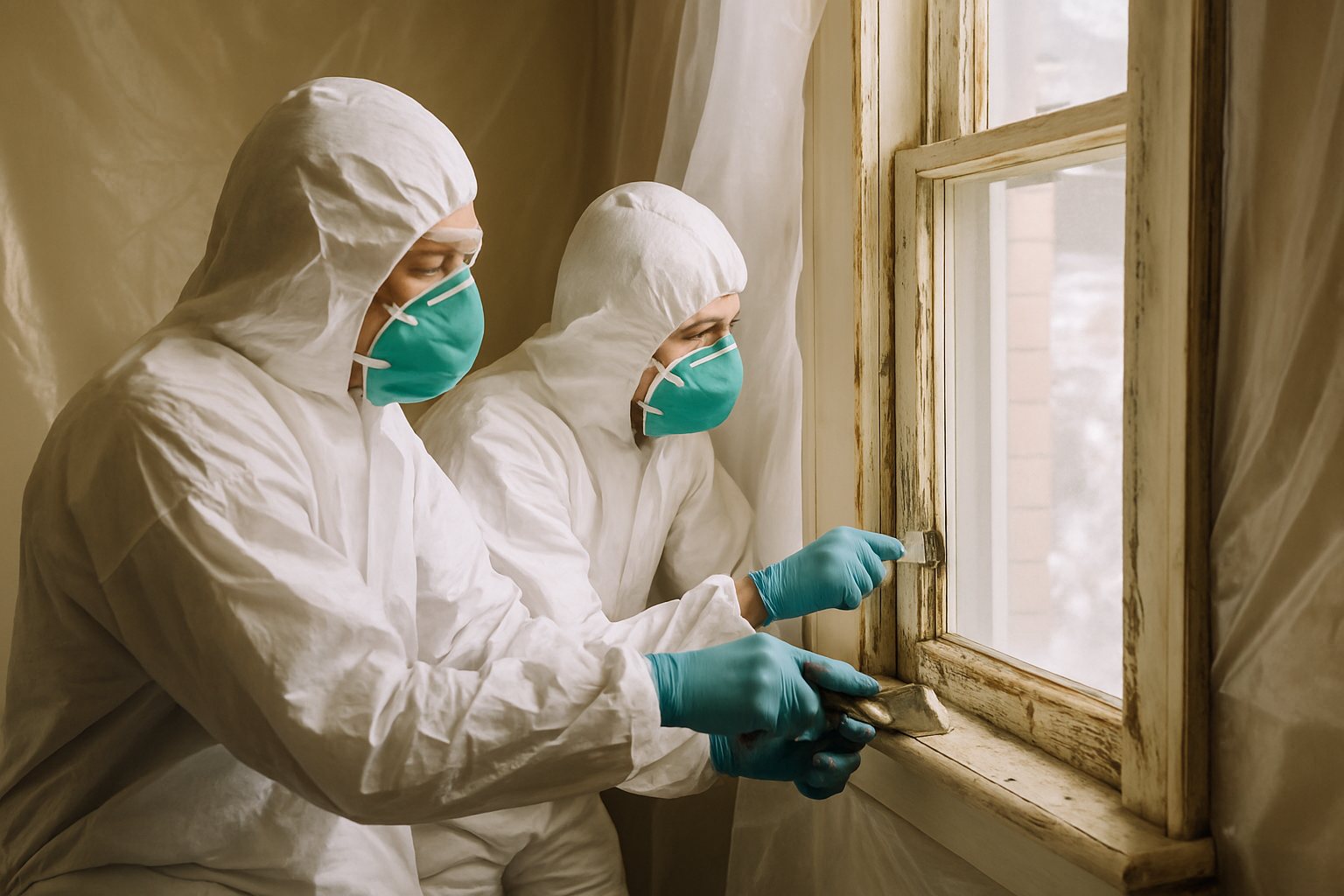
Lead paint removal means getting rid of the hazard for good, either by stripping the paint, replacing the painted parts, or covering it permanently. It is not a weekend sanding job: careless removal can spread lead dust and fumes through a home, which is why federal rules ban the riskiest methods outright. In most cases the right answer is a certified professional, a clear plan and a clearance test at the end.
In short: federal rules split lead paint work into abatement (permanent: removal, replacement, enclosure or encapsulation) and interim controls (temporary: repairs, paint stabilization, specialized cleaning and monitoring). Open-flame burning, torching, and power sanding or blasting without HEPA dust collection are prohibited for professionals, and heat guns must stay below 1,100°F. Contractors paid to disturb paint in pre-1978 homes must be RRP-certified; abatement must be done by certified abatement workers and supervisors. Every abatement ends with a dust clearance test by a certified inspector or risk assessor. Painting over lead paint with ordinary paint is not abatement.
First, do you need to remove it at all?
Not all lead paint has to come off. Under EPA’s definition, lead paint is a hazard when it is deteriorated (cracking, chipping, peeling), when it is on friction or impact surfaces like window sashes and door edges, or when it is on surfaces a child can chew, and when it contaminates dust or soil. Before you spend money, confirm what you have: see how to test for lead paint, and ideally get a risk assessment, whose report lists each hazard with interim control and abatement options in order of priority.
Abatement vs interim controls
EPA defines abatement as any measure designed to permanently eliminate lead-based paint hazards. It includes removing paint and dust, permanently enclosing or encapsulating lead paint, replacing painted surfaces or fixtures, and removing or permanently covering contaminated soil, plus the preparation, clean-up, disposal and post-abatement testing that go with it.
Interim controls are measures designed to temporarily reduce exposure: specialized cleaning, repairs, maintenance, painting, temporary containment, ongoing monitoring, and resident education. They cost less up front but need upkeep.
| Approach | What it means | Permanent? | Good to know |
|---|---|---|---|
| Paint removal (stripping) | Taking the paint off, on site or by removing the part for off-site stripping | Yes (abatement) | Generates the most dust; banned methods apply |
| Component replacement | Replacing old windows, doors or trim with new ones | Yes (abatement) | Removes the lead along with the part |
| Enclosure | Covering with rigid, durable construction materials mechanically fastened in place | Yes, if maintained | The lead stays behind the barrier |
| Encapsulation | Coating with a barrier product made for lead paint | Yes, if maintained | Not for friction or impact surfaces; see lead paint encapsulation |
| Interim controls | Paint stabilization, fixing rubbing doors and windows, wet cleaning, monitoring | No | Needs regular checks and repeat work |
EPA is explicit that painting over hazards with regular paint is not abatement.
Why DIY sanding, scraping and burning are dangerous
Removing paint the usual way turns lead into fine dust and fumes. That is why federal rules for professionals restrict these methods.
For abatement (40 CFR 745.227(e)):
- Open-flame burning or torching of lead-based paint is prohibited.
- Machine sanding, grinding, abrasive blasting or sandblasting is prohibited unless used with HEPA exhaust control that removes particles of 0.3 microns or larger at 99.97% efficiency or better.
- Dry scraping is allowed only with heat guns, around electrical outlets, or for small spots (no more than 2 square feet per room inside or 20 square feet outside).
- Heat guns are allowed only below 1,100°F.
For renovation by paid contractors (40 CFR 745.85), open-flame burning or torching of painted surfaces is prohibited; high-speed machines such as sanders, grinders, power planers, needle guns and blasters are prohibited unless they have shrouds or containment with a HEPA vacuum attachment collecting dust at the source; and heat guns must stay below 1,100°F.
These rules bind professionals, not homeowners working on their own home. But the hazard is the same for everyone. If you do work yourself, EPA’s lead-safe guidance for do-it-yourselfers says to:
- Move furniture and rugs out, seal what stays, cover floors with plastic sheeting, seal doors, and turn off forced-air heating and cooling
- Mist surfaces with water before sanding, scraping, drilling or cutting, to keep the dust down
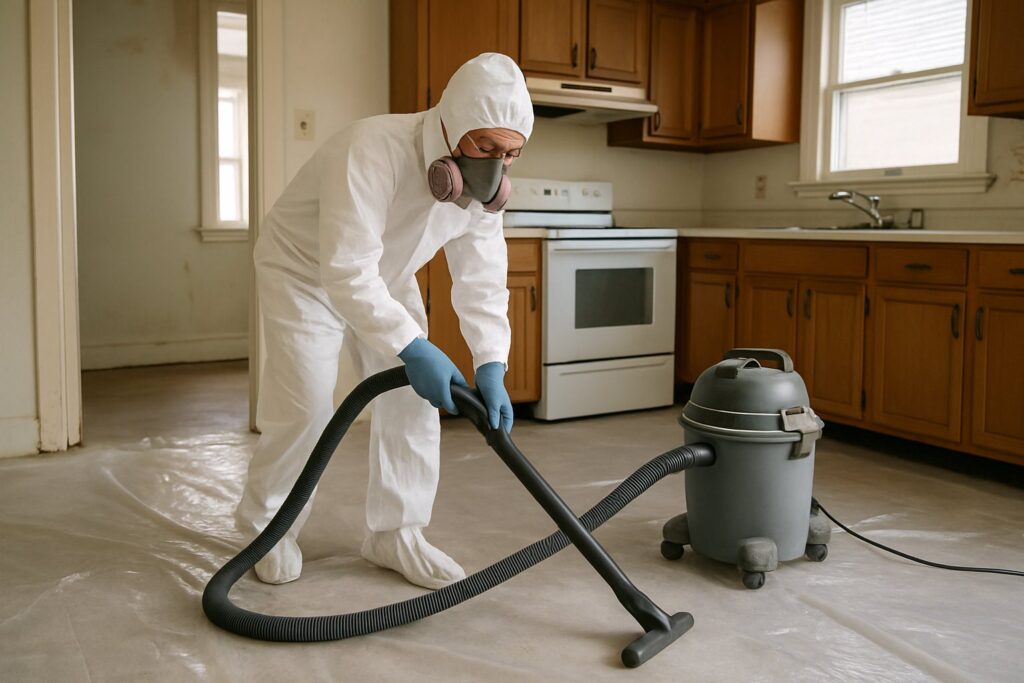
- Vacuum often with a HEPA vacuum, and clean the work area at the end of every day
- At the end, mop floors, wipe walls, HEPA-vacuum every surface, then wipe with wet disposable cloths until they come out clean
- Seal debris in heavy plastic bags, and check state and local disposal rules
- Keep everyone else out of the work area, wash hands and face when you stop, and wash work clothes separately
EPA still recommends hiring a lead-safe certified contractor for this kind of work in pre-1978 homes. If young children or a pregnant family member live in the home, talk to your doctor and see lead and health; only a blood test shows exposure.
The EPA RRP rule: what contractors must do
EPA’s Renovation, Repair and Painting (RRP) rule covers anyone paid to do work that disturbs paint in housing and child-occupied facilities built before 1978, including property management companies that do or offer such work. The firm must be EPA lead-safe certified (sole proprietors included), and the work must be done or directed by a certified renovator using lead-safe practices.
In general, the RRP rule does not apply to homeowners working on their own home. It does apply if you rent out all or part of the home, run a child care center in it, or buy, renovate and sell homes for profit. Small jobs are partly exempt as minor repair and maintenance: 6 square feet or less of painted surface per room inside, or 20 square feet or less outside, as long as no prohibited practices are used and the job is not window replacement or demolition.
RRP work is renovation, not abatement. A renovator works lead-safe so the job does not create a hazard; an abatement contractor is hired specifically to eliminate lead hazards permanently. Read more in lead-safe renovation and the RRP rule.
Professional lead abatement: how it works
Abatement must be done by individuals certified by EPA or an authorized state or tribal program. Under 40 CFR 745.227(e):
- Every project has a certified supervisor, on site during work site preparation and post-abatement clean-up, and reachable within 2 hours at other times.
- Where EPA runs the program, the certified firm must notify EPA at least 5 business days before starting, with a shorter path for work ordered after a child’s elevated blood lead level or an emergency order. States with their own programs may set their own rules.
- A written occupant protection plan describes how residents are kept safe during the work.
- The prohibited practices above apply.
- Removed soil must be replaced with soil at or below 400 ppm lead, as close to local background as practicable.
- An abatement report is prepared by the certified supervisor or project designer.
Families usually stay out of work areas until they pass clearance. HUD-funded programs are strict about this: the City of Warren, Michigan’s lead program guidelines state that federal regulations prohibit occupancy of areas under abatement or interim control work until the entire house passes a clearance examination, and households arrange temporary relocation. Ask your contractor what applies to your job. To compare companies, see lead abatement and find a lead professional.
Clean-up and clearance testing
Clearance is how you know the job is done. After abatement, a certified inspector or risk assessor:
- Does a visual inspection; any remaining deteriorated paint or visible dust, debris or residue must be fixed first
- Waits at least 1 hour after final clean-up, then takes dust samples from floors, interior window sills and window troughs, in at least four rooms, hallways or stairwells (or all of them if there are fewer)
- For exterior work, checks the area below for paint chips on the drip line and next to the foundation
- Compares lab results with EPA’s dust-lead action levels
On or after January 12, 2026, those action levels are 5 micrograms per square foot for floors, 40 for interior window sills and 100 for window troughs, down from 10, 100 and 400. Any area that fails is cleaned again and retested. Keep the clearance report with your inspection records; you will need it if you sell or rent.
How much does lead paint removal cost?
EPA and HUD do not publish a consumer price list for lead paint removal, and costs vary widely with the method, the number of surfaces, access, containment and clearance testing. We could not find a published average we trust, so here is what is documented, checked in October 2026:
- Program caps show the scale of full projects. The City of Warren, Michigan, which runs a HUD-funded lead hazard control program, caps its grant at $75,000 per home, with HUD permission needed to go higher for high-cost units. In its landlord example, $15,000 of abatement work means a $1,500 (10%) owner co-pay. These are program limits and examples, not typical prices.
- Testing is a separate line. Clearance and risk assessment dust samples are billed per sample by labs; an NLLAP-listed lab, the Wisconsin Occupational Health Laboratory, charges $40 per sample at normal turnaround.
Get at least two written quotes from certified abatement firms that name the method for each surface, the containment, who does clearance testing, and what happens if clearance fails. Ask your local health or housing department about HUD-funded lead hazard control grants. Some cities run them for income-eligible households; Warren, for example, gives priority to households with a child who has an elevated blood lead level.
Clean-up tools we checked
A HEPA vacuum is central to EPA’s lead-safe clean-up advice. These two were in stock on amazon.com when checked in October 2026 (limited stock on both); claims about RRP and OSHA compliance are the seller’s, not EPA’s:
Dustless Technologies D1606 HEPA Wet/Dry Vacuum
- Individually tested, serialized HEPA filter
- Listing: certified for lead paint pickup
- About $574, seen October 2026
Dustless Technologies D1618 HEPA Wet+Dry Pro Vacuum, 8 Gallon
- Certified HEPA system per listing
- Wet and dry pickup
- About $313, seen October 2026
EPA’s do-it-yourself guidance names a HEPA vacuum specifically, not an ordinary shop vacuum. For testing before and after work, see lead dust testing.
Frequently asked questions
Can I remove lead paint myself?
On your own home, federal RRP rules generally do not apply to you, but the health risk does. If you do it, follow EPA’s DIY lead-safe steps: contain the area, mist before scraping, never use an open flame or an unshrouded power sander, HEPA-vacuum and wet-clean daily, and keep others out. EPA recommends a lead-safe certified contractor.
Is it illegal to sand lead paint?
For professionals, power sanding lead paint without HEPA dust collection is prohibited in both abatement and RRP work. For homeowners, check state and local rules, and remember that dry sanding spreads lead dust through a home.
What is the safest way to remove lead paint?
There is no single answer; a risk assessor or certified abatement firm chooses per surface. Replacing a part, or enclosing or encapsulating a surface, avoids stripping paint on site. When stripping is needed, the rules limit it to methods such as HEPA-controlled tools and heat guns below 1,100°F, inside containment, followed by clearance testing.
Does painting over lead paint count as removal?
No. EPA says painting over hazards with regular paint is not abatement. Special encapsulant coatings can be part of abatement when used correctly; see lead paint encapsulation.
How do I know the job was done right?
A passing clearance examination by a certified inspector or risk assessor, with dust results below EPA’s action levels. Ask for the clearance report and the abatement report and keep them. Our lead paint testing hub has more on testing after work.