
A heavy metal test measures possibly harmful metals such as lead, mercury, arsenic and cadmium in a sample of blood or urine, and less often hair or nails. Which sample is right depends on the metal: for lead, the CDC and ATSDR point to a venous blood test, while urine is the usual sample for arsenic and for some forms of mercury.
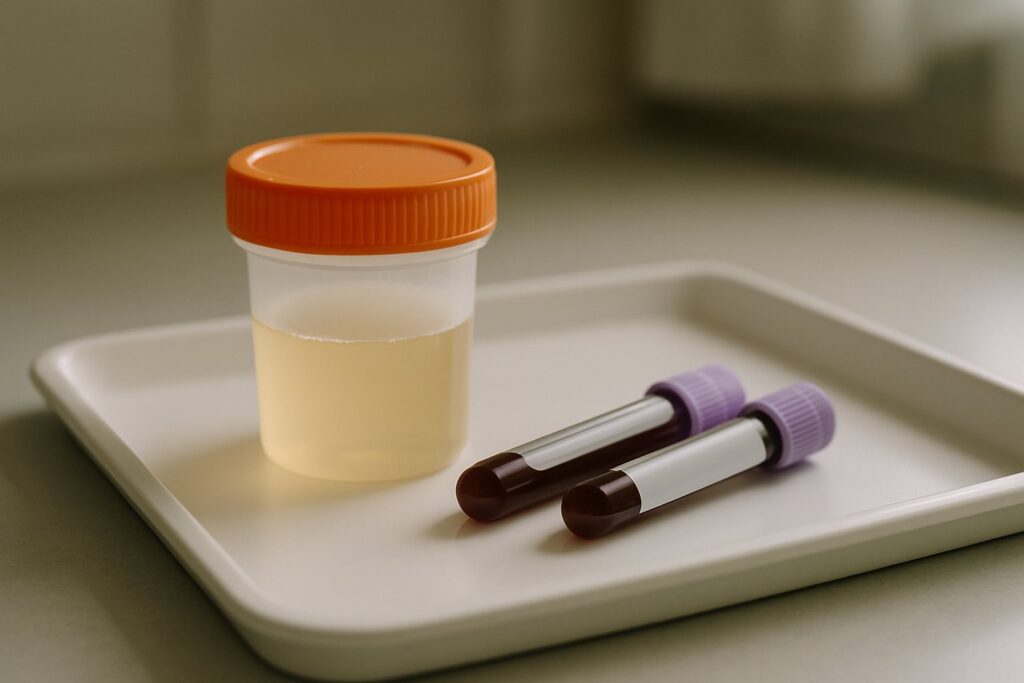
In short: a “heavy metal panel” usually checks lead, mercury, arsenic and cadmium together. For lead, a blood test is the standard; a lead in urine test is mainly a specialist tool. Arsenic and inorganic mercury are better measured in urine. Hair testing for lead is not recommended by ATSDR, because hair picks up lead from the outside. “Provoked” urine tests taken after a chelating drug are not scientifically validated, according to the American College of Medical Toxicology. The safest route is to ask your doctor to order the test from an accredited lab.
This guide summarizes official and clinical sources. It is not medical advice: only a health care provider can decide which test you need and what a result means. For urgent questions about a possible poisoning, call Poison Control at 1-800-222-1222.
What a heavy metal panel usually measures
MedlinePlus, the National Library of Medicine’s health site, describes heavy metal testing as a group of tests that measure possibly harmful metals in the body. The metals most often tested are lead, mercury, arsenic and cadmium, with chromium sometimes added. A doctor can order a single metal or a group of them, called a heavy metal panel. Blood and urine are the samples used most often.
Large reference laboratories list what their panels include, and the core four are the same:
- Blood panel: Mayo Clinic Laboratories’ Heavy Metals Screen, Blood (test ID HMDB) measures arsenic, cadmium, lead and mercury in whole blood.
- Urine panel: ARUP Laboratories’ Heavy Metals Panel 4, Urine measures arsenic, cadmium, mercury and lead in a 24-hour or random urine sample. Other ARUP panels drop cadmium or add copper and zinc.
Which sample fits which metal
Each metal behaves differently, so labs and ATSDR (the federal Agency for Toxic Substances and Disease Registry) use different samples for different metals.
| Test | Sample | Good for | Limits |
|---|---|---|---|
| Blood lead test | Venous blood (blood draw from a vein); finger-stick for screening | Recent or ongoing lead exposure; the standard lead test per CDC and ATSDR | Shows mainly recent exposure, not where the lead came from; a high finger-stick result needs a venous confirmation |
| Heavy metal blood panel | Whole blood | Lead, mercury, cadmium and arsenic in one draw | Blood arsenic shows only very recent exposure; labs prefer urine for arsenic |
| Heavy metal urine panel | 24-hour or random urine | Arsenic, inorganic and metallic mercury, cadmium | Seafood can raise arsenic; contamination can give false highs; contrast dye in the last 72 hours makes the sample unusable |
| Lead in urine test | 24-hour or random urine | Specialist uses, such as chronic exposure or monitoring treatment | ARUP says venous blood lead is the preferred routine test |
| Hair or nail test | Hair cut near the scalp, nail clippings | Methylmercury (hair), past high arsenic exposure | ATSDR says hair lead is not recommended; outside contamination, no agreed reference ranges |
| “Provoked” or “challenge” urine test | Urine collected after a chelating drug | Nothing validated | ACMT recommends against it; no reference values, and chelators raise metals in anyone’s urine |
Lead: blood first
The CDC calls a blood lead test the best way to find out whether a child has lead poisoning. ATSDR’s clinical guidance for doctors says venous blood lead testing is the most useful screening and diagnostic test for recent or ongoing lead exposure. The CDC’s blood lead reference value for children is 3.5 µg/dL. Our blood lead test guide explains finger-stick versus venous samples, and blood lead levels covers what the numbers mean.
Arsenic: urine
ATSDR says the urine test is the most reliable test for arsenic exposure within the last few days. ARUP Laboratories lists blood arsenic only for recent (under 24 hours) or large-dose exposure, and calls its urine arsenic test the preferred test for both acute and chronic exposure. Seafood can raise urine arsenic, so ARUP asks patients to avoid shellfish and seafood for 48 to 72 hours before collection. If total arsenic is high, the lab can split the result into its forms, separating the toxic inorganic kinds from harmless organic ones.
Mercury: depends on the form
ATSDR explains that urine mercury is used for exposure to metallic mercury vapor and inorganic mercury, while whole blood or scalp hair is used to monitor methylmercury, the form found in fish. Urine is not useful for methylmercury.
Cadmium: blood or urine
ARUP’s directory lists urine cadmium for chronic exposure and body burden, and blood cadmium for acute (recent) exposure.
The lead in urine test: when it is used
A lead in urine test is not the main lead test. ARUP Laboratories says a urine lead test may be useful for assessing chronic lead exposure or for monitoring chelation therapy, and that for routine testing of lead exposure a venous blood lead test is preferred. ATSDR’s toxicological profile for lead also describes blood as the common measure of absorbed lead.
ARUP also warns that high urine results may come from skin or collection contamination and should be confirmed with a second specimen. A lead in urine result is for a doctor to read alongside a blood test, not a stand-alone answer.
Why “provoked” urine tests are not recommended
Some practitioners offer a “provoked,” “challenge” or “post-chelator” urine test: the patient takes a chelating drug such as DMSA or DMPS, which binds metals, and then collects urine. The results often look alarming. The American College of Medical Toxicology (ACMT), the specialty society for doctors who treat poisonings, has recommended against this test since 2010 and repeated the position in 2017.
In its 2017 statement in the Journal of Medical Toxicology, ACMT says post-chelator testing has not been scientifically validated, has no demonstrated benefit and may be harmful. There are no accepted normal reference values for urine collected after a chelator, and chelators raise urine metals in healthy people as well as poisoned ones, so a “high” result does not show poisoning. ACMT warns the test can lead to unnecessary, costly and sometimes harmful treatment, and cites deaths after improper use of chelating agents.
Chelation itself is a medical treatment, not a test and not a detox. The FDA says every FDA-approved chelation product requires a prescription, and that it has never approved any chelation product for over-the-counter use. Whether anyone needs chelation is decided only by a doctor. Our lead poisoning treatment page explains what official guidance describes.
Hair test for lead: what CDC and ATSDR say
Hair analysis is painless and widely sold online, but federal health agencies do not support it for lead:
- ATSDR’s lead course for clinicians (on the CDC site) says that because hair and fingernails are exposed to outside contamination, testing their lead content gives an uncertain estimate of body burden and is not recommended. It cites the CDC and the American Academy of Pediatrics.
- An ATSDR expert panel on hair analysis (2001) found that metals on hair are hard to separate into what came from inside the body and what landed on it from dust, air or hair products. It also noted a lack of agreed reference ranges, and found an established link between hair levels and health outcomes only for methylmercury.
- ATSDR’s arsenic fact sheet says hair and nail tests can show high arsenic exposure over the past 6 to 12 months, but cannot predict whether the levels will affect your health.
At-home heavy metal test kits
Heavy metal kits sold online usually ask you to mail hair, urine or a few drops of finger-prick blood to a lab. We do not name or recommend any of them, for two reasons, besides the hair problem above:
- The FDA has warned about some. In its questions and answers on unapproved chelation products, the FDA says companies selling over-the-counter chelation products have also marketed heavy metal urine tests, that these kits are not cleared by the FDA and that they may give false or misleading results.
- Collection matters. Labs use trace-element-free containers, and the CDC warns that lead on the skin can get into a finger-prick sample and read falsely high.
Under federal CLIA rules (run by CMS), any lab testing human samples to assess health must hold a CLIA certificate, so if you consider a kit, ask whether the lab is CLIA-certified and which sample it uses for each metal. Even then, a doctor will want a confirmed blood test before acting on a lead result. Home swab and water kits, by contrast, test surfaces and water, not people; see our lead poisoning test guide.
How to get a heavy metal test through your doctor
- Tell your doctor why you are worried. Name the possible source (renovation of an old house, a job with lead, imported spices or remedies, fish, well water) so the right metal and sample are chosen.
- Let the doctor choose the test. For lead, that is usually a venous blood lead test. For arsenic or inorganic mercury, often urine. A panel may be ordered when the source is unclear.
- Follow the collection instructions. Labs may ask you to skip seafood for 48 to 72 hours before a urine test and to wait at least 72 hours after a scan with contrast dye (Mayo asks 96 hours for its blood panel).
- Go over the results together. Reference ranges differ by lab and sample, and a high result is usually confirmed first.
The CDC says most local health departments can also test children for lead. We do not list prices because they vary by lab, insurer and state.
If lead is found: look for the source
A blood test shows that lead got in, not where it came from. After a high result, the CDC says a doctor may recommend finding and removing lead from the home. Common places to look:
- Old paint and dust in homes built before 1978: lead paint testing and dust and soil testing
- Drinking water from lead pipes or fixtures: lead water testing
- Spices, imported foods and remedies: lead in cinnamon and spices
- Dishes and pottery: lead in pottery and dishes
- A household member’s work or hobby
A certified risk assessor can check a home for lead hazards; see find a lead professional. For health questions, start with our lead poisoning hub and lead poisoning symptoms.
Frequently asked questions
What does a heavy metal blood test check for?
Usually lead, mercury, arsenic and cadmium, as in Mayo Clinic Laboratories’ blood screen. A doctor can also order one metal alone.
Is a blood or urine test better for heavy metals?
It depends on the metal. Blood is the standard for lead and is used for methylmercury; urine is preferred for arsenic and metallic or inorganic mercury; cadmium can be measured in either.
Can a lead in urine test replace a blood lead test?
No. ARUP Laboratories says venous blood lead is preferred for routine testing; urine lead is for specific situations such as monitoring treatment.
Is a hair test for lead accurate?
No. ATSDR says hair lead is an uncertain estimate of body burden and is not recommended, because hair picks up lead from outside. Ask for a blood test.
My provoked urine test came back high. Do I have heavy metal poisoning?
Not on its own. ACMT says these tests have no valid reference values and that chelators raise urine metals in healthy people too. Ask your doctor about a standard blood or urine test, or a medical toxicologist.
Should I do a heavy metal detox?
No product sold over the counter is approved by the FDA for chelation or detox. Chelation is a prescription treatment that only a doctor decides on.