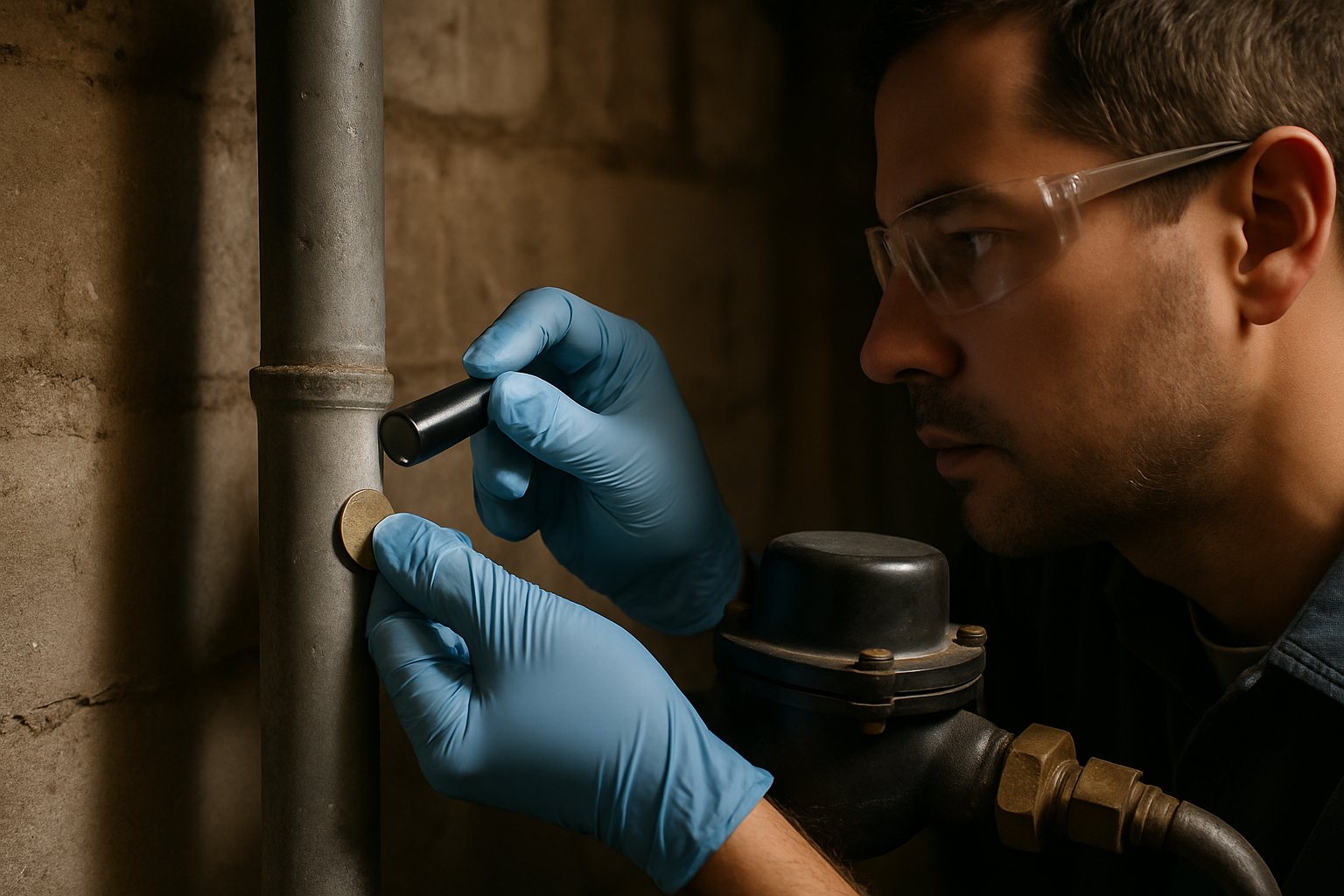
You can usually tell whether you have lead pipes in about five minutes with a coin or key and a fridge magnet: a lead pipe is dull gray, scratches easily to a shiny silver, and a magnet will not stick to it. Check the pipe where your water line enters the house, look up your address in your utility’s service line inventory, and if either points to lead, test your water and use a certified filter until the line is replaced.
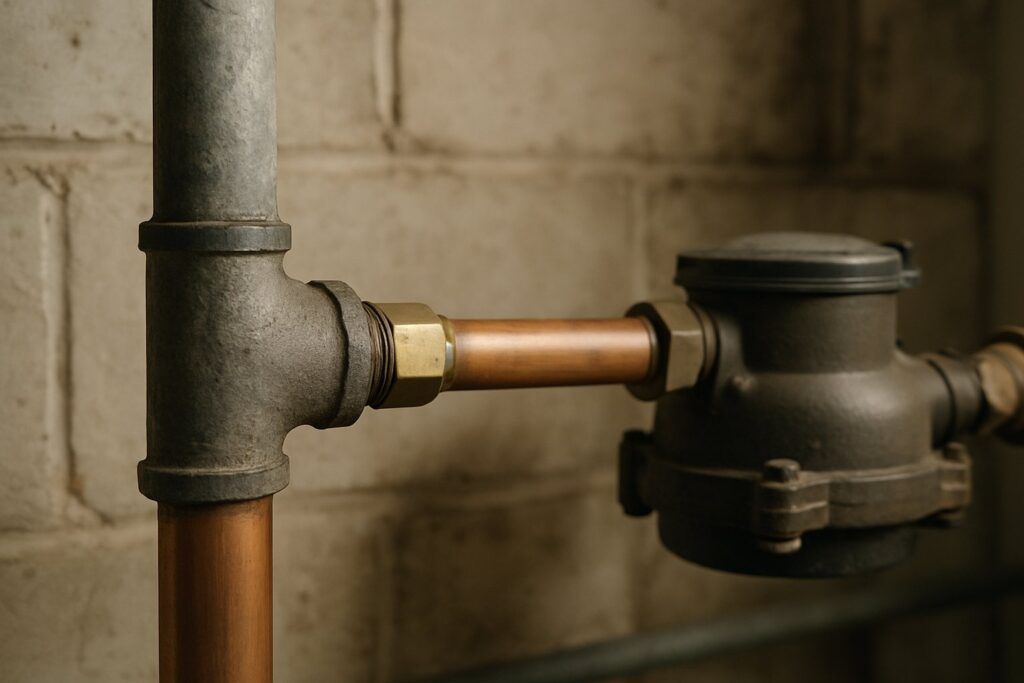
In short: the lead pipe that matters most is the service line, the pipe that brings water from the main in the street to your home. EPA’s latest estimate is about 4 million lead service lines in the US. Homes built before 1986 are the most likely to have lead pipes or lead solder, and older brass faucets can add lead too. Utilities had to publish inventories of their service lines by October 2024 and, under EPA’s 2024 rule, must replace lead lines under their control within 10 years in most cases. Your scratch test is a strong hint, not proof; confirm with your utility, a licensed plumber or a lab water test.
Where lead hides in a home’s plumbing
EPA says lead enters drinking water when plumbing that contains lead corrodes, and that lead service lines are typically the most significant source where they exist. Lead can sit in several places between the street and your glass:
| Where | What to look for | Why it matters |
|---|---|---|
| Service line | The pipe entering through the basement wall or floor, near the meter | Usually the largest source where present (EPA) |
| Lead connector | A short piece of pipe that can join the service line to the main, usually out of sight | Utilities must now list connectors in their inventories |
| Galvanized steel line | Gray, hard-to-scratch pipe a magnet sticks to | Can hold lead on its inner surface if it ever sat downstream of a lead line |
| Lead solder | Dull gray joints on copper pipes in older homes | Allowed until 1986; a common source in homes without lead lines |
| Brass faucets and fittings | Older brass or chrome-plated brass fixtures and valves | EPA names them a common source in homes without lead lines |
How to tell if pipes are lead: the scratch and magnet test
EPA’s customer guide for identifying service lines, which utilities can hand out to customers, lays out a simple check. You need a key or a coin and a magnet.
- Find your water meter. Inside, it is usually in the basement, crawl space or garage. Outside, it sits between the street and the house, on the sidewalk or in the yard.
- Find the service line. If the meter is inside, the line enters on the same wall near the meter. If the meter is outside, the line most likely enters at the point closest to it. If you can’t see the pipe, call your utility.
- Scratch gently with the coin or key, close to where the pipe comes through the wall or floor.
- Try the magnet. See whether it sticks.
- Take a photo. EPA’s template suggests utilities let customers send in a picture of the pipe, whatever they find, so the utility can verify it.
| Pipe material | After scratching | Magnet |
|---|---|---|
| Lead | Shiny silver; soft and easy to scratch | Does not stick |
| Copper | Penny color; may have a green to dark brown film | Does not stick |
| Galvanized iron or steel | Stays silver or gray; hard to scratch | Sticks |
| Plastic | Usually white or gray (other colors exist) | Does not stick |
Notice that a magnet does not stick to copper either, so the color of the scratch is what separates lead from copper. Be gentle: you only need to expose a small patch, and you should never dig into a pipe hard enough to damage it. EPA also offers an interactive version of this check called Protect Your Tap, at epa.gov/pyt, in English, Spanish and Portuguese.
Limits of a home check
The scratch test only shows the few inches of pipe you can see. A service line can be copper where it enters the house and lead under the yard, or lead on the utility’s side of the curb and copper on yours. Plastic pipe tells you nothing about your faucets and solder, which can still contain lead. So treat a home check as one clue, and combine it with your utility’s records and a water test.
Check your utility’s service line inventory
Under EPA’s Lead and Copper Rule Revisions, every community water system had to build an initial inventory of all service lines, whoever owns them, by October 16, 2024. Each line is listed as lead, non-lead, galvanized requiring replacement (GRR) or unknown. Systems serving more than 50,000 people must post the inventory online, and the public version must include a location identifier for each lead and GRR line. Many large utilities offer an address lookup map; Chicago’s, for example, is linked from its Lead Safe Chicago site.
The 2024 Lead and Copper Rule Improvements (LCRI) go further. Utilities must produce an updated “baseline” inventory, including lead connectors, by November 1, 2027, update it every year, and resolve every “unknown” line by their replacement deadline. Customers served by a lead, GRR or unknown line must be notified every year, and the notice has to explain how to tell the utility if you think your line is listed wrong. Under the improved rule, utilities must respond to those inquiries within 60 days.
If your line is listed as “unknown,” your scratch test and photo can help the utility classify it. If it is listed as lead or GRR, ask when it is scheduled for replacement and whether there is any cost to you.
Which homes are most likely to have lead pipes?
Age and location are the best predictors. EPA says lead pipes are more likely in older cities and homes built before 1986. That was the year Congress amended the Safe Drinking Water Act to limit “lead free” pipes to no more than 8% lead and solder and flux to no more than 0.2%. In 2011, the Reduction of Lead in Drinking Water Act lowered the limit for pipes, fittings and fixtures to a weighted average of 0.25% lead on surfaces that touch water. EPA’s 2020 rule required makers and importers to certify their products meet that standard, with certification required since September 1, 2023.
Lead service lines are not spread evenly. EPA’s November 2025 update, based on utilities’ own inventories, counts about 3 million reported lead service lines plus about 1 million “unknown” lines predicted to be lead, for an estimated 4 million nationwide. That replaced an earlier estimate of about 9 million, which some groups, including NRDC, have questioned. Chicago’s lead program site notes that service lines there were mostly made of lead until 1986.
Lead solder and brass fixtures
Even with a copper or plastic service line, an older home can have lead inside. EPA says that in homes without lead service lines, the most common problems are brass or chrome-plated brass faucets and plumbing with lead solder. Solder joints are hard to judge by eye, and you should not scrape them. If your copper plumbing predates 1986 or your faucets are old brass, a lab water test is the practical way to find out whether they are adding lead. Replacing an old kitchen faucet with a certified lead-free model is one of the simpler fixes a plumber can make.
I think I have lead pipes. What now?
- Call your utility. Report what you found, ask how your line is listed and when it will be replaced, and ask about free testing and filters. Some utilities, such as Denver Water, provide free filter pitchers to customers with a known or suspected lead line.
- Test your water with a certified lab. Our guide on how to test water for lead explains first-draw sampling, and best lead water test kits compares the options.
- Filter drinking and cooking water with a filter certified to NSF/ANSI 53 for lead (EPA’s consumer tool also looks for NSF/ANSI 42 Class I particulate reduction). See lead water filters and best water filters for lead.
- Use cold water only for drinking, cooking and baby formula, and run the tap before use when water has been sitting. EPA says boiling does not remove lead.
- Clean faucet aerators regularly, since lead particles can collect there.
- Plan for replacement. Read lead service line replacement for who pays, how it works and what to do afterward.
- Ask about health. If children or anyone pregnant live in the home, talk to your doctor about a blood lead test. More in lead and health.
Brita Elite Replacement Filter, 1 Pack
- OB06 on NSF's lead listing with Tidal and Pacifica pitchers
- 120 gallons or about 6 months
- About $20, seen October 2026
Tap Score Lead & Copper in Water Test Kit
- Sample goes to a lab for analysis
- Prepaid return shipping
- About $59, seen October 2026
Brita says its Elite filter’s NSF/ANSI 53 lead certification applies in the pitcher models listed on its performance data sheet, so check your pitcher. A mail-in kit is a convenient way to reach a lab; your utility or state-certified lab may test for less.
Replacing lead pipes
Filters and flushing reduce exposure, but removing the lead is the lasting fix. Under the LCRI, utilities must fully replace lead and GRR service lines under their control within 10 years in most cases, with most requirements starting November 1, 2027. EPA’s rule generally bans partial replacements, where only one side of the line is changed, except during emergency repairs or planned infrastructure work, because cutting a lead line can release lead for a period afterward.
Federal money is available: the Bipartisan Infrastructure Law put $15 billion into the Drinking Water State Revolving Fund for lead service line replacement, with 49% to be passed on as grants or forgivable loans, and EPA says the funding can cover the entire line from the main to the home’s plumbing regardless of who owns the property. Some cities replace lines at no direct cost; others share the cost with owners. Interior plumbing such as solder and faucets is the owner’s job; for that, hire a licensed plumber and, for a full home assessment, see find a lead professional.
For everything about water and lead in one place, start at our lead water testing hub.
Frequently asked questions
How can I tell if my pipes are lead?
Gently scratch the pipe where it enters your home with a coin or key and hold a magnet to it. If the scratch turns shiny silver and the magnet doesn’t stick, EPA’s guide says it is likely lead. Confirm with your utility’s inventory or a plumber.
Are lead pipes in a house still common?
EPA estimates about 4 million lead service lines remain in the US, based on 2025 inventory data. They are most likely in older cities and in homes built before 1986.
Is it safe to shower if I have lead pipes?
EPA considers bathing and showering safe because skin does not absorb lead in water. The concern is water you drink or cook with.
Do galvanized pipes contain lead?
Galvanized steel is not lead, but EPA notes that lead can attach to its inner surface if the pipe is or ever was downstream of a lead service line, and be released over time. That is why such lines are classed as “galvanized requiring replacement.”
Does a water filter make lead pipes safe?
A filter certified to NSF/ANSI 53 for lead, used and replaced as directed, reduces lead in the water that passes through it. It does not remove the pipe, so keep using it until the line is replaced and a test confirms the fix.
Who pays to replace a lead service line?
It depends on your utility and local rules. Some programs, such as Denver Water’s, replace lines at no direct cost to the customer; others share costs. Ask your utility, and see our replacement guide.