This article contains affiliate links: if you buy through them we may earn a commission, at no extra cost to you. Read our affiliate disclosure.
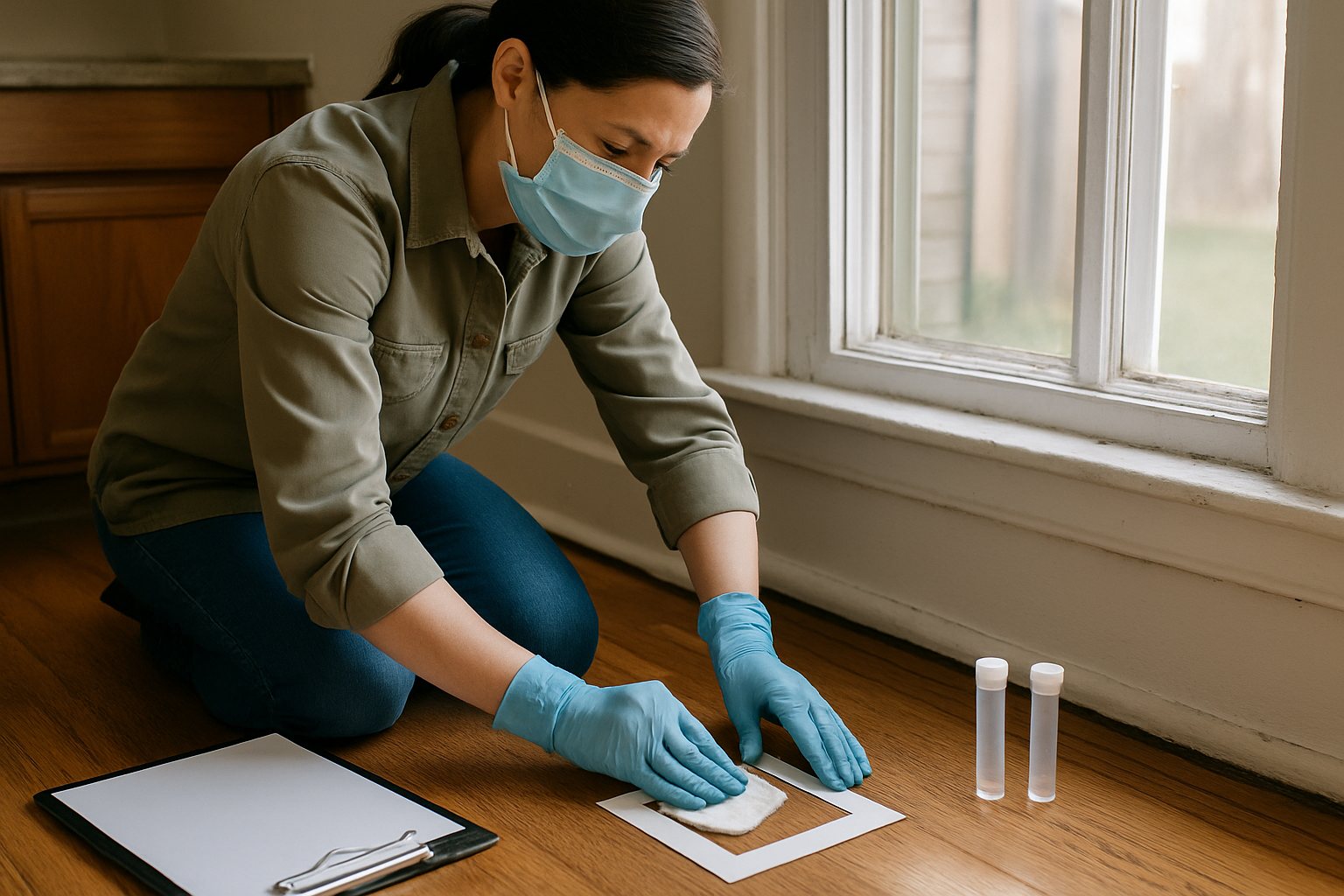
A lead dust test is a wipe sample: a special moist wipe is pressed over a measured patch of floor, window sill or window trough, sealed in a tube and sent to a laboratory that reports how many micrograms of lead were on each square foot. It is the most direct way to find out whether the lead in an older home is actually reaching the places children crawl and put their hands.
In short: since January 12, 2026, in states where EPA runs the lead program, any lead a recognized laboratory can report in floor or window sill dust counts as a dust-lead hazard during a risk assessment, and work after an abatement only passes clearance below 5 µg/ft² on floors, 40 µg/ft² on window sills and 100 µg/ft² in window troughs. You can collect a wipe yourself with a mail-in kit for your own information, but only a certified risk assessor or inspector can produce an official result. Send any sample to a lab in EPA’s National Lead Laboratory Accreditation Program (NLLAP).
Any reportable level of lead in floor or window sill dust is now a dust-lead hazard. Source: EPA, 40 CFR 745.65 and 745.227
Why lead dust matters more than the paint you can see
Lead paint in good condition on a wall is not usually the problem by itself. The trouble starts when paint wears, chips or is disturbed, and the fine dust settles on floors and sills. In its 2024 dust rule, EPA describes young children swallowing dust from floors and surfaces through normal hand-to-mouth behavior as the main pathway of lead exposure for young children. CDC says the most common source of lead exposure in young children is lead dust, and NIEHS says dust is the most common way people in the US are exposed to lead.
Window areas get extra attention because opening and closing old windows grinds painted surfaces together. EPA’s homeowner guidance points to surfaces with constant friction, like doors and window sills, as places where old paint produces chips and dust. EPA estimates that about 31 million US homes built before 1978 still contain lead-based paint, and that 3.8 million of them have at least one child under six living there.
If you are worried that a child has already been exposed, a dust test of the home does not answer that question. Only a blood lead test does. Talk to your child’s doctor or your local health department, and see our guides to the blood lead test and lead poisoning.
EPA dust-lead standards in 2026
EPA uses two kinds of dust numbers, and they do different jobs. The first decides whether there is a hazard in a home during a risk assessment. The second decides whether an abatement job is finished. EPA’s final rule of November 12, 2024 changed both. The rule took effect on January 13, 2025, and the new values apply from January 12, 2026 in the states and territories where EPA administers the program.
| What it is for | Surface | Before January 12, 2026 | From January 12, 2026 |
|---|---|---|---|
| Dust-lead hazard (now called the dust-lead reportable level) | Floors | 10 µg/ft² | Any reportable level from an NLLAP-recognized lab |
| Dust-lead hazard | Interior window sills | 100 µg/ft² | Any reportable level from an NLLAP-recognized lab |
| Clearance after abatement (dust-lead action level) | Floors | 10 µg/ft² | 5 µg/ft² |
| Clearance after abatement | Interior window sills | 100 µg/ft² | 40 µg/ft² |
| Clearance after abatement | Window troughs | 400 µg/ft² | 100 µg/ft² |
Source: 40 CFR 745.65 and 745.227 and EPA’s hazard standards page. µg/ft² means micrograms of lead per square foot of surface.
“Any reportable level” is not a fixed number set by EPA. It is the lowest amount the laboratory can reliably report, so it depends on the lab and the size of the area wiped. EPA says the new action levels are the lowest levels that can be reliably and quickly measured in laboratories, and that they match standards New York City put in place in 2021.
Two cautions. First, most states run their own EPA-authorized lead programs, and they have two years from the rule’s effective date to update their rules, so check your state program for the values it uses today. Second, EPA’s rules do not force owners to test their homes. They set the numbers that certified professionals must use when they do. Other rules, such as HUD’s requirements for assisted housing and some local laws, can require testing.
How a dust-wipe sample is taken
Professionals follow a documented protocol. EPA’s rules accept the HUD Guidelines for the Evaluation and Control of Lead-Based Paint Hazards in Housing, EPA methods and equivalent methods, and the federal definition of a wipe sample points to two ASTM standards: E1728 for how to collect it and E1792 for the wipe material. EPA and HUD’s Lead Dust Sampling Technician Field Guide sums up the steps:
- Mark the area. Use a clean 12 x 12 inch template, a disposable template or tape. On floors the tape forms a square; on sills and troughs it runs across the sill. Nobody touches the area inside.
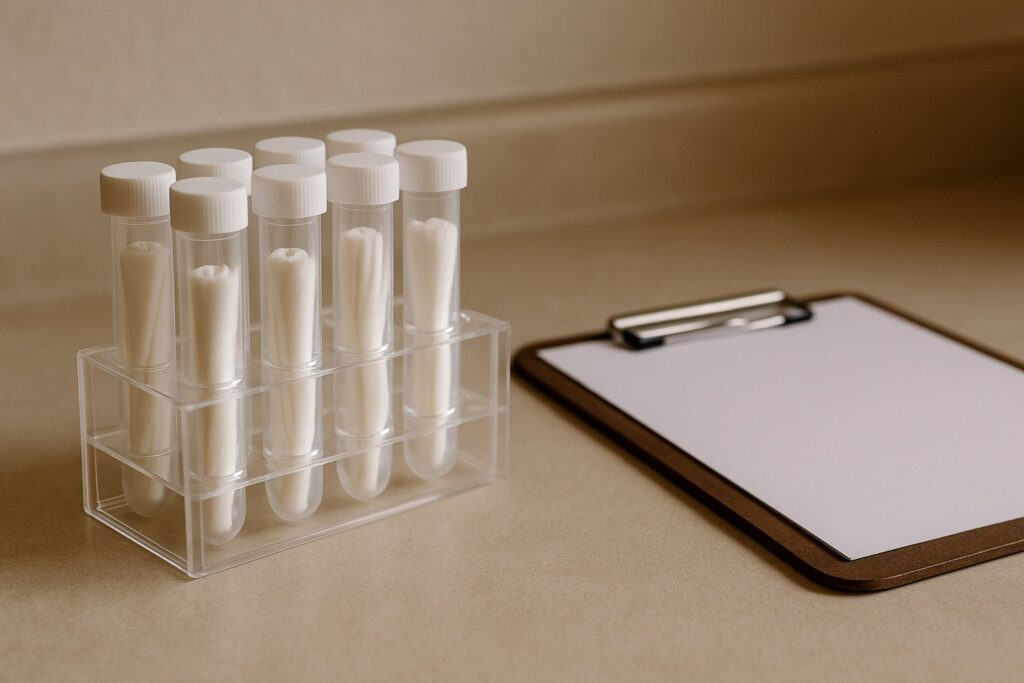
- Label the tube. Each sample gets an ID number recorded on the sample form and the chain-of-custody form.
- New gloves for every sample. After putting them on, touch nothing but the wipe.
- Wipe in three passes. Start at an upper corner and wipe side to side in S-shaped strokes without crossing the edge. Fold the wipe dirty side in and wipe again front to back. Fold again and go over the edges and corners.
- Seal and measure. Fold the wipe with the sample side in, place it in the tube and cap it. If no template was used, measure the length and width to the nearest 1/8 inch so the lab can convert the result to µg/ft².
- Send it to an NLLAP lab recognized for dust wipes.
Samples can be single-surface (one wipe per surface) or composite (several areas in one tube). The field guide recommends single-surface sampling when you want results for specific surfaces, and notes that HUD discourages composite sampling when clearing federally assisted housing. For clearance after renovation, the guide calls for one window sill and one floor sample in each room, hallway or stairwell of the work area (up to four), a window trough sample if the windows were not closed and covered, and one floor sample just outside the work area.
Note that this 2009 field guide prints older clearance numbers. Use the 2026 values in the table above, or the values of your state program.
Where dust samples are taken in a risk assessment
In a home risk assessment, federal rules require dust samples from interior window sills and floors in the living areas where children under six are most likely to come into contact with dust. In apartment buildings and child-occupied facilities, common areas are sampled too. A risk assessment also looks at deteriorated paint and bare soil, so dust results arrive in context. See lead paint inspection vs risk assessment for how the visit works.
DIY wipe kits vs a certified risk assessor
Mail-in dust kits let you take wipes yourself and pay a lab to analyze them. They can be useful for a parent who wants a first look, or for checking a room again after cleaning. They are not the same as a professional evaluation:
| Mail-in wipe kit | Certified risk assessor or inspector | |
|---|---|---|
| Who collects | You, following the kit’s instructions | A certified professional following a documented protocol |
| Lab | Whatever lab the kit uses; check it is NLLAP-recognized for dust wipes | Must be an EPA-recognized lab |
| What you learn | Lead per area on the spots you chose | Dust, paint and soil hazards, their sources and options to fix them |
| Official uses | For your information only | Risk assessments, abatement clearance, programs that require a certified report |
Most kits fail on technique, not chemistry. Wipe a measured area, record its size, use a new glove for each sample and do not let the wipe touch anything else. Your results are only as good as that area measurement, because the lab divides the lead found by the area you report.
Mail-in kits checked on Amazon on October 9, 2026 (In Stock that day; the price and stock can change):
Schneider Labs Lead Test Kit: Paint, Dust or Soil (1 sample)
- 1 paint, dust or soil sample
- Lead by EPA Method 7000B
- Results 5 business days after arrival
SimpleLab Lead Dust Surface Wipe Test, 4-Pack
- 4 surface wipe samples, mailed together
- EPA 7000B analysis
- Report in 5 business days
D-Lead Surface Wipes for Lead Dust Cleanup, 48 ct
- 48 wipes, 9 x 12 in
- Listed as meeting EPA wet cleaning cloth definition
- Cleanup, not a test
Schneider Laboratories, Inc. of Richmond, Virginia is on EPA’s NLLAP list for paint chips, soil and dust wipes. SimpleLab’s listing does not name the laboratory that analyzes its dust wipes, so ask before you buy if NLLAP recognition matters to you. The D-Lead wipes are for cleaning surfaces, not for measuring lead. Do not use a color-change paint swab on dust: EPA recognizes those kits only for paint on certain surfaces. Our home test vs lab testing guide explains the difference.
Finding an NLLAP laboratory
EPA’s National Lead Laboratory Accreditation Program recognizes labs that show they can accurately analyze lead in paint chips, dust and soil. A lab can be recognized for one, two or all three. EPA’s list, updated monthly, shows each lab’s city, phone, accrediting body, whether it is open to the public, and which of the three sample types it covers. Look for an X in the Dust Wipes column.
Some labs sell directly to homeowners. For example, the Wisconsin Occupational Health Laboratory in Madison lists $40 per sample for lead in soil, paint or dust wipes at normal turnaround (about 7 working days), with faster options at $60 and $80 (checked October 9, 2026). The National Lead Information Center at 1-800-424-LEAD (5323) can also help you find a recognized lab or a certified professional.
Reading your results
- Check the units. Results should be in µg/ft². If the report shows only micrograms per wipe, divide by the area wiped in square feet.
- “Below reporting limit” means the lab could not reliably measure lead on that wipe. It is the best result you can get.
- Any reported lead on a floor or sill would count as a dust-lead hazard in a federal risk assessment from 2026. That does not mean an emergency, but it does mean the dust is worth tracking to its source.
- Compare surfaces. High window troughs with low floors point to windows. High floors near an entrance can point to soil tracked in. See our lead in soil testing guide.
What to do if your dust has lead
- Get the source found. A certified risk assessor can tell you whether the dust comes from windows, friction surfaces, deteriorated paint or soil, and lay out options. Use our find a lead professional page.
- Clean wet, not dry. EPA advises wiping sills and surfaces with a damp cloth or paper towel and wet mopping hard floors. Where there is visible dust or debris from chipping paint, it says to use only vacuums with HEPA filters and not to dry sweep.
- Don’t sand or scrape old paint yourself. Renovation work in pre-1978 homes can create far more dust. Read lead-safe renovation (RRP) before any project.
- Consider a permanent fix. Lead abatement by a certified firm ends with clearance testing at the new 5/40/100 levels.
- Talk to a doctor about a blood lead test for young children or anyone pregnant in the home.
For the bigger picture on dust and soil, go back to our lead dust and soil testing hub.
Lead dust test FAQ
What is a safe level of lead dust?
EPA does not call any level safe. Its 2024 rule recognizes that there is no safe level of lead in blood, and from 2026 any lead a recognized lab can report on floors or sills counts as a hazard in a federal risk assessment. The 5, 40 and 100 µg/ft² figures are clearance levels for finishing abatement work.
Can I do a lead dust wipe test myself?
Yes, with a mail-in kit, for your own information. Wipe a measured area and send it to an NLLAP-recognized lab. For official purposes, such as a risk assessment or clearance after abatement, a certified professional must collect the samples.
Can a lead swab test dust?
Not reliably. EPA recognizes the LeadCheck, D-Lead and Massachusetts kits only for paint on specific surfaces. Dust needs a wipe sample analyzed by a laboratory.
How long do results take?
It depends on the lab. The kits and lab above list from the next working day (paid rush) to about 7 working days after the sample arrives, plus shipping time.
Do the 2026 dust levels apply in my state?
They apply now in states where EPA runs the program: Alaska, Arizona, Florida, Idaho, Montana, Nevada, New Mexico, New York, South Carolina, South Dakota and Wyoming, plus some territories and most Tribal lands. Other states run their own programs and have two years from January 13, 2025 to adopt them. Ask your state lead program.
Worried someone has been exposed to lead?
Testing your home finds the source; only a blood lead test shows whether a person has lead in their body. Here is how to get tested, and what the numbers mean.
How to test for lead poisoningBlood lead levels explainedLead screening for childrenTesting for adultsSymptoms
Leave a Reply