This article contains affiliate links: if you buy through them we may earn a commission, at no extra cost to you. Read our affiliate disclosure.
The only way to know whether there is lead in your tap water is to test it, because lead has no color, taste or smell. Start by calling your water utility, which may test for free and can tell you whether your home has a lead service line, then send a properly collected sample to a state-certified drinking water laboratory if you need a firm number. EPA puts the cost of a certified lab test at roughly $15 to $100.
In short: ask your utility first, collect a “first-draw” sample from water that has sat in the pipes for at least six hours, and use a certified lab for a result you can act on. Home kits and strips can screen, but they are not a laboratory result. Compare your number with EPA’s lead action level, which is 15 parts per billion (ppb) today and drops to 10 ppb from November 1, 2027, and remember that EPA’s health goal for lead is zero. While you wait, use only cold water for drinking and cooking, run the tap before use, and consider a filter certified to NSF/ANSI 53 for lead.
- 0 ppb EPA health goal
- 5 ppb FDA bottled water limit
- 10 ppb Action level from Nov 2027
- 15 ppb Action level today
Action levels trigger utility action; they are not safe levels. EPA's health goal is zero. Source: EPA, FDA (eCFR)
Why lead shows up in tap water
Lead rarely comes from the river, lake or aquifer your utility draws from. EPA explains that it enters drinking water when plumbing materials that contain lead corrode. Where they exist, lead service lines (the pipe from the water main to your house) are typically the biggest source. In homes without one, EPA says the most common culprits are brass or chrome-plated brass faucets and fixtures and copper pipes joined with lead solder.
That is why results can differ from one house to the next on the same street, and why a utility’s citywide report does not tell you what comes out of your own kitchen tap. EPA says lead pipes are more likely in older cities and in homes built before 1986, the year Congress first limited lead in pipes and solder.
Step 1: Ask your water utility
Your utility is the best first call, and it costs nothing. CDC notes that many public water systems will test drinking water for residents on request, and EPA says your supplier may know whether the service line to your home is made of lead. Ask three questions:
- What is my service line made of? Every utility had to publish a service line inventory by October 16, 2024, listing each line as lead, galvanized requiring replacement, non-lead or unknown. Large systems (over 50,000 people) must post it online.
- Do you offer free or low-cost lead testing? Some utilities mail kits; Denver Water, for example, offers free water test kits to customers.
- What did your latest lead sampling show? Your annual Consumer Confidence Report (water quality report) includes the system’s lead results and, for systems with lead lines, how to see the inventory.
If you are on a private well, there is no utility to call. EPA regulates public water systems, not private wells, so the testing is up to you (see the well section below).
Step 2: Choose how to test
There are three ways to test water for lead at home, and they are not equal. Keep them separate in your mind: a quick screen tells you whether to dig deeper, while a lab result is the number you act on.
| Method | What you get | Good to know |
|---|---|---|
| Utility test | A lab result, often free | Not every utility offers it; ask how the sample is collected |
| Certified lab or mail-in lab kit | A measured number in ppb (µg/L) from a lab | EPA recommends a certified lab; about $15 to $100 per EPA |
| Instant home kit or test strip | A color change within a range | A screen only; it is not a laboratory result |
State-certified drinking water labs
EPA recommends having water tested by a certified laboratory. Labs are certified for drinking water by your state’s certification program, and EPA keeps a list of state certification contacts; your state or local drinking water authority can also give you a list of certified labs. EPA itself does not test residential water on request. When you call a lab, ask whether it is certified for lead in drinking water, whether it sends bottles and instructions, and what its reporting limit is.
Mail-in kits vs strips
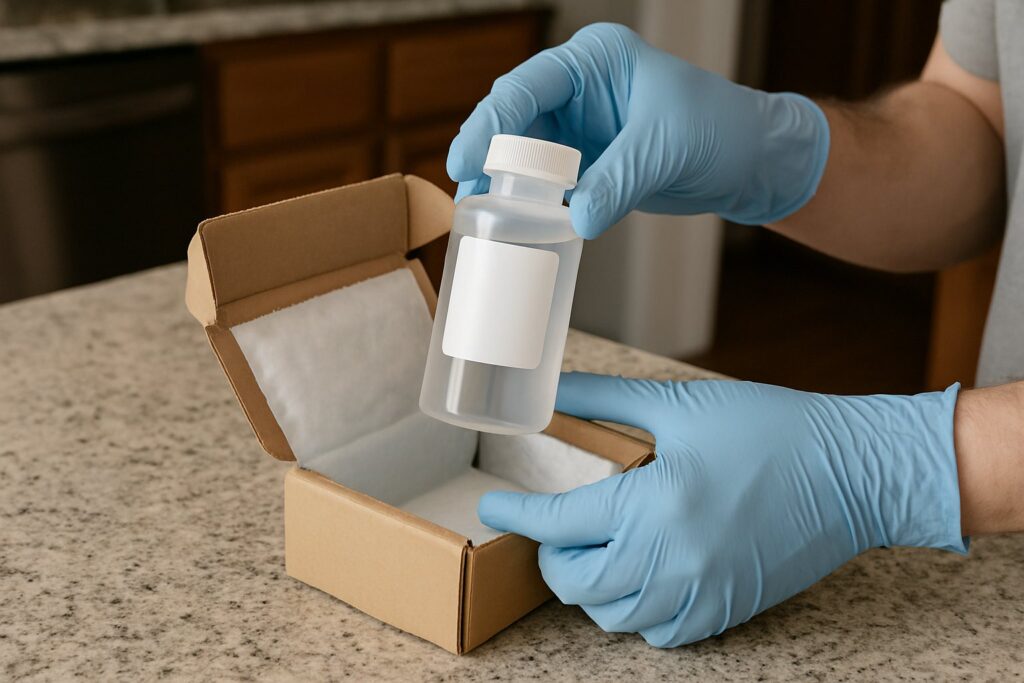
A mail-in kit is simply a way to reach a lab: you fill the bottle at home and ship it back for analysis. Instant kits and multi-parameter test strips work at the sink, and they can be handy as a first screen, but a lab measurement is what you need before making decisions about pipes, filters or a child’s exposure. One mail-in maker says it plainly on its own listing: lead matters at levels far below what test strips detect. For a side-by-side look, see home lead test vs lab testing and our picks in best lead water test kits.
Tap Score Lead & Copper in Water Test Kit
- Sample goes to a lab for analysis
- Prepaid return shipping
- About $59, seen October 2026
Safe Home DIY Lead in Drinking Water Combo Test Kit
- 5-minute home screen in 3 ranges: 0-4, 5-15, 15+ ppb
- Second kit for optional lab test (lab fee extra)
- About $20, seen October 2026
Step 3: Collect the sample the right way
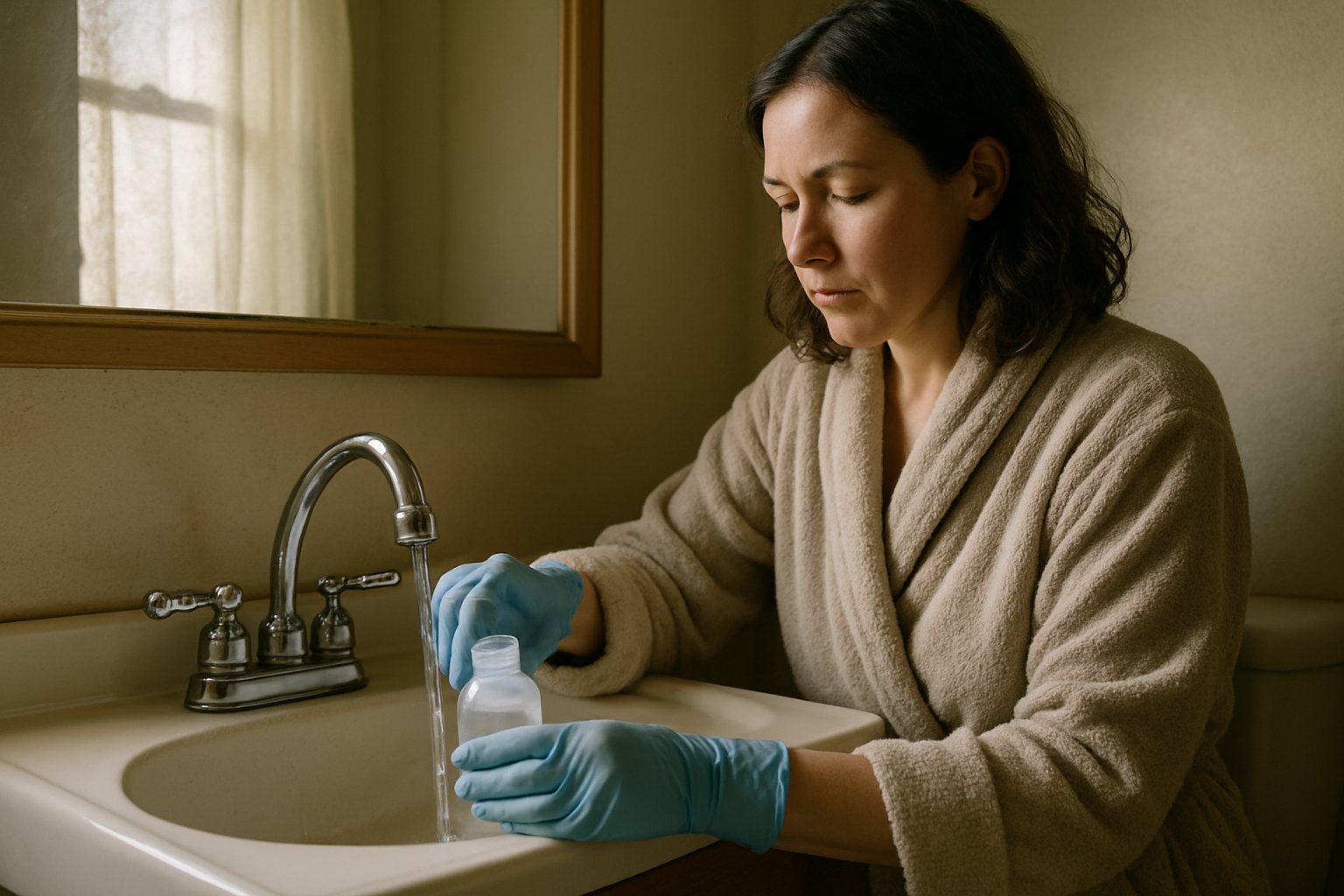
How you collect the water changes the result more than most people expect. EPA advises following the lab’s sampling directions exactly and collecting from a faucet you actually drink from, usually the kitchen cold tap.
First-draw vs flushed samples
A first-draw sample is the very first water out of the tap after it has sat unused in the pipes, typically overnight. It shows the worst case, since water picks up lead while it sits. Under EPA’s rules, utility compliance samples are collected after the water has been stagnant for at least six hours, and from November 1, 2027, homes with lead service lines will be sampled at both the first liter and the fifth liter, with the higher result counting. The fifth liter is more likely to be water that sat in the service line itself.
A flushed sample is taken after running the tap for a set time. Comparing first-draw and flushed results can hint at where lead is coming from: high first-draw but low flushed often points to the faucet or nearby plumbing, while lead that persists after flushing can point further back toward the service line. A lab or your utility can help read the pattern.
- Do not run the tap or remove and clean the aerator right before a first-draw sample unless the instructions say so; EPA’s rules for utilities prohibit pre-sampling flushing and aerator cleaning instructions, because they lower the result.
- Use cold water only.
- Fill the bottle to the line, close it, label it with the time and tap, and ship it as directed.
Testing well water for lead
Private wells fall outside EPA’s drinking water rules, and CDC notes that most local health departments have jurisdiction over private wells. Lead in well water usually comes from corrosive groundwater acting on the well’s pump, fittings and household plumbing. CDC’s guidance is to take a tap sample following your state’s approved protocol (or EPA’s, if your state has none) and send it to a certified laboratory, because testing is the only way to confirm whether lead has leached into the water. Your county or state health department can usually point you to labs and sometimes to free or subsidized testing.
Reading your results
Labs report lead in parts per billion (ppb), micrograms per liter (µg/L, the same as ppb) or milligrams per liter (mg/L). To convert, 0.010 mg/L equals 10 ppb, and 0.015 mg/L equals 15 ppb. Many reports also show a reporting or detection limit; “not detected” means below that limit, not necessarily zero.
| Number | What it is | What it is not |
|---|---|---|
| 0 ppb | EPA’s Maximum Contaminant Level Goal (MCLG) for lead, its health-based goal | An enforceable limit |
| 15 ppb (0.015 mg/L) | Today’s action level: if more than 10% of a utility’s samples exceed it, the utility must take extra steps | A “safe” level for your home |
| 10 ppb (0.010 mg/L) | The action level under the 2024 Lead and Copper Rule Improvements, from November 1, 2027 | A health threshold for individuals |
The action level is a trigger for utilities, measured across the 90th percentile of their samples. It is not a line between safe and unsafe water in one home. EPA and CDC agree there is no known safe level of lead in a child’s blood, and the improved rule requires utilities to tell customers there is no safe level of lead in drinking water. So any detectable lead is worth acting on, especially with babies, young children or a pregnancy in the home.
What the 2024 Lead and Copper Rule Improvements change
EPA finalized the Lead and Copper Rule Improvements (LCRI) in October 2024, and most requirements apply from November 1, 2027. Besides the lower 10 ppb action level and first- plus fifth-liter sampling, the rule removes the old 10 ppb “trigger level,” requires a public notice within 24 hours when a system exceeds the lead action level, and requires utilities to replace lead service lines under their control within 10 years in most cases. Utilities must also tell you your own tap results no later than 3 business days after they receive them, whatever the level. If you are curious about your pipes, read lead service line replacement.
What to do while you wait for results
You don’t have to wait for a number to lower your exposure. These steps come from EPA and CDC:
- Use only cold water for drinking, cooking and making baby formula. Hot water can carry more lead.
- Run the tap before use when water has been sitting. How long depends on your plumbing; EPA suggests asking your utility for local flushing times, and CDC suggests 1 to 2 minutes for households on wells with lead.
- Do not boil water to remove lead. Boiling does not remove it.
- Use a certified filter. CDC and EPA point to filters certified to NSF/ANSI 53 for lead and NSF/ANSI 42 for particulate (Class I) reduction. Replace cartridges on schedule and don’t run hot water through them. See lead water filters and best water filters for lead.
- Clean faucet aerators regularly, since lead particles can collect in the screen (but follow your lab’s instructions before sampling).
- Bathing and showering are considered safe, according to EPA, because skin does not absorb lead in water.
Brita Elite Replacement Filter, 1 Pack
- OB06 on NSF's lead listing with Tidal and Pacifica pitchers
- 120 gallons or about 6 months
- About $20, seen October 2026
Brita states its Elite filter is certified to NSF/ANSI 53 for lead in specific pitcher models listed on its performance data sheet; check that your pitcher is on the list. For a wider comparison, including under-sink and reverse osmosis systems, see our filter guides.
If your water tests high
- Tell your utility and ask whether your service line is lead and when it is scheduled for replacement. Read how to tell if your pipes are lead.
- Switch to filtered or bottled water for drinking, cooking and formula. CDC notes certified bottled water virtually eliminates lead from drinking water, though it can be costly long term.
- Talk to your doctor or pediatrician about a blood lead test, especially for children and anyone pregnant. CDC says a blood test is the best way to check for exposure. More in lead and health and lead and children.
- Retest after any fix, such as new fixtures or a replaced service line, to confirm it worked.
- Get professional help if you need a full home assessment of paint, dust and soil as well as water: find a lead professional.
For the bigger picture on water, including what utilities must do and how filters compare, start at our lead water testing hub.
Frequently asked questions
How much does it cost to test water for lead?
EPA puts a certified lab test at about $15 to $100. Many utilities test for free on request, so call them before you pay.
Can I test for lead in tap water at home?
Yes, as a screen. Instant kits and strips give a quick color reading, but they are not a laboratory result. For a number you can act on, use a certified lab or a mail-in kit that is analyzed by one.
What is a first-draw sample?
It is the first water out of a tap after it has sat unused in the pipes, usually at least six hours or overnight. It shows the highest lead you are likely to drink from that tap.
Is 5 ppb of lead in water safe?
EPA’s health goal for lead in drinking water is zero, and the 15 ppb (soon 10 ppb) action level is a trigger for utilities, not a safety line. Any detectable lead is worth reducing with cold water, flushing and a certified filter. Ask your doctor if you are concerned about exposure.
Does boiling water remove lead?
No. EPA and CDC both say boiling does not remove lead.
How often should I test?
Test when you move in, after plumbing work or a service line replacement, and whenever your utility reports a problem. Well owners should follow their state health department’s schedule.
Worried someone has been exposed to lead?
Testing your home finds the source; only a blood lead test shows whether a person has lead in their body. Here is how to get tested, and what the numbers mean.
How to test for lead poisoningBlood lead levels explainedLead screening for childrenTesting for adultsSymptoms
Leave a Reply