
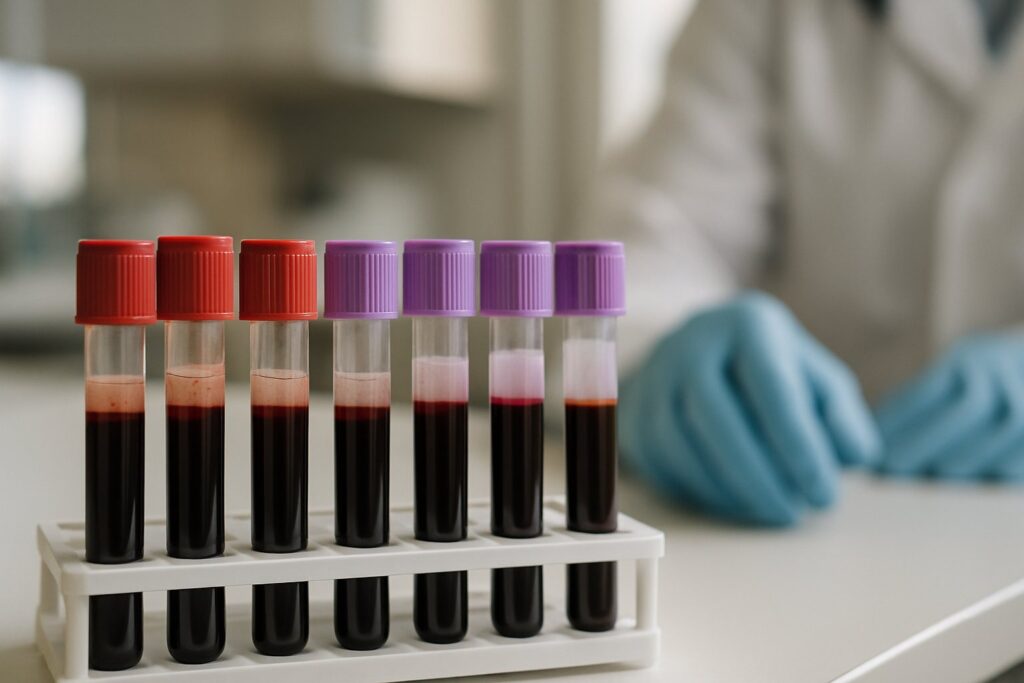
A blood lead test measures how much lead is in a person’s blood, and it is the only reliable lead poisoning test: the one way to know whether someone has been exposed. The CDC calls it the best way to find out whether a child has lead poisoning, because most children with lead in their blood look and act healthy.
In short: the test is a small blood sample, taken either from a finger or heel (capillary) or from a vein (venous). Results come in micrograms of lead per deciliter of blood (µg/dL). The CDC’s blood lead reference value is 3.5 µg/dL, in use since October 2021: a child at or above it has more lead than 97.5% of US children aged 1 to 5. A high finger-stick result should be confirmed with a venous test. Children on Medicaid must be tested at 12 and 24 months, and between 24 and 72 months if never tested. Ask your child’s doctor or your local health department about testing.
This guide explains what official sources say about the test and the numbers. It is not medical advice, and only a health care provider can interpret a result for you or your child. For urgent questions about a possible poisoning, call Poison Control at 1-800-222-1222.
What a blood lead test measures
Lead that is swallowed or breathed in enters the bloodstream. A blood lead test reports the concentration in µg/dL. The CDC says any detectable lead means a child has been exposed, and may still be exposed, and it states that no safe level of lead in children has been identified.
A blood test shows mainly recent and ongoing exposure. It does not show where the lead came from, so a high result is usually the start of a search for the source, not the end of the story. For that search, see our guides on lead paint testing, lead water testing and dust and soil testing.
Finger-stick vs venous: the two kinds of sample
| Capillary (finger-stick or heel-stick) | Venous (blood draw from a vein) | |
|---|---|---|
| How it is taken | A prick on the finger or heel; a few drops of blood | A standard blood draw from a vein in the arm |
| Speed | Often the first step; can give fast results, including point-of-care tests in the office | Results usually take a few days from a lab |
| Reliability | Can read falsely high if lead on the skin gets into the sample | The CDC says venous samples are more reliable at identifying lower blood lead levels |
| Typical use | Screening | Confirming a capillary result at or above the reference value; follow-up |
The CDC advises that when a capillary result is at or above the reference value, a venous sample should be collected to confirm it. If the first test was already venous, no second draw is needed for confirmation. That risk of lead on the skin getting into the sample is the main reason a high finger-stick result is not treated as final.
The CDC blood lead reference value: 3.5 µg/dL
The blood lead reference value (BLRV) is how the CDC identifies children with more lead in their blood than most US children. It is 3.5 µg/dL. The CDC lowered it from 5 µg/dL to 3.5 µg/dL in October 2021, based on the National Health and Nutrition Examination Survey (NHANES) cycles from 2015 to 2018. It marks the 97.5th percentile of blood lead levels among US children aged 1 to 5, so a child at or above it is in the top 2.5%.
Two points are easy to miss:
- The BLRV is not a safe level and not a health-based standard. The CDC’s 2021 report says plainly that no safe blood lead level in children exists. A result below 3.5 µg/dL does not mean lead can be ignored.
- The value can change. The CDC says it reviews the latest two NHANES cycles every four years to decide whether to update it. The CDC estimates that about 500,000 US children have blood lead levels at or above the current value.
Who should be tested, and when
Children on Medicaid
Federal Medicaid rules require that all children enrolled in Medicaid receive blood lead screening tests at 12 months and 24 months of age. Any child between 24 and 72 months with no record of a previous blood lead test must also be tested. This applies whether coverage comes through Medicaid (title XIX) or CHIP-funded Medicaid (title XXI). A CMS bulletin from 2016 adds that a risk questionnaire alone does not meet the requirement; the blood test must actually be done. Medicaid covers point-of-care tests drawn in the doctor’s office.
Other children
For children not on Medicaid, the CDC recommends testing children at higher risk. It names children who live in or often visit homes or buildings built before 1978, children in low-income households, children who are immigrants, refugees or recently adopted from other countries, and children exposed through a household member’s job or hobby. The American Academy of Pediatrics’ Bright Futures schedule calls for a lead risk assessment at the 6, 9, 12, 18 and 24 month well-child visits, followed by a blood test when the assessment shows risk. Many states set their own rules, sometimes universal testing at certain ages, so ask your pediatrician or state health department what applies where you live.
Adults and pregnancy
Adults can be tested too, usually when a doctor suspects exposure from work, a hobby, a home renovation or a contaminated product. NIOSH advises anyone who works with lead to tell their doctor. During pregnancy, the CDC says lead can pass to the baby, and its guidance asks providers to look for the source of exposure when a pregnant or breastfeeding person’s level is 5 µg/dL or higher. If you are pregnant and think you may have been exposed, ask your provider about a test.
Where to get a lead poisoning test and what it costs
The CDC says health care providers and most local health departments can test for lead. Many private insurance plans cover it, and Medicaid covers it for enrolled children. We do not list prices because they vary by lab, insurer and state; ask your provider or health department before the test.
Home swab kits and water kits do not test people. They are for surfaces or water, and our lead test kits hub explains what each kind can and cannot do.
What your child’s results mean: the CDC follow-up table
The CDC publishes recommended actions for health care providers based on a child’s confirmed venous blood lead level. This summary is for understanding the conversation with your doctor, not a substitute for it.
| Venous blood lead level | Confirm a capillary result within | Follow-up testing (CDC) | Other actions the CDC lists for providers |
|---|---|---|---|
| Below 3.5 µg/dL | Not needed | Per the usual age-based schedule (Medicaid: 12 and 24 months) | Education about lead sources, developmental checks, diet review |
| 3.5 to 9 µg/dL | 3 months | Early follow-up at 3 months, later every 6 to 9 months | Report to the health department, exposure history, environmental investigation as required, check for iron deficiency, review diet and development |
| 10 to 19 µg/dL | 1 month | 1 to 3 months, later every 3 to 6 months | Same as above |
| 20 to 44 µg/dL | 2 weeks | 2 weeks to 1 month, later every 1 to 3 months | Above, plus full history and exam, environmental investigation and hazard reduction; providers may consult a Pediatric Environmental Health Specialty Unit or Poison Control |
| 45 µg/dL or higher | 48 hours | As soon as possible | Urgent medical evaluation; the doctor decides on treatment, which may include hospital care |
For children above the reference value, the CDC says a doctor may recommend finding and removing lead from the home, a diet rich in iron and calcium, early educational services and repeat testing. Treatment decisions are for the child’s doctor; our lead poisoning treatment page explains what official guidance describes. Do not try home remedies or supplements sold to “remove lead.”
After a high result: finding the source
In many states, a child’s elevated result is reported to the health department, which may offer a home visit or an environmental investigation. Medicaid also pays for lead investigations in the homes of enrolled children with elevated levels. You can also hire a certified risk assessor; see find a lead professional and lead paint inspection vs risk assessment.
Common places to look, depending on your home and habits (our lead poisoning causes and prevention page covers each in more depth):
- Old paint and the dust it makes, especially in homes built before 1978: is lead paint dangerous?
- Drinking water from lead pipes or fixtures: lead pipes
- Soil near old houses and busy roads: lead in soil testing
- Spices, imported candies, remedies, cosmetics and dishes: lead in cinnamon and spices and lead in pottery and dishes
- A household member’s work or hobby
More on symptoms and health is on our lead poisoning symptoms page and the lead poisoning hub.
Frequently asked questions
What is a normal blood lead level?
There is no “normal” or safe level. The CDC uses 3.5 µg/dL as a reference value to identify children with more lead than 97.5% of US children aged 1 to 5, and it says no safe blood lead level in children has been identified.
Is a finger-prick lead test accurate?
It is a good screening test, but it can read high if lead on the skin gets into the sample. The CDC recommends confirming a capillary result at or above 3.5 µg/dL with a venous blood draw.
At what age should my child get a blood lead test?
Medicaid requires tests at 12 and 24 months, and between 24 and 72 months if never tested. For other children, the CDC recommends testing those at higher risk, and the AAP calls for a risk assessment at well-child visits from 6 to 24 months. Ask your pediatrician what applies to your child.
How long do blood lead test results take?
Finger-stick tests done in the office can give results quickly. Venous samples sent to a lab usually take a few days, according to the CDC.
Can I test my own blood for lead at home?
Lead in people is measured with a blood test through a health care provider, a health department or a lab. Home swab kits are for surfaces such as paint, not for people.
My child’s level is above 3.5 µg/dL. What happens next?
The CDC recommends confirming the result with a venous test, then follow-up testing, a search for the source and a review of diet and development. Your doctor and local health department will guide the next steps. If your child has severe symptoms, call 911.
Leave a Reply