
Yes, many Stanley tumblers contain a small amount of lead, but not where your drink goes. Stanley says the lead is in a sealing pellet at the bottom of the vacuum-insulated wall, covered by a stainless steel cap, and that no lead is present on any surface that touches you or what you drink.
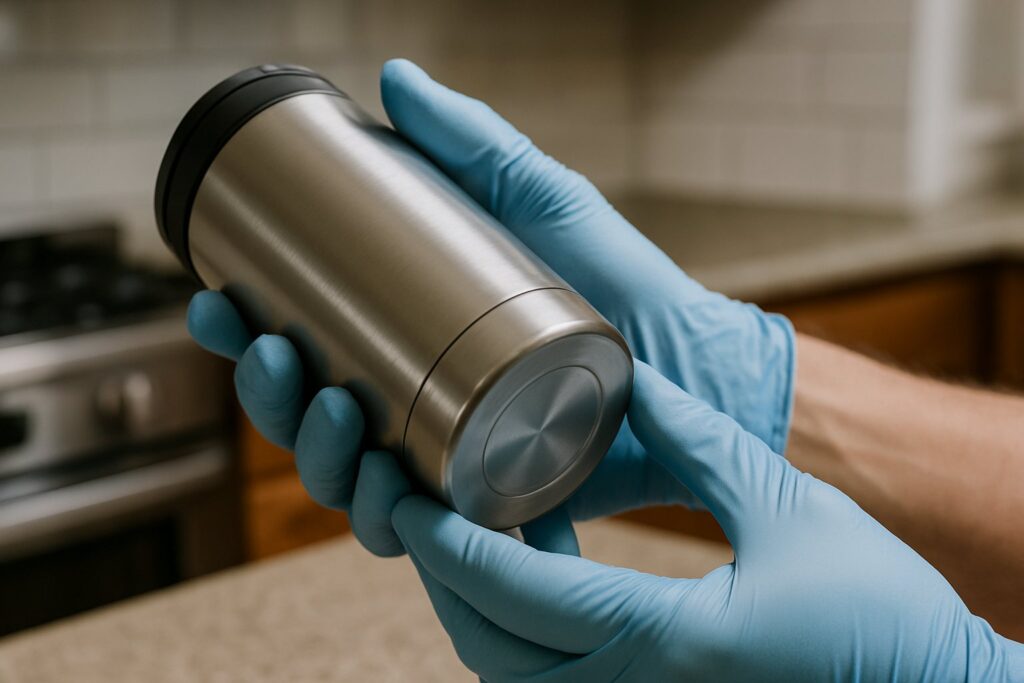
In short: in January 2024, after viral videos of people testing their cups, Stanley confirmed it uses an “industry standard pellet” containing some lead to seal the vacuum insulation, covered by a durable stainless steel layer. Experts quoted by TODAY and NBC News said there is no exposure while that cover stays on; the concern is a damaged or missing base cap, especially around young children who might chew or mouth it. The CPSC has recalled several children’s insulated cups from other brands whose lead solder at the base was accessible. If a base cap has come off, keep the cup away from children and contact the maker.
This guide reports what Stanley and the experts said at the time, and what the CPSC has done with similar products. It is not a lab result for any specific cup, and nobody we cite measured how much lead each pellet contains.
What happened in 2024
In January 2024, social media videos showed people swabbing the bottoms of Stanley tumblers with home lead test kits, some of which changed color. The tumblers were at the height of their popularity, and the posts spread quickly.
Stanley’s parent company, Pacific Market International (PMI), responded with a statement that several news outlets published. In short, Stanley said:
- Its manufacturing process uses an industry-standard pellet to seal the vacuum insulation at the base of its products, and the sealing material includes some lead.
- Once sealed, the area is covered with a durable stainless steel layer that makes it inaccessible to consumers.
- No lead is present on the surface of any Stanley product that comes into contact with the consumer or the contents of the product.
- Its products meet all US regulatory requirements, including California’s Proposition 65, and it said its engineering and supply chain teams were making progress on alternative sealing materials.
Stanley’s current support page repeats that the vacuum insulation is sealed with pellets that include some lead and are covered by a stainless steel layer, that no lead is on surfaces that touch the consumer or the drink, and that if the base cap comes off during ordinary use the product may be covered by its Lifetime Warranty.
In February 2024, NBC News reported that a potential class action had been filed against PMI, alleging that the company had not disclosed the lead or warned about exposure if the seal is damaged. PMI said exposure potential was minimal. NBC did not report an outcome, and we have not confirmed one.
Why insulated tumblers use a sealing pellet
A vacuum-insulated tumbler has two stainless steel walls with the air pumped out between them. That vacuum is what keeps ice frozen for hours. To close the vacuum, makers seal a small opening, usually at the bottom of the outer wall, with a pellet or dot of sealing material, then cover it with a steel cap or plate.
Stanley called its pellet an industry standard. CPSC recall notices show that other brands have used lead solder at the same spot, as we cover below. So the question for any insulated cup is not only whether it contains lead somewhere, but whether that lead can be reached.
Is there a contact risk? What experts said
An article published by TODAY on NBC News on January 24, 2024 asked several lead specialists. Their views, summarized:
| Expert | What they said |
|---|---|
| Ronnie Levin, former EPA scientist, Harvard T.H. Chan School of Public Health | If the base barrier stays intact, there is no lead exposure and no risk from owning the cup. A single touch of exposed lead is unlikely to poison someone, but a child who mouths an exposed base could be contaminated. |
| Jenna Forsyth, Stanford University School of Medicine | Touching exposed lead once is low risk; swallowing lead is what matters most. Scraping the exposed spot on hard surfaces could flake off tiny pieces. |
| Dr. Vicki Iannotti, pediatrician, Columbia University | Repeated exposure is the main worry, not a single incident. |
| Paul Allwood, CDC lead poisoning prevention branch | Spoke generally: even low lead levels once thought safe are now linked to harm. He did not comment on Stanley cups specifically. |
Other reporting from the same period quoted Jack Caravanos of New York University’s School of Global Public Health saying there is practically zero risk of ingesting the lead in the cup. Several experts added that they would still rather companies used no lead at all.
The picture from these experts is consistent: an intact cup is not a lead source for your drink. A cup whose bottom cap has fallen off is a different story, because the sealing material may then be exposed where small hands and mouths can reach it.
What the CPSC has done with similar cups
Stanley tumblers are general-use products, not children’s products. Children’s products face the federal lead content limit of 100 parts per million in any accessible part. The CPSC has used that rule to recall several children’s insulated cups whose lead solder was accessible:
- Green Sprouts toddler stainless steel bottles and cups (November 2022, about 10,500 units): the bottom base can break off, exposing a solder dot that contains lead. The firm had seven reports of bases breaking off and no injuries.
- PandaEar stainless steel children’s cups (November 2023, about 1,600 units, sold on Amazon): an accessible solder bead on the bottom exterior had lead above the federal limit.
- Klickpick Home stainless steel children’s cup sets (November 2023, about 3,600 units, sold on Amazon): same problem, an accessible solder bead on the bottom.
- CUPKIN stainless steel children’s cups (July 2023, about 346,000 units): lead above the federal limit in the cups.
A CPSC spokesperson told TODAY at the time that consumers can report lead concerns about any product at SaferProducts.gov, and that each report is reviewed.
How to check your Stanley or any other insulated tumbler
- Look at the bottom. Most insulated cups have a steel cap or plate over the seal. If it is intact and firmly attached, the experts above said there is no exposure from the seal.
- If the cap is loose, dented or missing, stop letting children use or handle the cup. Do not pick at, scrape or file the exposed spot. Contact the maker; Stanley says a base cap that comes off in ordinary use may be covered by its warranty.
- Check recalls. Search the brand on CPSC.gov/Recalls, especially for children’s cups and sippy cups. The CDC’s list of lead-related recalls also includes stainless steel bottles and sippy cups.
- Choose children’s cups with care. For cups marketed to children, check the CPSC recall list and buy from sellers that can show compliance with the federal lead limits for children’s products.
- Be cautious with home swab tests. The bright-colored swabs people used in the videos are made for paint. The EPA recognizes certain kits only for paint on wood, ferrous metal, drywall and plaster. A CPSC staff study found home lead kits often gave false negatives and some false positives on paints and other products. A color change on a cup’s bottom does not tell you whether the drink is exposed. For a real answer about a specific product, you need a laboratory test, for example with an X-ray fluorescence (XRF) analyzer, the kind of instrument the CPSC uses; see home lead test vs lab testing.
Should you worry if you have used one for years?
If the base cap has always been in place, the experts quoted by TODAY said the cup was not exposing you to lead. If a cap came off and a child chewed or mouthed the base, or you are worried for any other reason, talk to your doctor or your child’s pediatrician; a blood lead test is the only way to know whether someone has been exposed. For urgent questions, call Poison Control at 1-800-222-1222.
Most lead exposure in the US still comes from familiar sources: old paint and dust, lead pipes, soil and certain imported products. Our lead and children page and the lead poisoning hub explain them. For other everyday items, see our lead in household items hub, including pottery and dishes, toys and jewelry and cinnamon and spices.
Frequently asked questions
Do Stanley cups have lead?
Stanley says the sealing pellet at the base of its vacuum-insulated products includes some lead, covered by a stainless steel layer. It says no lead is on any surface that touches you or your drink.
Can lead from a Stanley cup get into my drink?
According to Stanley and the experts quoted in early 2024 coverage, no: the lead is outside the drinking chamber, under a steel cap on the outer wall. Exposure is only possible if that cap comes off and someone touches or mouths the seal.
What should I do if the bottom of my Stanley cup fell off?
Keep it away from children, do not scrape the exposed spot and contact Stanley, which says a base cap that comes off during ordinary use may be covered by its Lifetime Warranty.
Are other tumbler brands lead-free?
Some makers say their cups use lead-free seals; we have not verified individual brand claims. CPSC has recalled several children’s insulated cups whose lead solder at the base was accessible, so check the CPSC recall list for any cup a child uses.
Can I test my cup with a home lead swab?
You can, but the result will not tell you much. Swab kits are made for paint, and the CPSC has found home kits unreliable on other materials. A laboratory test is the only reliable way to measure lead in a specific product.
Worried someone has been exposed to lead?
Testing your home finds the source; only a blood lead test shows whether a person has lead in their body. Here is how to get tested, and what the numbers mean.
How to test for lead poisoningBlood lead levels explainedLead screening for childrenTesting for adultsSymptoms
Leave a Reply