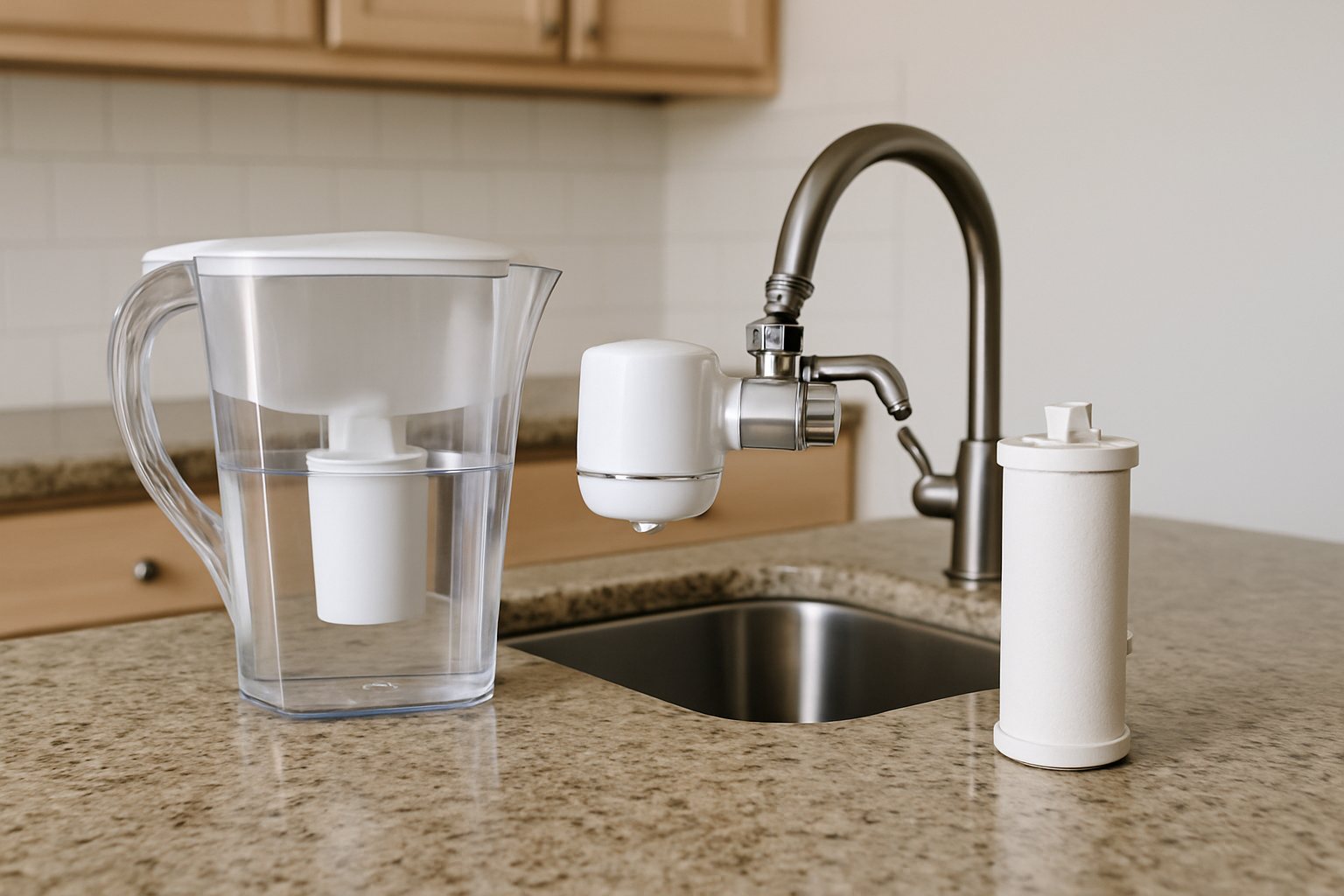
A water filter that removes lead is one certified to NSF/ANSI Standard 53 for lead reduction (or, for a reverse osmosis system, NSF/ANSI Standard 58 with a lead claim). The certification, not the brand or the price, is what tells you a filter was independently tested to bring lead down to 5 parts per billion or less. Below we compare four filters, one of each main type, that we verified on NSF’s official listings in October 2026, with the exact certification and the cartridge life for each.
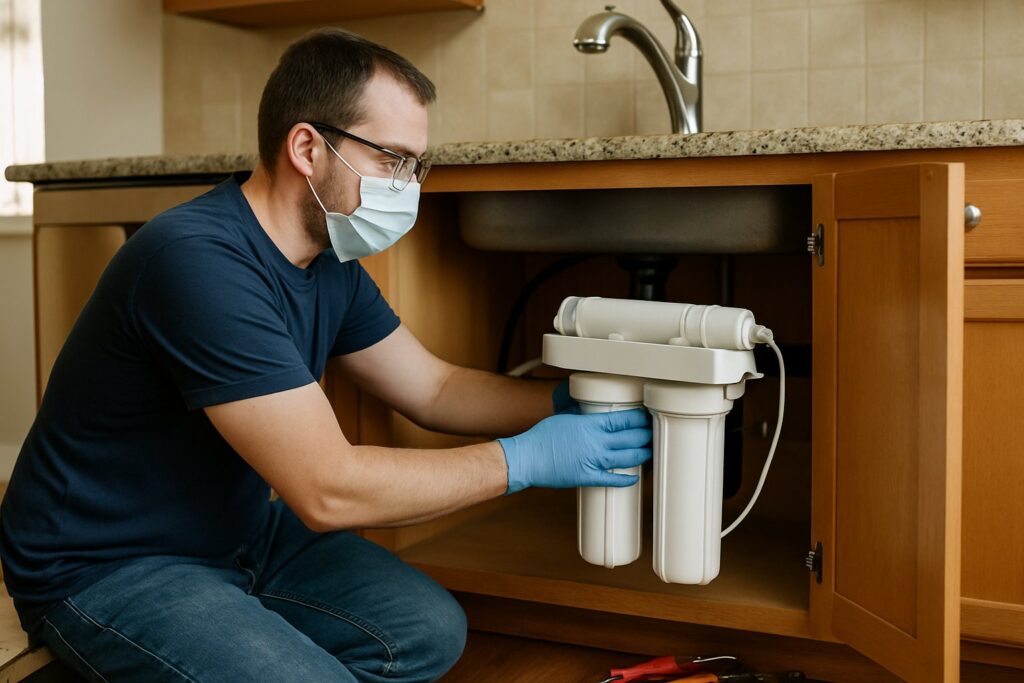
In short: for most people a certified pitcher (Brita Elite filter, 120 gallons per cartridge) or faucet-mount filter (PUR PLUS, 100 gallons) is enough while you sort out the source of the lead. For a whole family drinking and cooking with filtered water, an under-sink system (3M Aqua-Pure 3MDW301-F, 1,000 gallons per cartridge) is less work. Reverse osmosis (iSpring RCC7AK-BLK, NSF/ANSI 58) also reduces lead and many other contaminants, at more cost and with a drain line. Whatever you choose, check the lead claim in the certifier’s listing, use cold water only, and change cartridges on schedule.
What to look for: the certification, exactly
EPA’s consumer tool for choosing a lead filter covers point-of-use and pitcher filters that an accredited third-party certifier has tested for lead reduction to 5 ppb or less, and for Class I particulate reduction, against NSF/ANSI Standards 53 and 42. The particulate rating matters because some lead comes out of pipes as tiny particles. Three points trip people up:
- The standard must list lead. NSF/ANSI 53 covers many health contaminants, and a filter can be certified to it without a lead claim. A good example: on NSF’s listing (checked October 9, 2026), PUR’s standard pitcher filter (PPF951K) is certified to NSF/ANSI 53 for cadmium, copper, mercury and several chemicals, but lead is not among its listed claims. PUR’s faucet filters, by contrast, are listed for lead.
- NSF/ANSI 42 alone is not enough. It covers taste, odor and chlorine, plus particulate classes. On its own it says nothing about dissolved lead.
- NSF is not the only certifier. WQA, IAPMO, UL and CSA also certify to these standards. Brita and PUR, for example, advertise WQA certification for lead. Check whichever certifier the box names, in that certifier’s own online listing.
The bar was raised in December 2019, when NSF/ANSI 53 and 58 were updated to require lead in treated water to be reduced to 5 ppb, down from 10 ppb, for any new product claiming lead reduction. EPA notes there is no federal requirement for point-of-use filters to be certified at all, which is exactly why the certification is the thing to check.
Lead water filters compared
| Filter | Type | Lead certification we verified | Cartridge life | Price seen (Oct 2026) |
|---|---|---|---|---|
| Brita Elite filter (OB06) | Pitcher / dispenser | NSF/ANSI 53, Lead Reduction (NSF listing, in Brita Tidal and Pacifica pitchers); Brita also states WQA certification | 120 gallons, about 6 months | About $30 for 2 filters |
| PUR PLUS Faucet Mount PFM350V (RF-9999 filter) | Faucet mount | NSF/ANSI 53, Lead Reduction (NSF listing); meets Michigan’s Filter First criteria | 100 gallons, about 3 months | About $33 |
| 3M Aqua-Pure 3MDW301-F (3MDW311 cartridge) | Under-sink, separate faucet | NSF/ANSI 53, Lead Reduction (NSF listing) | 1,000 gallons | About $294 |
| iSpring RCC7AK-BLK | Reverse osmosis, under-sink | NSF/ANSI 58, Lead Reduction (NSF listing) | Pre-filters 6–12 months; membrane 2–3 years (iSpring) | About $250 |
Prices are what we saw on Amazon when checked in October 2026 and change often. Cartridge life is the rated capacity in gallons from the certification listing; the months figure is the maker’s estimate for typical use, so a busy household will hit the gallon limit sooner.
Pitcher filters for lead
Pitchers are the cheapest way in and need no installation. The Brita Elite filter (model OB06) is the one we can verify: NSF’s listing shows the OB06 element certified to NSF/ANSI 53 for Lead Reduction, with a 120-gallon service cycle, in Brita’s Tidal and Pacifica pitchers. Brita describes the filter as WQA certified to NSF/ANSI standards, rated for 120 gallons or about six months, and compatible with every Brita pitcher and dispenser except the Stream line. Brita’s basic white “Standard” filter is a different product; check its own listing before assuming it reduces lead.
The trade-offs: pitchers filter slowly, hold only a few quarts, and are easy to forget to refill, which tempts people back to the tap. They suit a renter, a temporary fix while a lead service line is replaced, or a small household. Remember that 120 gallons is a little under 5 gallons a week over six months.
Faucet-mount filters for lead
A faucet-mount filter clips onto a standard faucet and gives filtered water on demand with a lever. NSF lists a range of PUR PLUS faucet systems, including the horizontal PFM350V and the vertical FM2500V, with the RF-9999 filter, certified to NSF/ANSI 53 for Lead Reduction, with a rated 100 gallons and a flow of about half a gallon per minute. NSF’s listing also notes these systems meet the requirements of Michigan’s EGLE “Filter First” program, which calls for certification to NSF/ANSI 42 for Class I particulate and NSF/ANSI 53 for lead.
PUR says the filter lasts up to 3 months or 100 gallons, with a light that tells you when to change it. Faucet mounts don’t fit pull-out or handheld faucets or faucets with internal aerators. PUR also warns that look-alike replacement filters are not tested or certified the way genuine PUR filters are, so a cheap third-party cartridge can quietly cost you the lead certification.
Under-sink filters for lead
An under-sink filter connects to the cold-water line and usually feeds its own small faucet. It costs more up front but has far larger cartridges and a faster flow, which makes it practical for cooking as well as drinking. The 3M Aqua-Pure 3MDW301-F is listed by NSF as certified to NSF/ANSI 53 for Lead Reduction, along with cysts, VOCs and other claims, with the 3MDW311 replacement cartridge rated for 1,000 gallons at 0.75 gallons per minute. 3M’s listing says it is certified to NSF/ANSI 42, 53 and 401, and uses a quick-change cartridge with a built-in shut-off valve. Brita’s Total360 under-sink line also has NSF/ANSI 53 lead listings if you prefer that brand.
Reverse osmosis systems for lead
Reverse osmosis (RO) pushes water through a very fine membrane and sends the rejected water down the drain. RO systems are certified under NSF/ANSI 58, and as with Standard 53, the listing must include lead. NSF lists the iSpring RCC7AK-BLK (and related RCC7 models made at iSpring’s Nanjing facility) under NSF/ANSI 58 with Lead Reduction among its claims, along with TDS, fluoride, asbestos, barium, cadmium, chromium (trivalent), copper and selenium. iSpring’s Amazon listing states 98.9% lead reduction in that certification testing. Note that some other RCC7 variants on NSF’s list, from a different facility, are listed for TDS reduction only; match the model on the box to the listing.
iSpring advertises 75 gallons per day; NSF’s listing shows a tested daily production rate of 25.41 gallons, a reminder that real output depends on water pressure and temperature. iSpring recommends replacing the three pre-filters and the alkaline filter every 6 to 12 months and the membrane every 2 to 3 years, sooner if flow drops or dissolved solids rise. RO is the most thorough option here but needs under-sink space, a storage tank, a drain connection and more maintenance than a carbon filter. Brita’s Total360 RO system is also NSF/ANSI 58 listed for lead.
Which type should you choose?
- Renting, or waiting for a lead line to be replaced: a certified pitcher or faucet mount. Low cost, no plumbing changes, easy to take with you.
- A family that drinks and cooks with a lot of water: an under-sink filter. Larger cartridges mean fewer changes and less temptation to skip the filter.
- You also want to reduce other contaminants, such as fluoride or dissolved solids: reverse osmosis certified to NSF/ANSI 58 with a lead claim, if you have the space and a drain.
CDC’s advice is the same for every type: look for NSF/ANSI 53 for lead and NSF/ANSI 42 for particulate reduction, and use only cold water for drinking, cooking and preparing baby formula.
The lead filters we would buy
All four were in stock on Amazon when checked in October 2026, and each model matches an NSF listing with a lead claim.
Brita Elite Replacement Water Filter, 2 Pack
- NSF/ANSI 53 lead reduction (OB06)
- 120 gallons, about 6 months each
- About $30, seen October 2026
PUR PLUS Horizontal Faucet Mount Filtration System PFM350V
- NSF/ANSI 53 lead reduction with RF-9999
- 100 gallons, about 3 months
- About $33, seen October 2026
3M Aqua-Pure Under Sink Filtration System 3MDW301-F
- NSF/ANSI 53 lead reduction
- 3MDW311 cartridge, 1,000 gallons
- About $294, seen October 2026
iSpring RCC7AK-BLK Reverse Osmosis System
- NSF/ANSI 58 lead reduction
- Pre-filters 6-12 months, membrane 2-3 years
- About $250, seen October 2026
We left out filters whose lead claim we could not match to a certifier’s listing on the day, including some pitchers advertised as “NSF certified” without saying for what. That doesn’t mean they don’t work; it means we couldn’t confirm it. More options are on our lead water filters hub.
Using a lead filter so it keeps working
- Cold water only. EPA advises never running hot water through a lead filter.
- Change cartridges on time. The certification only covers the rated gallons. Follow the maker’s replacement directions; a spent cartridge can still make water taste fine.
- Use genuine replacement cartridges, or ones with their own lead certification.
- Filter water for drinking, cooking and baby formula. Those are the uses the filter is for.
- Don’t stop at the filter. Find out whether you have a lead service line and what your utility is doing about it: see lead pipes and lead service line replacement.
Certified does not mean perfect. An EPA study of certified point-of-use and pitcher filters found they removed only part of the lead when it was in the form of very small lead phosphate nanoparticles. A filter lowers your risk; it is not a substitute for fixing the source.
Test first, then test the filter
Testing tells you whether you need a filter and whether it is working. Start with a lab test of your unfiltered tap water, then test filtered water the same way. See best lead water test kits, how to test water for lead and the lead water testing hub. If someone in your home may have been exposed, especially a young child or someone pregnant, talk to your doctor or local health department about a blood lead test; see lead poisoning.
Frequently asked questions
Do Brita filters remove lead?
The Brita Elite filter (OB06) is certified to NSF/ANSI 53 for lead reduction on NSF’s listing, and Brita states WQA certification too. Check the specific Brita filter you buy; not every Brita filter carries a lead claim.
Does reverse osmosis remove lead?
RO systems certified to NSF/ANSI 58 with a lead claim are tested for lead reduction. Check that the exact model is listed with lead, since some RO listings cover only total dissolved solids.
Does boiling water remove lead?
No. CDC says boiling water will not reduce the amount of lead in it. Use cold water for drinking, cooking and baby formula, and a filter certified to remove lead.
Is a whole-house filter better for lead?
Not necessarily. EPA’s lead filter guidance focuses on point-of-use and pitcher filters, which treat the water you drink and cook with. If you consider a whole-house system, ask for its lead certification, and remember lead can also come from faucets and pipes after the filter.
How do I check a filter’s certification?
Find the model number and the certifier’s mark on the box, then look up that model in the certifier’s online listing (NSF, WQA, IAPMO, UL or CSA) and confirm “Lead Reduction” appears among its claims.